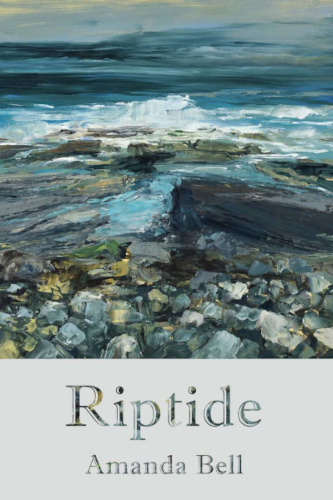
Riptide by Amanda Bell, Doire Press 2021 was launched on-line by Maurice Devitt on 29 September 2021.
Good evening all, and welcome to the launch of Riptide, Amanda Bell’s sumptuous new collection. It is a real honour to be asked to launch the collection as I’ve been a great friend and admirer of Amanda’s work since we met on the Poetry Studies Masters in Mater Dei in 2011 and, as we are both members of the Hibernian Writers’ Group, I’ve had the joy of experiencing first-hand the constant development of Amanda’s work over the last 10 years.
While thematically very consistent with her previous collections, I think the poetry in Riptide is bolder and asks more questions of the reader. Amanda has something of a magpie-mind. Interested in and inquisitive about everything, she seeks to better understand every aspect of our world, no matter how small, and our pivotal role in it – how we are influenced by, and respond to, nature, art, travel and climate change; the dark history of the woman’s role in the family and society and how this must change; and, right up to date, the Covid pandemic and what it has taught us about ourselves, but, essentially, these poems are a celebration of beauty, a beauty often shadowed by loss.
This juxtaposition comes across immediately from the powerful ‘Plaga II’ by Donald Teskey on the front cover, reinforced by the title itself, Riptide, defined as ‘an extremely strong unpredictable current that flows across another; may be hazardous to swimmers’ and the collection plunges in, opening with the title poem and the story of a precious ring ‘lost…to strong currents’, a ring that cannot be replaced:
No new gold ring
could bond that me, that you,
those strangers lost to time.
And so, the agenda is set and from here there is a sinuous flow as the poems arrive, at first dipping into the poet’s, and our own, ambivalent relationship with water and the sea, then broadening out to the ecology of the earth and our role in keeping it sustainable and safe. This is emphasised in ‘Co-existence’, the first haibun in the collection, the body of which opens rather ominously with “There is a huge spider in the kitchen. It lives in a recess of the skylight.” and continues playfully, and with some considerable detail on how to deal with it. In the same vein there are few poets who would have the chutzpah to write a poem with the title ‘A Compost Bin in Rathmines’, inspired by Derek Mahon’s ‘Disused Shed’ and replacing mushrooms with brandling worms, use it to deliver a treatise, both subtle and masterful, on our lives during lockdown and the fears we face going back into the world:
They are begging in their wordless way
to be left where they are, safe in the dark
– an isolated tribe, lost to the world
and happy to be so.
Perhaps the most significant formal development in this collection is the increased presence of Japanese forms, most particularly in the shape of haibun but also in the use of individual haiku almost as ‘circuit-breakers’ through the book as an alternative to explicit section-breaks, creating the sense of ‘taking a breath’ without interrupting the seamless flow, while tangentially reinforcing key themes
More storms forecast –
on a broken branch
green figs withering
The strong presence of haibun is both a reflection of the broadening focus of Amanda’s writing and her ability to harvest ‘the best of both’, the haibun serving as a plush vehicle for Amanda’s elegant prose style, but also acting as a more concentrated infill of key themes and messages. The heart-breaking ‘Grandfather’s Medals’, in memory of her grandfather George Bell, opens with the succinct finality of:
He rarely speaks of his two years in the trenches. At twenty he has already put it behind him.
And ends with:
When they come upon a flock of sheep torn apart by dogs, it all comes flooding back.
the third of September 1939 –
my grandfather stays up all night,
weeping.
The concise poem ‘In the chocolate factory’ introduces a short series of poems interspersed through the centre of the collection, which are inspired by an invitation to participate in ‘The New Scream’, an expedition around Oslo to see sites associated with the Norwegian artist Edvard Munch. His most famous painting feels like a pervasive presence in the cold, sharp Oslo air:
You grasp the bars, lean towards the fjord,
your howling swallowed
by the fog.…………………………………… – The Scream
but the ethereal beauty is once again interrupted by loss, as the memory of a domestic terrorist attack in 2011 comes to the fore in ‘The New Scream’:
The thread of Munch’s influence is evident, both ekphrastically and emotionally, as Amanda’s thoughts turn to art and travel, starting in her beloved North Mayo with ‘Donald Teskey, Ballinglen’ and stretching out to Lisbon and her Spanish idyll, Cadiz, where a consideration of ‘The Vigil of Our Lady of Ransom’ surfaces a complex lattice of memories and reflections on how formal religion and family often shaped the role a woman played in life:
Funerals were not a family affair, and though three of my grandparents had died by the time I was twelve, children did not attend; interments were a male preserve.
The poem ‘Trinity’ considers the requirement to balance the different roles of ‘Daughter, mother, wife – each with their own solicitudes.’. This balance is writ large in the final third of the book as Amanda’s daughters, Elizabeth and Grace, to whom the collection is dedicated, take centre stage – the relationship captured lovingly in a really touching series of poems including ‘My Daughter, Drawing’, ‘Aubade’ and ‘My Daughter, in the Wash House, Taroudant’. The final poem in the collection, ‘Curtains’, dedicated to Amanda’s mother, seems to capture the chain of family roles quite perfectly:
And I forget to remember that summer’s day
of sewing on the lawn – a toddler pottering,
me pregnant, you central to it all.
Donald Teskey in a recent interview on RTE’s The Works referred to “the layers of meaning” in his art. This is a collection richly imbued with such layers, hooks that will keep drawing you back, to poetry that is remarkable in both its imagery and music: the truly cohesive work of a gifted poet, who ensures the different themes and styles are seamlessly interwoven.
This is a sparkling collection and it is a honour and a pleasure to declare it launched and to invite Amanda to read some poetry from the book.
– Maurice Devitt
———————————————–
 A past winner of the Trocaire/Poetry Ireland and Poems for Patience competitions, he published his debut collection, Growing Up in Colour, with Doire Press in 2018. Curator of the Irish Centre for Poetry Studies site, his Pushcart-nominated poem, ‘The Lion Tamer Dreams of Office Work’, was the title poem of an anthology published by Hibernian Writers in 2015.
.
Riptide by Amanda Bell is available from https://www.doirepress.com/writers/amanda-bell
.

 Rochford Street Review