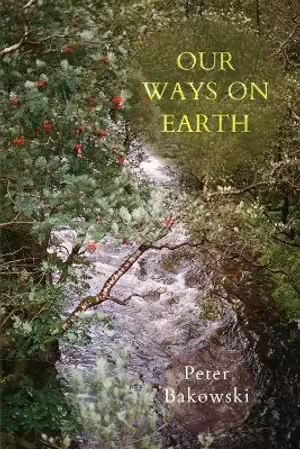
Our Ways on Earth by Peter Bakowski, Recent Work Press, 2022.
I should state upfront that Peter Bakowski is a friend. Our poetry has appeared in the same magazines for decades. Some of those magazines have disappeared but we both continue to write poetry undeterred, or should that read under turd, (he would never use such a phrase, he is too good natured.) We continue, regardless of the famous American humourist, journalist, and author Don Marquis’s famous quip, “Publishing a book of poetry is like dropping a rose petal down the Grand Canyon and waiting for the echo.” Peter and I have also shared the stage, such as it is, even though Peter lives in Melbourne and I live in Sydney. At least in poetry terms, this can sometimes feel like living in different countries.
I remember the first time we read together. With boundless energy and enthusiasm, Peter had organized to read in the harbour city and needed someone to partner with, someone he might have felt was simpatico, to help fill the evening. He kindly asked me. I responded to his generosity of spirit, a key feature of his poetry and his personality, but also to the fact that we often, although not always (I speak for myself here), have a desire to make our writing clear. We both like to entertain, but I hope not at the expense, (maybe even in the service of) quality and gravity.
On the specific night I refer too, we decided, on the spur of the moment, to read turnabout rather than first and second. While he was the featured poet, he was prepared to do what he thought would be enjoyable and interesting. We also decided that, as much as possible, his poems would be in conversation with mine. It turned out to be a fun night and helped cement our interstate camaraderie.
As it says on the back of his latest book, Our Ways on Earth, “His key aims as a poet remain—to write as clearly as possible and to make his next poem different from the last.” While the second aim is a big ask for anyone plying their art in any medium, the first is one I believe he achieves. In fact, his poetic clarity has increased over the years through admirable minimalism, concision, and sheer goodwill. And while we share a love for aphorism, my favourite poems in the book are portrait poems which, at least for me, evoke Tom Waits, Richard Hugo and Cesare Pavese.
Backwater song is one poem that particularly stands out for me. Here it is in its entirety:
Backwater song
Mindy didn’t leave a note.
She once mentioned a cousin in Philly, but he might be a lie.
Anyway, I can’t make the bus fare.Sitting on the porch, I’m alert
to movement slithering fatal in the bayou reeds
or the pigeon-toed approach of Floyd Hammit
with his beer belly and dented sheriff’s badge,
ready to bellow a howdy through the screen door.Around a decade ago Floyd crossed the colour line,
lay with Mindy in that abandoned shack on Firefly Hill,
the one in which Hal Giltrebb hung himself.When Floyd’s ailing wife, Mary Ann, died from tuberculosis
Floyd drank a Mississippi of beer—
jury in his head calling for punishment.
One night, neighbours heard a gunshot in Floyd’s house.
Hell, he was ashamed of that bullet hole in the bedroom wall.
For a while I wished that Floyd was a better shot
but that kind of thinking made me feel lower than a turtle’s belly.I prayed a little, fished a little,
tension eased in my shoulders
and I put my mind
into my harmonica playing,
sitting out each night on the cooling porch—
mixing notes in with frog, cricket and grasshopper sounds
until I was more spirit than man.This year Floyd and me have gone forwards—
talk about favourite baseball pitchers and Dixieland tunes,
how both of us don’t always like to study ourselves in the mirror
first thing in the morning,
how some fish you catch are poisonous,
need to be thrown back in the water.
Sometimes there’s laughter, a game of chess,
two men quiet
when a bishop or a knight is moved.
I love the opening line for three main reasons. It is a statement which is simultaneously clear but disorienting. It feels like part of a conversation that we are overhearing. And it introduces us to a character called Mindy without explaining who Mindy is. This serves the function of making us want to keep reading to find out. Gradually we are introduced to the whole cast. There is, “Floyd Hammit with his beer belly and dented sheriff’s badge,” and “Hal Giltrebb,” who, “hung himself.” There is also, “Floyd’s ailing wife, Mary Ann, [who] died from tuberculosis.” With names like these we know are in the deep American South. This is further confirmed through the reference to, “… movement slithering fatal in the bayou reeds,” a bayou being a marshy area, a word derived from indigenous American language. And later to Floyd drinking “…a Mississippi of beer..,” and “…Dixieland tunes…”
Poverty, death, and threat pervade the poem. But there is, “…harmonica playing, sitting out each night on the cooling porch—mixing notes in with frog, cricket and grasshopper sounds…” too. This poem seems to exemplify the title of the book. A small slice of life on earth, albeit a particular region. The line, “…some fish you catch are poisonous, need to be thrown back in the water,” encapsulates for me Peter’s stance in the poem but also his actual attitude, which is that life plunges all of us into adversity but, like in chess, we need to make the most of the moves we are given or have left.
I will finish with something about Peter’s facility with aphorism and epigram. Here are two pithy examples that I particularly like:
Beneficiary
Far below the hairpin bend
a fox drinks rainwater
from an upturned hubcap.
.Surrealist weather report
When it rains it purrs.
Beneficiary I find quite remarkable. It manages to capture in very few words what haikus attempt without using the syllabic structure of that form. It also incorporates both a feeling of being outside the city, with the presence of a fox, but not entirely away from the city with the presence of a hubcap. The combination of all the elements is reminiscent of William Carlos Williams and even William Stafford. Surrealist weather report speaks for itself. Firstly, the title is almost the size of the poem. It immediately demonstrates Peter’s sense of humour or at least his whimsical attitude which is always close by.
I think Our Ways on Earth provides something for everyone. It is also an instruction manual for the hard work and persistence that good poetry requires.
– Mark Mahemoff
———————————————-
 Mark Mahemoff is an Australian poet, critic, and psychotherapist. His next book, Beautiful Flames (Flying Islands Press), will be published later this year.
.
.
.
Our Ways on Earth by Peter Bakowski is available from https://recentworkpress.com/product/our-ways-on-earth/
.
 Rochford Street Review