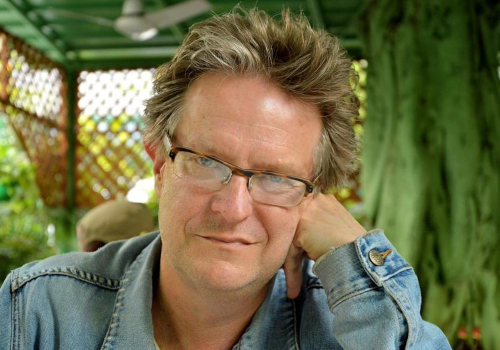
Author’s Photograph by Arundhati Sen
The Baroness is from a collection of twelve stories, with the working title of Everyone on Mars: stories from the Red Shift. In these stories set in the near future, despite all obstacles humanity has colonised Mars, largely for its minerals as foreseen by previous generations of writers, such as the great Philip K. Dick. The collection is an imagining of the impact — psychological, interpersonal, existential — of our colonisation. It interweaves threads of the isolation, loss and alienation of living on inhospitable Mars, if with a nascent love of its cold, harsh beauty, as humanity truly becomes a bi-planetary species. The stories were written in the first half of 2022 and will be published mid 2024 by Puncher & Wattman.
**……….**
THE BARONESS
It had taken months of negotiations with her agent, but just when he had all but given up hope it had come through. As he went in the front gate he could barely wipe away his grin. The setting was so typically charming, too: a little Cornish cottage in the mist, with the pot-pourri front garden and the path leading up to the door. Had not Betjeman himself breathed his last in a Cornish village? There were leadlights in the windows, the ivy creeping up the walls to the thatched roof and, somehow, here he was on the doorstep.
He knocked. Nothing. Knocked again. He heard shuffling inside and at last a woman of about seventy, sharp of eye and nose, opened the door in a ragged tee-shirt, pyjama pants and blue men’s slippers, grey hair in stringy strands on her damp brow. She just stood and looked at him. He felt inspected as if by a leery hillbilly.
‘I’m Uhuru Ngugi.’
‘Are you now?’
He shifted a little on the welcome mat. ‘I have an appointment. With the baroness.’
‘Her ladyship didn’t mention anything. What do you want? The last person who washed up here looking smarty pants as you tried to get in with a fucking Watchtower. Mind you, I got him to do the housework while he preached his horseshit. Useful idiot.’
‘Queenie?’ A woman’s voice called behind her. ‘What’s going on?’
‘Some young black chappie at the door,’ the woman called back. ‘Trying to sell us Jehovah.’
‘Why do you mention he’s black?’ the voice called. ‘Getting racist in your old age dear?’
‘He’s black because he fucking is! It’s just a fact.’
‘Would you say there’s a young white chappie at the door?’ the voice yelled.
‘Spare me your bourgeois fucking correctness!’ she yelled back.
He called past her, ‘I’m Uhuru Ngugi! We have an appointment, baroness!’
Queenie gave him a stern looking up and down and over and hissed. ‘Piss off, god nut.’
Another face materialised in the gloom, a woman of similar height and age, but very slight, bony in the shoulders, with a spittle of remnant brown in her cropped hair and the pixie face and gold-rimmed spectacles he knew so well.
‘Queenie,’ she said patiently, ‘I told you Mr Ngugi was coming. He’s not from the Watchtower. He’s from a much more august organ.’
‘Oh? And what would that be?’
‘The Guardian,’ he said.
‘The Guardian!!??’ Queenie cried, full bore Lady Bracknell, and scowling ever more suspiciously up at him.
‘Queenie, stand back, stand aside please, and let the gentleman in. Come in, Mr Ngugi.’ Still eyeballing him, Queenie finally stepped back a pace and he was able to enter the cottage where Brenda Webster awaited with her familiar quarter-strength smile.
‘Baroness,’ he said, extending his hand.
She shook it peremptorily. ‘Call me Brenda.’
‘Yes. Because you do know, don’t you,’ Queenie put in, with a bony jab of forefinger at his chest, ‘that this is the Brenda Webster, herself, standing before you? You do know who she is and what she’s done I hope, angry young man from The Guardian. You’d better. She’s the Poet fucking Laureate. Mate.’
‘Queenie,’ the baroness sighed. ‘I’m sure Mr Ngugi is fully prepared. That’s why he’s come all the way down from London to see me. Now would you please go and make us a pot of tea.’ She turned to him. ‘Tea do for you, Mr Ngugi? Or coffee, or would you perhaps take a sherry?’
‘Tea, thank you. Brenda.’ It didn’t feel at all right to him to call her that.
‘Milk? Sugar? You look a sugar type to me,’ Queenie said.
‘Just black, thank you.’
Queenie grunted something and walked off.
‘And I’ll have a scotch while you’re at it dear,’ the baroness called after her, and waved her hand to him and led him away through a place so dark he could barely even make out the shapes of the furnishings and worried he might knock over something priceless. He wondered why the elderly so often seemed to live in dark houses, then remembered the baroness had a condition of some sort that meant her eyes were hypersensitive to light. He’d have to give the readers at least some idea about the place though, and wondered if he could ask for a light or two to be switched on at some point.
He followed her into what he presumed to be her office. She shut the door and sat in a leather chair on the far side of an old wooden desk – nothing special, but he knew he should ask about its provenance – that was surprisingly clear of clutter, almost empty, nothing like the cliché poet’s messy desk. There was a small green notebook with a fountain pen beside it, a Lamy he saw. Fountain pen recidivist she may be, but he saw a laptop open on one side of the desk and, beside it, an Olivetti portable typewriter seemingly in working condition, and he wondered if she went pen to typewriter to screen. Lucian Freud on one wall, Bacon on the other – both modest enough pieces but presumably gifted by an admirer of means – and an enormous framed black and white photograph of Ginsberg in full flight at his famous first reading of Howl at Six Gallery. One might have known the books on the shelves that backed her: Plath, Bishop, Dickinson, Heaney, Eliot, Auden. If he’d spied Atlas Shrugged it would have been news.
‘Sit down please, Mr Ngugi.’ Her voice had always reminded him of the long-lamented Dame Judi’s after enough double somethings and a pack of cigarettes. In person it was even more so, chill and wry. And despite her telling him to address her by her first name, he found himself still mentally calling her “baroness”.
He located a chair, pulled it up to the desk and took out a recorder, with his phone as backup and tablet with questions, also as a second backup. She waited patiently, saying nothing. When he was finished preparing, he looked up into eyes grey as the pelt of a wolf.
‘So, Mr Ngugi … any relation to James Ngugi? Ngugi wa Thiong’o?’
‘Distant.’
‘ “Disdaining nature, pissing poison on it… murmuring gratitude for our shares in the gods of capital…” And I love his A Grain of Wheat. What a novel.’
‘My grandmother dined with him once in Nairobi. Well, it was a big group dinner. Meja Mwangi was there too.’
‘Ah, yes. Going Down River Road … The Cockroach Dance … also very fine. Two of Africa’s best. Mind you, so many since, so good.’ She stopped, murmured ‘Africa.’
‘Have you been?’
‘Only in my bones. Humanity was born on your continent, Mr Ngugi.’
‘Call me Uhuru, please.’
‘I can’t do that. To me you are Mr Ngugi. I use formal names for all interviewers. It’s better that way. And if it wasn’t for Africa, we wouldn’t have Homo sapiens, and have all we do as a species. With all the Earth ours. And Mars too. Funny, I’ve been to Mars, but not Africa.’
Queenie walked in without knocking, sloshed a mug of tea down in front of him and handed the baroness a tumbler of scotch.
‘Thank you,’ he said. The baroness nodded and Queenie left with a deep ironic bow and tug of forelock.
‘So, are you writing a novel Mr Ngugi? Every journalist of any worth is. It’s a shit job with a French name.’
He took a moment. ‘Yes, I am.’
‘What about?’
‘Well, I’m not really sure yet.’
‘How far in?’
‘Seventy or so thousand words, first draft.’
‘Good. That you don’t know yet. Because you shouldn’t if it’s going to be of any worth. A good novel is not a planned birth. It’s a love child.’ She sipped her scotch. He took a little tea and got a mouthful of leaves. ‘Queenie’s a good egg but she can’t make tea to save her life. Life’s too short for tea anyway.’ She took the mug from him, opened the window and dumped it out, tipped half her scotch into the mug and handed it back to him. ‘Cheers,’ she said, and they raised cups, clanked and drank.
‘Nice drop,’ he said.
‘Well come on then Mr Ngugi. Let’s get to it.’
‘May I start recording?’
‘Of course.’
He touched buttons and got all three recordings going, and she started up without a question. ‘You’re here to find out how I spent nearly a year on Mars on the public purse, and despite being some fancy poet haven’t published a single line about it. And don’t try to deny that’s what it is. I’ve turned down dozens who wanted the same thing. What else would you be here for?’ She looked at him and he didn’t deny it. ‘My commission, which I was honoured to receive, was to write about the experience of being on Mars. Simple as that. Though I think the committee secretly hoped I’d come back with my own Odyssey. But of course they haven’t been there, to Mars.’ She took a smidge of whisky. ‘In my first month at ElonGate I felt like caged rat in a lab. Confined, claustrophobic, dank. That’s about how pleasant it is. The only thing that makes it tolerable living there is knowing everyone is part of history. And the Mess bar.’
‘A lot of people say it’s difficult.’
‘Human beings cut off from all their connections back on Earth. Many fearing they might never get back to those they love. What else could it be? Endless talk about radiation too. The perils of just venturing outside. The corrosion of sanity within the four small walls of your domus. You hear everything, living spaces cramped and walls thin. People screaming, fighting, fucking, coughing, laughing, singing, farting, weeping. It’s all around you. And no way out. And let’s put it this way, you can’t just step out for a breath of air.’ She swilled the rest of her scotch, unlocked the desk drawer and pulled out a bottle. ‘Don’t tell Queenie. She thinks I’m rotting my liver. Mind you, she’s got a stash of her own, and her own rotting liver too.’ She held up the bottle and he nodded and she topped up his glass. ‘Drinking on the job. Good, Mr Ngugi.’
‘So you left.’
‘No choice. If I stayed there I thought I’d end up writing doggerel.’ He smiled at that. She gave him a look that said she couldn’t be flattered. ‘It took time of course.’ She peered up into the tall shadows where the cobwebs crept. ‘I met a young man over beers in the Mess. Horny little chap. A pocket devil. And that’s all I’ll say on that topic.’
He took a sip. ‘And this is a nice scotch too, thank you.’
‘Civilisation must endure, even in deepest Cornwall.’
They drank on in silence as Queenie began coughing convulsively in the next room. She hacked and hacked. It sounded like a life and death struggle with phlegm.
‘Is she all right?’ he asked.
‘As my doctor once said to me when I was ill, you’ll either get better or die. Queenie smokes on the sly as well as drinks. Her clothes stink worse than a knackery.’
While they waited for Queenie to splutter herself into quiet or death, he took the opportunity to run his eyes a little more searchingly over the bookshelves. A few were almost surprises on closer inspection, some not. Notes from the Underground sat beside Sitwell’s Façade. Next to that was The Female Eunuch, Malinowski’s Argonauts of the Western Pacific, and Reich’s The Mass Psychology of Fascism. And adjoining them he saw a battered paperback set of the Illuminatus trilogy.
‘I love Illuminatus,’ she said, somehow knowing. ‘I can’t tell you how much silly pleasure I derive from a world that can no longer tell it’s fiction.’
‘No wonder we had to escape to Mars.’
She almost did her quarter-smile at that. ‘So, yes, and as you’ve already gathered… I soon chafed at being stuck in ElonGate. I wanted to be on Mars, the real Mars, not in some squalid clutch of bedsits.’
‘Surely they arranged excursions.’
‘A few laps around the block in those crawling tractor things they have. And after an hour or two we’d be back, and that was my “experience” of Mars. And they’d ask how is the “poetry writing” going, like it was cooking that just needed a pinch of salt. Who could be more alien in a place like ElonGate than a poet? They think we’re all impoverished eccentrics. Which we are up to a point, but not how they think. The truly impoverished in this world are all the non-poets. Only they don’t even know it. Sleepwalking into oblivion, never reflecting even for a moment on what they’re doing and where they’re going. Inhaling, never exhaling. The soul dies of asphyxiation, and they go on as zombies to their tombs.’
Queenie was at it again. This time the bout went on and on. The baroness didn’t budge.
‘Shouldn’t we …’ he said.
‘Nothing anyone can do. I’ve tried for years. She’d secretly smoke underwater.’
Queenie went quiet again, after a final flourish of hacks. He didn’t say anything. The baroness looked straight ahead. ‘You know who Queenie is of course.’
‘I know she was a poet at some point.’
‘No. She wasn’t a poet, Mr Ngugi. She was a fucking genius of a poet. One of the greatest these blighty isles have ever borne. She was fire and she was majesty. Love in a bud in a couplet. The rain running down your window as your lover gets into the last taxi you’ll ever see them in.’
‘What happened?’
‘You don’t know?’
‘I tried to research her. Didn’t find much.’
‘No. It’s not easy. Some time ago she paid a tech infant to erase her from the web. Did it pretty well too. She even goes around to actual libraries stealing and burning her collections, anthologies she’s in, text books with a chapter or passage about her. Some libraries have even marked her as an official menace and banned her on sight.’ She was speaking more quickly now. ‘In her twenties, people queued for her readings. For a poetry reading, right … not a fucking gadget. Her books sold. Critics creamed. I was a minor nothing back then, a minnow. I’d go to her readings and take the Tube home in a stupor. Bach might have composed it. Hendrix might have played it. Shakespeare might have written it. But she was it.’
‘So what happened?’
‘Well. There was a review. More a slag-off of her entire body of work, even her performances, while panning her latest collection as “derivative” of some obscure Russian I know she’d never even heard of.’ She stopped, took a steadying breath. ‘Queenie had never taken much notice of critics before. But that one she did. It was devastating, ruthless and long. Full page, with pic. Shattered her confidence. The critic went on to an illustrious career as a neo-post-modernist literary Svengali. Queenie fled to a valley in Wales and basically gave up.’
Now she said it, he did recall something. It had happened a decade before his birth but it was still quietly notorious. He reproached himself for not having dug harder. Lazy.
‘And the critic wrote for …’
‘The Guardian.’
‘So …’ he said, floundering a little now, ‘so why … would you agree to me interviewing you … when I’m from …’
‘Because I’ve read all your work and followed your career as a cultural observer and literary critic, Mr Ngugi. And I knew if I was ever going to speak to anyone about this, it had to be you no matter where you were from and what Queenie might feel.’ She sipped, thought. ‘And, well, there are some things we all have to get over in life. Boils lanced to heal.’
He had a terrible intuition. ‘I hope Queenie and The Guardian is not the real reason you agreed to speak to me.’
‘Don’t be foolish. I know you’re not.’ She held up the bottle. He hesitated, then nodded and she topped up their glasses. He glanced at his phone. Twenty past eleven and onto their third, but the baroness might just have had tea for all it seemed to do to her. ‘And that’s where I met her, in Wales, in a pub in Cardiff, and we’ve lived together most of our lives since.’ She raised her glass and drank.
‘With her a forgotten nonentity … and you now Poet Laureate.’
‘Fate. Shit, I know,’ she shrugged. ‘And so now we may proceed to the nub, Mr Ngugi. I’ll pave the way. That horny young devil I met in the Mess … I won’t give his name in case of reprisals, even now … worked maintaining those tractor things. And when I told him what I wanted, he told me each one had at least two hand-wheeled “emergency pods” with oxygen, supplies, even a special radiation-proof tent a person can survive in down to minus 80 Celsius. And he copied me with a chart of the emergency shelters sited in an arc around ElonGate. Then, bless his heart, he gave me a contact who got me attached to a research expedition.’
‘That much we kind of know, if not the details. But anything more we don’t.’
‘And that’s why you’re here, as a gentleman from the gentlefolkery Guardian. I always enjoy it, by the way. But it’s hard to go past The Telegraph for its goat-fucking freemasonry. I relish every encrypted syllable. Who needs Illuminatus when you’ve got The Telegraph?’
‘So you headed out.’
‘With a group of Swedes. We drank some very good stuff on the way. I told them my one word of Swedish: Systembolaget … government grog shop. A fine crew, those Swedes. They even played Abba and we danced around the cabin as we crawled along for hours, slept the night and ventured on. We passed mountains, gorges, traversed endless rocky plains and desolation so obsidian it seared the eye with its perfect hardness,’ she said. ‘And the next day, as they all went off with their science stuff, I said I was staying behind to write about what I’d seen so far, and then took one of the wheeled pods, stepped out in my suit, switched off communications and transponders and so on as the horny young devil had shown me, and strode off in the opposite direction, dragging the pod and whistling Waterloo. To pillage Dr King, free, free, free at last.’
‘Did you know where you were going? Were you trying to get anywhere?’
‘No. Beyond an emergency shelter, in my own time. I knew I couldn’t go to the closest one as they’d expect that. I was only too aware I had precious little time whatever the case until some drone or other gismo located me, and so I used it well. I walked. I looked. I walked.’
‘What was it like?’
‘There is a harshness of a kind I cannot even begin to describe. If you wonder why not one line has come from me, imagine this. That first day I walked to the top of the nearest hill, and standing there as night came, I stood unshielded beneath the stars on an alien world. A sentient creature, not just a life form, but a reasoning entity, alone, under the Milky Way, the universe, whatever it may be.’
She stopped, and for a moment he wondered if that was it.
‘Here was The Waste Land. A place naked of life, stripped even of atmosphere, in every sense. Yet that atmosphere overwhelmed me. Without life to fuck it up, the universe was overwhelming, commanding, brilliant. These orange-red rock-strewn plains of nothing, these mad gargantuan mountains with no-one to stand on them, barren skies that fled before the eye, they were the perfection of creation, untroubled by the messiness of life, and here I was, like a landlady goddess, arrived at last to view my own little patch. It was pure and exquisite as it was eternal, and for this moment all I surveyed was mine only to see. I drew no conquistador puffed-chestedness at that, but did get a modicum of satisfaction it had been me, not a boffin, surveyor, engineer, who first laid a close human eye upon every pebble I beheld.’
She stopped again and he found the time to recall that here he was, in a gloomy Cornish cottage where most people would bang their head on the lintels, listening to someone slip off alone into the wastes of Mars. And for what … poetry? That was all very fine. But worth her life?
‘Did you ever think you were taking an unnecessary risk?’
‘No. Yes. But then I wasn’t Plath, gassing myself over that crow Ted Hughes … or Shelley drowning while “pleasure-boating” in a wild storm. I was doing something no human had ever done before. Yes I was gambling absurdly with my life, but I had no dependants or family, well, other than Queenie, so I could at least try to have something akin to a genuine experience of this other world, and, from the thoughts and emotions it provoked in me, perhaps sprinkle a pinch of poetic pixie dust back on my own human race.’
‘How far did you get?’
‘Like the hippie Jesus, I was gone two days and nights. Funny how Christians can’t even count. Crucified by the Romans on a Friday afternoon – do you remember Hemingway’s Today is Friday … with the two soldiers in the tavern later saying “he did all right up there” or such ..? – and he’s dead all Saturday, but rises from the dead at sparrows on Sunday morning … dead on my reckoning as little as 36 hours … not 72. The three days stuff is probably more to do with some triple goddess worship or something … did dear old Mr Graves ever mention it, I wonder ..?’ She stopped. ‘Oh, sorry. Sorry to be tedious. It’s the only crime.’
He smiled. ‘No. Go on, please.’
‘Well. I kind of froze in the tent for two nights, and somehow got myself to one of the emergency shelters … and when I arrived I must have tripped some e-buzzer or something, and before I knew it there was a drone hovering and staring at me and then one of the tractor things came trundling along. I was apologetic, gave some excuse. I can’t even remember what. Nervous attack or something. And got shunted back to ElonGate and put on the next ship out.’
‘And here you are back home.’
‘Weirdly I felt more at home there. Earth is too dense, cloddy, rotting, rank. Mars is swept clean, seven maids with seven mops. Nothing touches the face of Mars but a little powder. It’s tough. Harsh. Glorious. Some might say the glory of God. I just say glory. It’s enough.’
‘So, you never wrote …’
‘How could I? Every word signifies a notion that fails to tell the full truth. And what I experienced there was that … utter truth. We live in a dead universe. Mostly gas. A giant celestial fart. A few flecks of fire in it, like a kid’s held a lighter to the Cosmic Arse. It’s chemistry, not biology. Physics, not philosophy. Tougher than Nietzsche, more pointless than Camus.’ She looked him in the eye. ‘It’s perfection unto itself. And so, accordingly, Mr Ngugi, I wrote nothing. Because no word is ever perfect for meaning, and so it is perfect not to write it.’
He was about to give a rejoinder when Queenie barged in and tossed something into his lap. ‘There it is!! You wanted it!! That’s it! Now fuck the right off!’
The thing in his lap looked like an old-fashioned typed manuscript. The cover page read “ElonGate: Poems by Brenda Webster”.
‘Queenie!! You fucking bitch hag!!’ the baroness yelled, leaping to her feet.
‘That’s it!’ Queenie roared at him. ‘That’s what she wrote! It’s a lie! She wrote it all right. She wrote and wrote! But now she hates it and lies about it! “Not good enough for what I felt” she says … And it’s beautiful! Beautiful! Take it and read it and just give it to her fucking publisher and let me out of my misery here!’
The baroness leapt and went for it but Queenie was surprisingly quick, grabbed her hand and the next thing they were arm-wrestling and on the floor, fighting.
‘You fucking old harradin!’
‘You witch! Utter witch!!!’ Queenie screamed. ‘I edited that book! Every fucking word!! Pound to your pathetic idiot Eliot! More! I wrote half of it!!’
‘Yeah?? I didn’t see you on fucking Mars!!’
‘I didn’t need to go to fucking Mars!’ Queenie yelled. ‘At least you did that much!’
He jumped to his feet. ‘Ladies, please!’ It sounded stupid even to his own ears.
They rolled over and over on the floor, knocking down a lamp and a chair.
‘Get out!’ Queenie screamed at him. ‘Go back to your fucking Guardian and write all this shit up!’
‘Yes! Go!’ Brenda yelled at him. ‘You got what you wanted! Take it and get the fuck out of here! Burn it!!’
‘No!! Don’t!!’ Queenie roared.
He rustled his things together as they wrestled and spat and scratched, and stumbled away through the darkened house. He stepped out into the open air on the welcome mat and saw it was raining, put the manuscript under his jacket and ran to his car.
Late that night as his wife slept beside him, he took out the manuscript. He wondered if it was the only copy. For such a fuss it had to be, he guessed. He started reading. As he put it down and switched out the bedside lamp just before dawn, he thought that in the film version he would have burnt it, or gone out in the morning mist down to the Thames in his dressing gown and slippers, and tossed it into the river. In the film version he would have deleted his interview recordings too.
When he awoke a few hours later he took a cab and delivered the manuscript to Brenda Webster’s publisher. On the way back home a call came in from her agent. He ignored it. He ate a plate of bacon and eggs in the kitchen and his wife smiled, presumably to see him with an appetite. She always said he worked too hard and ate too little. He rang his editor and said he needed to mull the story for a while, and she said no rush. He also said there might be another development with it too, and left it at that. He went on to say he was thinking of taking some time off to visit his family in Nairobi. When he asked his wife she smiled and said “yes let’s go”. She knew him well enough to leave it at that.
– Larry Buttrose
————————————–
Larry Buttrose is something of a fringe dweller in the landscape of Australian poetry. He was co-editor of two poetry magazines in the 1970s, Dharma and Real Poetry, and published poems in literary magazines, journals and anthologies. He branched out into fiction and nonfiction (ghost-writing the book upon which the film Lion was based) and writing for the stage and screen. His Selected Poems was published in 2017 by BryshaWilson Press in Melbourne.

`
 Rochford Street Review