
Some of These Stories are True by Maurice Devitt, Doire Press 2023, was launched by Maeve O’Sullivan on 24 May 2023 at The Teachers Club, Dublin.
Good evening! At the end of his poem ‘Among School Children’, W.B. Yeats famously asks the question: How can we know the dancer from the dance? Many interpret this line as a comment that some creative acts are so intimately connected to the artist who produced them that separating the two is almost impossible. Since poetry, in general, tends to be more autobiographical than fiction or drama, maybe the idea is just as applicable to this artform. How can we know the poet from the poem? So I’m going to talk a bit about Maurice the person, and then about his work.
To make a full disclosure, I’m a friend of Maurice’s as well as a fan of his work. I think of him as a ‘constant gardener’: of his life, his relationships and his poetry. Like any good gardener, he’s observant, patient, encouraging and consistent. Once Maurice commits to a project, person or group, he’s loyal and steadfast in his cultivation. For example, he has supported the Manchester United soccer team since he was very young, and a couple of poems in this book testify to that. He’s been a faithful fan to them ever since, through thick and thin, and – let’s face it – there’s been quite a lot of ‘thin’ in recent years.
I first met Maurice on the Faber & Faber course, ‘Becoming a Poet’, a six-month workshop for emerging poets which took place in 2010 and was ably facilitated by Paul Perry. Others on the course included Geraldine Clarkson, Susan Lindsay, Afric McGlinchey, Leeanne Quinn, Jane Robinson, John Saunders and Breda Wall Ryan.
Around half of us from that group founded the Hibernian Poetry Workshop later that year, and it’s still going strong. Others who joined us in subsequent years include Amanda Bell, Catherine Ann Cullen, Eleanor Hooker, Brian Kirk, Annette Skade and Grace Wilentz. These are names that many of you will recognise and it’s great to see so many ‘Hibernians’ here tonight.
Maurice is the leader of our group, and is highly efficient at organising and chairing the workshops. He was also involved in the production of our group’s 2015 anthology, The Lion-Tamer Dreams of Office Work, edited by Amanda Bell and published by Alba Publishing. Amanda chose the title of Maurice’s poem as the overall title of the book, quite an honour. The poem itself has a lovely surrealist twist, one of the hallmarks of Maurice’s work.
Although he’s largely moved out of this ‘Cubist’ phase now, there’s still some evidence of this tendency in certain poems in the new collection, especially when he personifies various animals and birds, such as the pet chicken with the mood swings that stars in the opening poem, ‘Still Dreaming of Livorno’, and the pet cow in ‘Animal Husbandry in Dublin 6’. Both pets like watching TV, incidentally! And let’s not forget the tuxedoed magpies in ‘Pearl’, a poem that was published to great acclaim in The Irish Times last summer.
Being a constant gardener, Maurice almost always has a poem in his back pocket when he shows up to our workshop every month, here in the Teachers’ Club. And, not only does he produce the work, he also seems to have an automatic built-in editor as there’s hardly ever any flab in the poems that he presents. This causes a wee bit of envy in those of us who regularly share our chubby young poems and prepare to have pounds of ‘puppy fat’ scalpelled off them! Maurice’s work invariably garners favourable feedback from everyone in the room, which is really saying something.
His poems are tightly crafted, showing great control of the line, whether short or long. Both the imagery and the language that Maurice employs in his work are fresh and unclichéd, which those of us who write know can be hard to achieve.
Maurice is someone who engages in literary citizenship. In other words, he gives generously of his time and energy for a number of projects on behalf of his fellow poets on a voluntary basis, for example as chair of the Hibernians, which role I’ve just mentioned. He is also the curator of the popular Facebook page for the Irish Centre for Poetry Studies, on which he posts a different poem every day, though rarely if ever his own work! And one more thing: you won’t find Maurice waxing lyrical about his Muse, or updating his Ars Poetica on a weekly basis. Neither will you see him getting into rows with other poets, on or off Facebook. He just gets on with the job of writing fine poems with no fuss. In short, Maurice is a ‘lean, mean poetry machine’.
Maurice’s first collection, Growing up in Colour, published by Doire Press five years ago, was very well-received by readers and critics alike, and many of us have been looking forward to reading this second collection.
Some of these Stories are True. What a great title! And, as a brief aside, what a great cover by Triona Walsh as well. Some of these Stories are True, or SOTSAT, as I like to call it, is a very ‘Maurice’ title. It suits the collection well, since the poem-stories he shares in it tend to follow Emily Dickenson’s advice to: ‘tell all the truth but tell it slant’. He likes to keep his readers on their toes with the intriguing nature of many of his poems. He also manages quite a neat feat: to write consistently but never predictably.
If Maurice was a film director, he’d be a cross between Stephen Spielberg and David Lynch, with a dollop of Baz Luhrman thrown in for good measure. This cinematic quality is very evident in much of the work in SOTSAT. There are Spielbergian poems of childhood: remembering family outings, schooldays and makeshift soccer games. These are nostalgic but never sentimental or rose-tinted, with a teenage bully and an awkward first date being featured alongside Sunday drives and days spent on the beach. There are tender poems for or references to family members, including his late parents and his four siblings.
One of my favourites of these is ‘Victorian Christmas Cake’, in which the sighting of his mother’s recipe for this transports him back to the childhood home and her presence:
then there you are, sitting aproned at the kitchen table
your hair a halo of flour, cup of tea
like a chalice in your hands,
and the smell of mixed peel and whiskey
crowding the room.
These poems are evocative and moving, but written in a beautifully understated way. And, just like Spielberg, Maurice has won a number of awards for his work.
That brings us to David Lynch. I still expect to see an actual white picket fence featured in a Maurice poem one of these years, but it hasn’t appeared yet. In ‘Coming Home’, the speaker tries to get into his own house, but his key won’t work so he
Stands in silence on the doorstep,
as though waiting for someone to open the door.
There should be no one home, yet he listens
for the slightest tremble of sound
and, when he calls to a neighbour to borrow a spare,
a stranger answers – explains
how nobody has lived there for years.
Also quite dark are the poems ‘Walking’, ‘The retired magician’ and ‘Neighbourhood Watch’, in each of which another suburban resident mysteriously disappears, Twin Peaks-style. These Lynchian poems are eerie and yet somehow still relatable.
And, completing the hat trick of directors, Maurice gives us the Baz Lurhmann-esque ‘Summer Pastoral’, in which a large group of the speakers’ neighbours spontaneously breaks into a song-and-dance routine:
A man passed me a parasol
and I sashayed into the swell,
toes and heels in perfect time
to the lush music that enveloped
the scene, every movement
choreographed to a jaunty rhythm,
smiles appearing on even the cloudiest
faces. When we reached the end of the street
we twirled and bowed in concert,
hats and caps erupting into the sky
as the music crescendoed and started to fade.
I suspect that this is one of the stories in the book which sadly isn’t true but, speaking as someone who was reared on musicals, I’d love to live on that street! Of course, there are many poems which don’t fit into my auteur construct. I could say a lot more about SOTSAT, but I’m sure you’d prefer to hear the man himself reading from it at this point.
So, to sum up, Maurice has a uniquely original voice which incorporates many aspects of what I consider to be very fine poetry. For those of you already familiar with his poems, you’ll enjoy the continuation of your journey through his work for sure. For those of you who are new to his poetry, you’re in for a big treat! Congratulations to him, and to Lisa & John of Doire Press for a beautifully produced book. I’m very honoured to introduce this wonderful collection.
– Maeve O’Sullivan
—————————————-
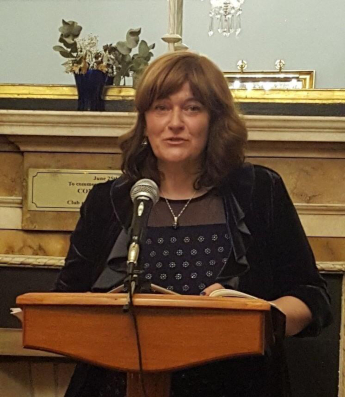 Maeve O’Sullivan’s poetry and haikai have been widely published, anthologized, awarded and translated. She is the author of five collections from Alba Publishing, the most recent being Wasp on the Prayer Flag (2021). Maeve leads workshops in haikai for adults and children on behalf of a number of organisations, including the Irish Writers’ Centre and Poetry Ireland. She can be found at www.maeveosullivan.com.
.
.
Some of These Stories are True by Maurice Devitt is available from https://www.doirepress.com/books/poetry/irish-poetry/some-of-these-stories-are-true

 Rochford Street Review