
Sasha Cuha: 3 Performances
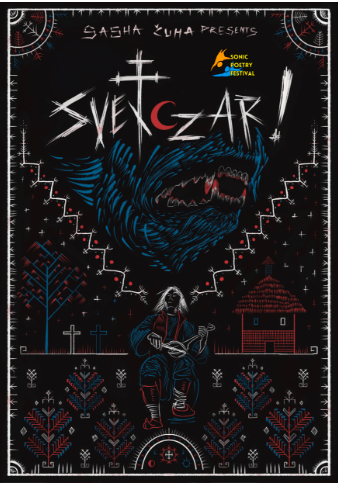
Acclaimed poet, multi-instrumentalist and actor Sasha Cuha returns to his cultural roots in this new and exciting poetic cycle. SVETOZAR! combines the tradition of Serbian Epic Poetry with his love of experimental music and narrative poetry and storytelling; bridging the gap between the Ancient and the modern. More details.
The story exists in a shadow realm between silence and speech.
The story lives when it is told, when it is read, when it is written, when it is heard or seen.
The story slinks back, as an actor does, to the safety of darkened wings when the tale ends, the book kept closed, the page left unfinished.
As long as a copy of the story exists the story cannot truly die.
As long as the story can be heard, or read, the story lives on.
As long as the story is remembered, it lives on.
In a way, story’s are immortal.
My new work, SVETOZAR! Explores the interstices between oral tradition and performance, modern soundtrack and experimental music and extended technique of ancient musical instruments in a modern context. This definition, whilst fine for academics, does not address the experiential.
SVETOZAR! At it’s heart, is a return to the root’s of entertainment – the narrative epic poem with accompaniment on a traditional and ancient instrument – updated for the current century. SVETOZAR! Straddles the fine line between fact and fiction. The story itself is about my great great grandfather, and was told to me by my mother and contains many fantastical and folkloricm elements. When hearing this tale, I ask you not to suspend disbelief, but to hold the story as equal part’s truth and equal part’s lie, as all folktales and myth’s must be held.
The ballads of Serbia occupy a high position, perhaps the highest position, in the ballad literature of Europe. They would, if well known, astonish Europe… In them breathes a clear and inborn poetry such as can scarcely be found among any other modern people. – Jacob Grimm
My cultural background is Serbian, and within my culture we have a long and ancient tradition of storytelling, the tradition of the guslar, so named for the instrument that they play – a single stringed fiddle – in accompaniment to the telling of stories. Guslar were wandering bards that would travel from village to village, or court to court retelling the tales of the current battlefield, or folkloric stories of the earlier cycles. During the Ottoman occupation (1459–1804), guslar’s were particularly targetted and if they were caught, could have their tongues or hand’s removed. Such is the power of song, of myth and poetry. This tradition, it has been said, goes back to the Homeric tradition.
When a story is told, performed – it takes on a greater life than when it exists on the page. With each retelling new embellishments and additions occur. The story begins to breathe, shift, adapt and mutate. This is a part of SVETOZAR! And of the guslaric tradition. In many ways I have broken from certain traditional trappings, particularly in the way verse is approached in this project – the meter and verse shifts here, traditionally it would be fixed and unrhymed decasyllabic. This was an artistic choice to allow me to enhance the poem’s dramatic effect.
So far the poem has been performed twice for the Goldfields Gothic Festival of Dark Ideas (as regarding genre, it can be said to be cut from the cloth of folk horror) to a very positive reaction.. It was wonderful to see the hold that such an ancient artform can still have on people in this day and age.
Storytelling forces the listener to engage with the work. It is not like film, or theatre in the way that we are simply reacting to what we are told, asked to passively follow along. The audience dances with the story and imagination is king, and I ask you humbly to waltz.
Sasha Cuha is a poet, painter, actor, filmmaker and musician currently living in Naarm/Melbourne. He is of Serbian decent and is known for his narrative poetry and cinematic work.
.
. .
.
 Rochford Street Review