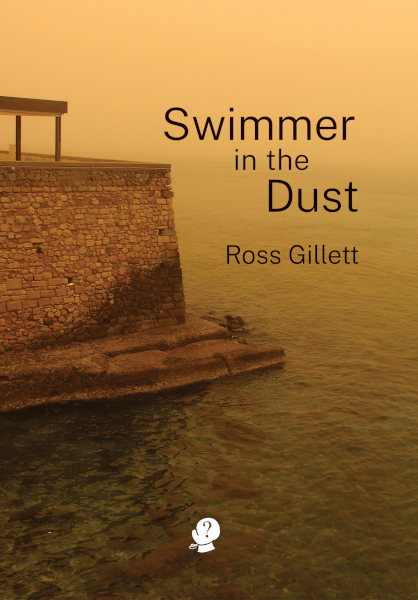
Swimmer in the Dust by Ross Gillett. Puncher & Wattmann, 2022
The opening poem in this collection, ‘Ash Wednesday Windows’, provides an introduction to the kind of poetic journey we are about to embark on. After a fire, perhaps bushfire, the windows, almost personified, “lay on their backs beside the dirt driveway/ waiting for walls.” The onlooker sees soil, weeds, singed grass, “the only views he’d ever see through them”, and the poet leaves him “patrolling the melted windows,/ checking the shifts in perspective, the small distortions.” Gillett’s spare but loaded descriptions leave it to the reader to imagine the conflagration , the sense of loss and waste.
With similar sleight of hand, he does not allow us to meet his eponymous “swimmer” until ‘Remembering Iraklion’. Here, in a travel scenario:
That night, the dust storm,
an airborne desert coming for Iraklion.
Grains of the Sahara piled up on the windowsill.On leaving, the dust of the past
was with us in the Cretan streets,
a gritty benediction.My lover waved to me
from the end of a clouded street
in the faintly invaded city.She beckoned with both arms.
She was a swimmer in the dust.
The poem concludes:
These streets, these memories
− as if there’s a way through
the haze of time.
……………………………..
Even the dust
was a way of seeing.
In the following sequence, ‘Daedalus and Son’, there is another swimmer, Icarus, who doesn’t survive: “It’s possible to burn and drown/ in the one instant.” This fine poem is also about flight:
Never regret our breakout flight. My world is a damp haze.
A directionless wind tugs at everything, so grant methe remembered ecstasy of disaster – the way your wings
hauled me higher and higher, hot thin air around the sun,then a radiance that took my breath away. The fall
was a last twisted minute of living.
But Gillett’s collection is not really about swimming (whether through dust or water), except as a metaphor. ‘To the Lifeguard’ begins with an epigram: “Blessed are the poor swimmers/ for they shall be saved”, later saying “Diving’s just another way of falling”:
I’m the hopeless swimmer,
the underwater wanderer,
the pool bottom drifter.
Gillett is an environmental poet, his favoured topics here being the sea and beaches, and especially rain. There are at least six poems on rain in this collection – ‘Missing the Rain’, ‘Waking to Rain’, ‘Bringing on the Rain’, ‘Love Song’, ‘Rain Sonnet’, ‘Better Weather’, all of them reminding us of its regenerative power and the significance of rain in our lives, as we
weathered inhabitants, live in a loose
relationship with it, and might be
rain at heart, as untranslatable
and loosely put together as we are,
like this day’s rainpour, like a life of rain.
Similarly, there are many poems about the sea and beaches, with epiphanic moments and, towards the end of the book, an added warning that “the mind is a dark beach”. The first of these poems, ‘Kelp’, is a beautiful vignette describing “the sea weighed down/ by a darkness”, the breakers “held back/ by the life they make possible”. Yet nature prevails:
The weed-filled wave heaves.
The weighted world
rises to the occasion.
‘South Coast Sonnets’ is a series of five poems detailing a weekend coastal visit, an immediate affinity with the ocean, and a somewhat fearful merging:
We stood back
from the edge of an ocean truth,
immensity ending in collapse
………………………………..
In the end, the wind turned us
home through the dunes, but we were a told
story by then, our staggering narrative written
step by step across the sea’s terrain.
‘Night Beach’ further emphasises the ambiguity of this relationship, and perhaps that of the human relationship touched by its backdrop:
Who could trust the sea in this breaking light?
Even the dunes
have their faint stinging song.
……………………………………………….
I can feel the shifting of the ocean’s feet,
rumours from the other end of the world.
By comparison, other poems can be deceptively simple, but usually with a volte-face or epigrammatic couplet at the conclusion, signalling that the story is not yet over. Gillett’s land and seascapes convey levels of meaning and receptivity far beyond the literal, and deepen our understanding of the forces that move us.
– Margaret Bradstock
————————————————————
 Margaret Bradstock is a Sydney poet, critic and editor. She lectured at UNSW for 25 years and has been Asialink Writer-in-residence at Beijing University, co-editor of Five Bells for Poets Union, and on the Board of Directors for Australian Poetry. She has eight published collections of poetry, including The Pomelo Tree (winner of the Wesley Michel Wright Prize) and Barnacle Rock (winner of the Woollahra Festival Award, 2014). Her latest collection, from Puncher & Wattmann, is Brief Garden (2019). Editor of Antipodes (2011) and Caring for Country (2017), Margaret won the Banjo Paterson Poetry Award in 2014, 2015 and 2017.
Swimmer in the Dust is available from https://puncherandwattmann.com/product/swimmer-in-the-dust/
.

 Rochford Street Review