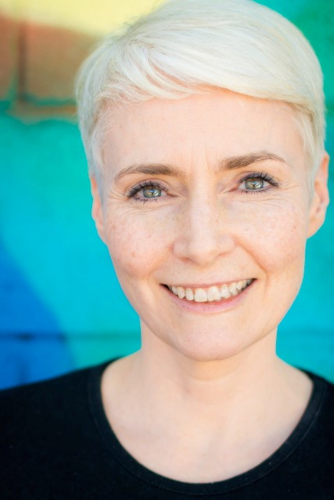
Alison Flett, 1965-2023. A tribute by Heather Taylor Johnson
I met Alison Flett in 2012, almost two years after she’d arrived in Adelaide. Ours is a small city, meaning the poetry scene, too, is small, so when you attend a reading and someone new is performing, you take notice of them if they’re talented, and you thrill at the thought of hearing them read again. Alison was that talent, and when I introduced myself to her at a book launch and she smiled and was graceful and humble and eager to converse, I knew I had to have her as my friend.
Alison, myself and another poet, Rachael Mead, talked much of the night, went out to dinner, made plans to form a critiquing group, and just like that the three of us became ‘Edit When Sober’, a nod to Hemingway and all drunken writers since our meetings were wine- and word-fuelled spectacles. Was it really that immediate? Incredibly, it was. Over falafel platters and fava bean stew, the three of us gushed over each other’s poems and felt seen and inspired, but Rachel and I always said to one another afterwards, ‘Alison’s writing is ridiculous, it’s that amazing,’ feeling her poetry to be on a completely different level to ours. Over the years we would learn that not only were her poems exceptional, but so were her critiques. Her instinct with active verbs and line breaks and assonance and creating spaces to ask Big Questions – How came I into this? – were ever-illuminating and sometimes call for epiphany. Top this off with the person she was – calm yet fiery, open yet guarded, warm, friendly, complimentary, funny, anecdotal, insightful, intelligent, fun – and it was true love.
Alison, Rachael and I became the best of friends that year, and it grew and it grew and it grew. When she died this year on 29 July after a three-year coming-to-terms with a surprising stage four cancer diagnosis, she left an enormous hole in our hearts. The Adelaide poetry scene, Australia’s wider poetry landscape, indeed the beloved Scottish poetry world that raised her from the start, are lesser for her loss. We miss Alison, but we have her books, and we’re grateful for them because when we hold them in our hands and we read them to ourselves, she’s there. There’s her wee voice, that Scottish lilt, the defiance and reasoning and wonder.
In Scotland, in her twenties, Alison was an up-and-coming poet and writer, running with now-luminaries Irvine Welsh, Ali Smith and Alan Warner. There’s a photo of Welsh from the 90s when Trainspotting was everywhere, wearing a t-shirt with one of her poems printed on it. Her poetry also appeared in Dreamstate: New Scottish Poets (Polygon, 1994), Ahead of Its Time (Jonathan Cape, 1997), Modern Scottish Women Poets (Canongate, 2003) and 100 Favourite Scottish Poems (Luath Press, 2006). Celebrating Scots, her poetry collection Whit Lassyz Ur Inty (Thirsty Books, 2004) was shortlisted for the prestigious Saltire First Book of the Year Award. Deftly combining humour with politics and delivering quite the punch, she shared her poetry on national television and radio, and at literary festivals around the UK and further afield in Europe.
In her beloved Orkney, Alison worked to establish and run the first Orkney Book Festival and was on the Board of the George Mackay Brown Fellowship, which encouraged new writing coming out of the island. The Fellowship eventually supported Wordsmit, an initiative of Alison’s to bring young people together to compose, share and talk about their work, and Wordsmit continues to this day. Her legacy also lives on in Orkney’s renga groups, which keep remerging since her departure to Australia. This is how poet Yvonne Gray describes the early days, under Alison’s facilitation: ‘We would spend 4-5 hours on a Sunday writing a renga with a break in the middle for lunch. Occasionally there was a renga on another island. I remember one in Hoy, one in Shapinsay – and I think there was one I couldn’t go to in Westray.’ Alison was a mover and a shaker.
Her writing career became a more private one once she arrived in Australia, as she worked to develop a new voice that expressed her experience of transnationalism and dislocation. Though she longed for Orkney to her dying day, she made a home for herself in Adelaide with her partner, three children and cat, as well as with her tight-knit group of mostly writing friends. Her poems were published in Australian Poetry Journal, Cordite Poetry Review, Island, Plumwood Mountain, Rabbit, Southerly and Westerly and in the anthology Australian Love Poems, among others. She was also shortlisted for the prestigious Whitmore Press Manuscript Award, Adelaide Festival Unpublished Manuscript Award, The University of Canberra International Poetry Prize and the Newcastle Poetry Prize. She was a regular on stage at Ken Bolton’s Dark Horsey readings and later a favourite at the Halifax Café poetry readings and the more recent No Wave readings. She was the poetry editor for the academic journal Transnational Literature and, with Jill Jones, co-publisher of Little Windows Press, which brought out three series of four carefully curated chapbooks by writers from Adelaide, the wider Australia, and Scotland, including Andy Jackson, Ali Cobby Eckerman, Quinn Eades, John Glenday, Jen Hadfield, Dom Symes and others – both Jill and Alison contributed their own chapbooks, too. In 2022 – eighteen years after Whit Lassyz Ur Inty – her first full-length Australian poetry collection was brought out by Cordite Press. Where we Are is a testament to Alison’s patience and perfectionism, with each poem of belonging devastatingly probing and painstakingly expansive. The book confirms what the Scots knew all along: Alison was one of the finest poets around.
She was also an accomplished prose writer, having won the Olga Masters Short Story Prize and been longlisted for the Elizabeth Jolley and UK’s Bridport Short Story Prizes. Her memoir Rattled (Allen & Unwin, 2022), written under the pseudonym Ellis Gunn, is about her personal experience of being stalked, and examines why women are set up for such encounters from a very young age. Her slide from the main story and other disturbing personal sketches into research-heavy statistics and then poetic stream-of-consciousness is both seamless and enviable. The voice in the book – the same voice I heard her use every time I saw her – is consistently generous. She was also an Arts critic for InReview, primarily reviewing contemporary dance, and those short pieces are stunning, too.
In 2018, Edit When Sober had run its course, but the trio-friendship Alison, Rachael and I shared remained as strong as any we’d ever had. In the last few years we’d joined up with a few other local poets to write and critique work, and during the last session, Alison’s body was thin and weak, though her smile still shone, as did her determination to share new poetry. This is what she read out loud to us that night. I believe it’s the last poem she wrote.
.
Unbearable lightness
Old self that once was dot, was free-range
cells. What whispered magic spun me
from your coiled chains, made blue veins
and solid thump of heart? Plump meat, bone,
breath sewn through with darts of thought?
How came I into this? And how to reconcile return?
To turn away from touch of skin
on skin, from sound of song? To leave behind
the blush of evening sky, the rush of birds
through dawn, the clash and cry of waves
on rock? How to enter once again the empty
realm of naught? Old self, guide me home,
ballasted by joy of this. Let it be enough
to once have been.
———————
.
.
 Rochford Street Review