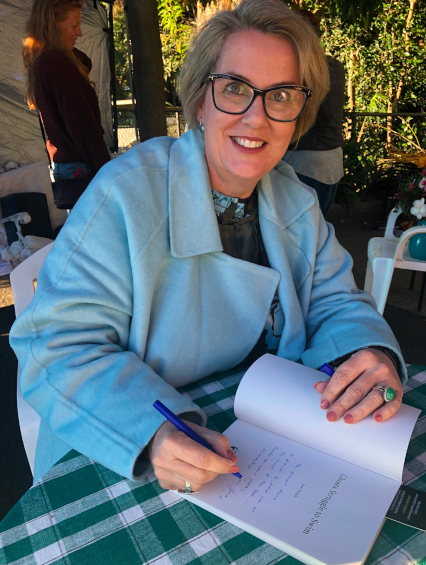
Jane Frank signing copies of Ghost Struggle to Swim
Ghosts Struggle to Swim by Jane Frank, Calanthe Press 2023, was launched by Damen O’Brien at Under the Greenwood Tree Bookshop and Art Gallery, Tamborine Mountain on 20 May 2023
Perhaps the work of poets is the work of memory. Pressing each poem between the leaves of a book, like a flower is pressed between pages. To retain it. To recover it. To linger upon it with wistfulness and with longing.
Studies using an MRI to show the parts of the brain which are active when someone reads a poem, have found that the same parts of the brain which are involved with memory also light up. Poetry is inextricably linked to recollection. That is why so often the poem itself becomes quotable, memorable – so often, out of the depths of grief or despair a line from a poem which connects with our situation returns to us, like it is dredged out of the dark waters of our subconscious. It is easy to memorise poetry.
Jane’s poetry is very conscious of this relationship – of poem as fragment of memory. In ‘The House is An Aquarium at Night’ she writes ‘first cascading sun / light from above reminding me that the past is gone forever’. But the reader sees the irony – the past is not gone forever, it is caught in Jane’s recounting, it is fixed within the freezing of her lines. Later in her poem, ‘Ghosts’, the poem from which she took the titular line, she tells us ‘I want to write about this place….push against / the past’s unwriting’. There is an urgency in these poems, a sense of her obligation as witness and chronicler of these moments.
The act of writing is itself talismanic, symbolic – the animate and the inanimate are engaged in writing: bodies write upon the water (‘Crossover: Paragliders at Sandgate, August 2020), the moon writes upon the sky (‘Moon Garden’), the river is tabula rasa in ‘Lost Language’, sails shape ‘scrawl’ in ‘Not Saving the World’. What is witnessed without recording is not real, what is remembered without documentation cannot be recovered. Humans are fragile and temporary, only as meaningful as the signs we leave behind. In her astonishing poem, ‘Keeping Records, Rainbow Beach’, Jane describes humanity as ‘tiny notations on a page / forever changing’. We think, given this book’s focus on ghosts and remembrance, of the words etched in Keats’ gravestone: ‘Here Lies One Who’s Name is Writ in Water’.
I first met Jane online through Twitter. I suspect that this or one of the other numerous social media platforms, is the way that many poets now meet. I had liked some of her tweets or perhaps she had liked some of mine. I was astonished to find out that she was a fellow Queenslander. We later met in the flesh at the Queensland Poetry Festival at the Judith Wright Centre, where we whiled away a great evening talking about poetry, poems and poets we knew and liked (many) and ones that we didn’t (a common few).
I have tried to trace Jane’s poetic antecedents, her creative inspirations, but I have found this difficult. There are many, no doubt, but they are hidden from me. Her voice is unique and strong. I need to say something about form in this context. There are so many different approaches to the white page in this book: complex, dense lines; jagged blocks of text zigzagging down the page; short lines, giving the poem an opportunity to breathe; serene meditations in prose; stanzas of two, three, four and five lines.
The variations are constant and refresh the eyes every-time we turn the page. This is the sign of a poet who wants to make herself with each poem she writes – who wants the poem to speak for itself, to tell her what shape they want to be, rather than the shape the poet has chosen for them.
I was honoured to be able to read an early draft of Jane’s poems, some of which are now in this wonderful book and later I had a sneak peek at the manuscript itself. Jane has always been polite enough not to be offended by my particular line in acerbic criticism. She may even have agreed with a small percentage of it. Even in the rough I could see what this manuscript would be and couldn’t wait for others to enjoy it, like I did. I also know that there were a number of fine poems that didn’t quite make the cut, but that is the nature of things and perhaps they will turn up in a future book. The ones that did have been organised into three sections: Lunar Fish, Along the Silk Road and Black Isn’t a Colour.
Ghosts and the sea, so prominent on the cover of her book, are prominent in the first section, ‘Lunar Fish’. So is the motif of the moon. I am so glad that the cover is a picture of the sea. There is so much sea, so much ocean, rain and water in Jane’s poems. Water is everywhere, we cannot get away from it. As Jane reminds us, ‘Water / covers 71 percent of the surface. Never turn your back on the sea.’ Water, for Jane, is a medium for change – something portentous – imbued with meaning. Here are some lines from ‘Recurring’:
a repetend of rain…
I’ve been poring through a creel of photographs on my desk today
his smile repeating
the rain is gunfire on the roof
there are billions of raindrops I tell you
a prosody of water: dripping, splashing, seeping
as if it will never be dry again
but there is only a finite amount of water in the world I add
not like love.
The middle section of this book, ‘Along the Silk Road’ is the most intensely personal of the entire collection. I won’t embarrass Jane by reading any of the poems about her children, but I would like to take this opportunity to read ‘Green Bathroom’, a poem which captures many of the themes of memory and ghosts and photographs in this book:
Green Bathroom
I am keeping you company in the vintage bathroom
of mint green enamel. It is the moments before my
childhood ended—I know because your heart is loudand the black and viridescent tiles in the Art Deco
design are pristine. I have a photographic memory
for that geometric pattern: a screensaver from a winterafternoon long, long ago. The sun never shone through
that window on the south side of the house, but I
imagine the red setter dog sitting on next door’scar tracks below near the front gate, only metres away.
It is almost dark so there is no birdsong but I can hear
running water—it would be the hose on its stand inthe begonia bed framed by pink-blue pride of India,
the colour of musk. There is also a sound of dripping.
It is the high basin tap with the big H and C on left andright. There is a worn spot on the enamel where the
water constantly drips and the bitter smell of Ipana
toothpaste with its hard crust around the top of thetube, its tight-coiled used end. Your head is bald and
florid, your face turned away, eyes open. Your glasses
are not on but you are wearing a dark striped dressinggown with a cord tie, blue flannel pyjamas. Your long
toes are hidden by brown half slippers. Down the hall
there is a basket on the table with soup and rolls, acoffee pudding and in the food safe there is a tin with
custard cream biscuits. A glossy black telephone sits
on a polished wood table. Soon it will ring. I havestill not seen a dead body. I am also walking home from
tennis practice. Everything is calm and still, only faint
laughter from the kitchen and a cold sky of stars opening.
The final section of the book, ‘Black Isn’t a Colour’, brings together all her poems of art and artistry, of the process of art and the inspiration of ekphrasis. In this section’s poems we return to the work of art to preserve memory. In ‘Rose Madder’, we read ‘…Vermeer used / rose madder to deepen vermilion, to stop the / rich colour fading, to hold memory in place.’ In the section’s titular poem, the world itself becomes a painting or a map of descriptions. She paints herself into the poem as a bird in ‘Self Portrait as Bowerbird’, but in truth every poem is a strange, inverted, distorted self-portrait.

Jane’s poems are the paintings and portraits of a person watching the difficult moments of their life happening. There is always a part of every poet that remains an observer, even at the worst extremity, that stands apart to watch what is happening. I am reminded of the artist in Judith Wright’s ‘Request to a Year’ who paints the scene while she watches her son floating towards a waterfall, knowing that nothing can be done.
This is how we prove that it really did happen. We write it down. We describe our past. Or more correctly, because we are poets, we recreate our past, we form it into more pleasing shapes. Poets are always unreliable narrators, of their own actions and inactions, most of all. Jane understands this. Her poems have an artist’s sensibility – they are pictures hung in a gallery, each of them depicting a different style, a different image, a different form – each bringing to the page different baggage and drawing from a different legacy.
If we find ourselves in these remembrances, it is because Jane has accomplished the difficult trick of déjà vu – of writing a poem that makes us think we have experienced this before. The false memory stuttering in the synapses of our brain. Here we have so many memories taken like surreptitious photos, like cheat notes, while the work of living goes on, regardless. As Jane says in ‘A Fading Music’, ‘curled like old photographs / in a beached album on a / high shelf’.
Much of this book is written in the past tense, so these lines become, over many readings, less poems and more a way for the poet and the reader to come to grips with a revenant, a regret, to work through a problem long mulled over and returned to. Even where the poem teeters on the edge of the present, like one of my personal favourites, ‘A Gift of Chickens’, it is fleeting, like the present always is, retreating into the already golden past. Whether we are religious or secular, we have sense of our footprint in time as extending beyond the brief period of our lives and into the even briefer domain of memories. We have a sense that we cannot truly be said to be gone while someone lives that remembers us, or for writers and poets, while our works memorialise us and our loved ones.
In Jane’s poetry, there is a special place for her father. His legacy, his image is deeply felt in her words and they form a powerful theme – poems like ‘Earthing’ and ‘Searching for Goldfish’. ‘Father’s Day’ brings us a deep sense of the presence and absence of a loved one, while the moon once more peeks into the poem. But we also see glimpses of her mother, in ‘Keeping Records, Rainbow Beach’ and in ‘The Last Ferry’ and in ‘Strawberry Farm’ and ‘400 Days’. In these poems, as in the poems about her father, her parent is mostly twinned by water – by the sea, by a river, by a pool. In her introduction, Jane tells us she believes in the healing power of water, not in the way of Keats, as a means of forgetting, but as way to resolution.
So, naturally, to ghosts. What (or who) are the ghosts in this book? Jane’s father, certainly. But I am brought to mind of the long history of spirit photography – the sepia images of solemn men and women sitting in their Sunday best, while behind them, the vague grinning outline of another face appears. Of course, we know that these disturbing photos are often the product of the long exposures of the time, where a momentary passer-by accidentally photo-bombed the arrangement, or the glass plate negatives, that would occasionally result in a doubled image – negative on negative.
I like to think of Jane’s poems like they are Kodak prints, shaken in our hands to cool, the image slowly coalescing from white to black. Her ghosts are friendly ghosts, they are the fleeting exposure of one thought over the other. The reader cannot be haunted by them, even if the poet is. We look on them with interest. After all, they are Jane’s personal recollections – her travels, her life, her time in Spain and Scotland, her boys as they have grown.
And now, we have come to the end of end of the book. The poet has taken us through the important work of memory and memorialising and is telling us, ‘Look! I have exorcised my pain. I have made peace with my memories. I have drowned my ghosts.’
It is my pleasure, to invite Janene Gardner to return to the microphone and introduce Jock Macleod and Jane. With the utmost delight, it is also my duty to announce that Jane’s book, Ghosts Struggle to Swim, is now launched.
– Damen O’Brien
————————————–
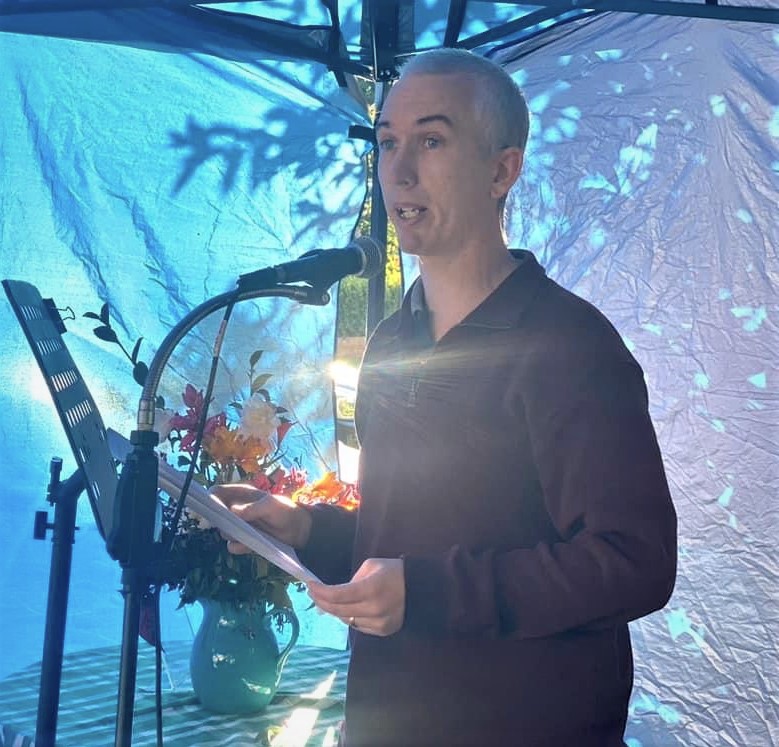 Damen is a multi-award-winning Brisbane poet. Damen’s prizes include the Moth Poetry Prize, the Newcastle Poetry Prize (both the Australian and UK versions) the Peter Porter Poetry Prize, Gwen Harwood Poetry Competition, Val Vallis Award, Cafe Writer’s Poetry Prize and Magma Judge’s Prize. Damen has been published in numerous journals, including Southwords, Poetry Wales, Touchstone, Island, Rabbit, New Millennium and Booranga 4W. Damen’s first book of poetry, Animals with Human Voices, was published in 2021 by Recent Work Press.
Ghosts Struggle to Swim is available from https://www.calanthepress.com.au/books-and-authors/jane-frank

 Rochford Street Review