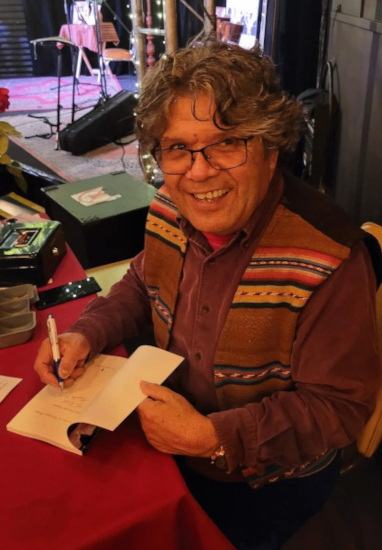
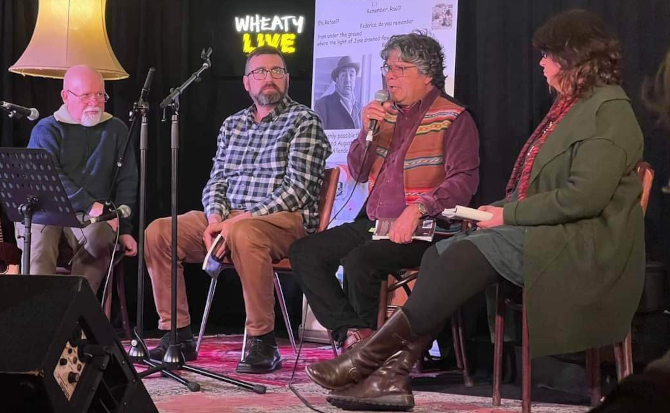
The dilemma of writing a poem, by Juan Garrido-Salgado, Puncher & Wattmann 2023, was launched by Steve Brock at the Wheatsheaf Hotel, Adelaide on 24 July 2023.
Good evening and welcome all. It is an honour to be invited to launch Juan Garrido-Salgado’s The dilemma of a writing a poem a work of significant depth and breadth that runs to 140 pages.
This is a volume of poems that is well travelled, written in the in-between spaces of countries including Chile, Australia, Russia, Spain and Nicaragua. International in outlook, home and away is a central theme, with poems smuggled across borders and living clandestine lives in the margins of the societies they inhabit.
As a political refugee, Garrido-Salgado is essentially a travelling poet, and his suitcase of words creates and reimagines home through the act of writing a poem. The dilemma of writing a poem is considered from many angles, including the key concern that the dual tools of his trade, Spanish and English, are the language of the coloniser. Garrido-Salgado brings this postcolonial dilemma to the fore of his writing in poems such as “Reflection about my Australian citizenship”:
My language was to open and close old suitcases
where everything was, that had fed my soul.
This was the beginning of communication.
They invited me to pronounce my origin and my verses
in the language of genocide . . .When speaking, I have the shadow accent of a kangaroo on my walk.
I jump with a lame leg and I still try to take flight,
jumping in the attempt to reach the defeated wings of my inner condor.
In dialogue with poets including Lionel Fogarty, Ali Cobby Eckermann, Robbie Walker, Judith Wright and John Kinsella, Garrido-Salgado explores the parallels in political and colonial oppression in Chile and Australia.
More than a postcolonial theoretical engagement, Garrido-Salgado finds home in a community of poets and activists, discovering continuity in the struggle against Pinochet with the fight for Aboriginal rights and justice in Australia. This struggle is real and authentic and is reflected by both the people in this room here today to celebrate the launch of this important book, and the friends and poets referenced in the poems, including in this verse from the poem ‘Which is the country, which is the true? – Judith Wright’:
I believe my new country is a friendship.
My new country is the struggle and dances of welcome from my
brother Steve Goldsmith.
These are stories of resistance and sharing,
voices of truth by Aunty Veronica B & Aunty Maggy
are the land of the long walk for freedom by Uncle Ken Buzzacott . . .I am a freedom fighters’ poet
writing in two coloniser languages.
My verses beating with the sound of the Mapudungun
Cachuín, Pichintún, irse a las pailas, pichiruch
Faced with the dilemma of writing a poem in English or Spanish, Garrido-Salgado takes the bull by the horns and writes bilingual poems, reinventing English through a Spanish lens and the transcreation of reverse translation.
This book is a product of a dialogue between English and Spanish literary traditions, and Garrido-Salgado draws deeply both on contemporary poets and also the canon, often taking a verse as a theme to spark a new poem or provide a window on past experience.
The garden is a recurring trope in Garrido-Salgado’s work, and it is through our gardens that we create a sense of home and place. For Garrido-Salgado, the garden is both his work growing vegetables for the homeless in the day centre, and also a deeply personal space of poetic inspiration. In more than one poem the garden and poem become one, as in “Sometimes I don’t know who I am when the sunset comes”:
My garden not only gives fruit to eat, as in the leaves of a cauliflower
my verses find a home to dream.
In the broccoli florets I can read a verse from Judith Wright (p.19)
Ultimately the poem itself is home and a place of solidarity to be shared with other poets, as in the poem ‘Today call death by its name’:
I told you that I enter the poem,
my true home,
the only one that I have, mine,
since everything else is rent
And in dialogue with Mario Benedetti the poems ends:
I will be here old dear poet
waiting for you
in our home, common as the poem should be.
While The dilemma of writing a poem is the work of a politically committed poet, one who has paid a personal price through torture and imprisonment, it is also a book that delights in the sound and imagery of poetry, a celebration of words and language:
My reason to write poetry has always been
a political/humanitarian reason, just as I love the sound,
the skin and how the words creak
on my paper’s lips, full of ink and reasons to speak (p.56)
I would like to conclude by congratulating Garrido-Salgado on this new volume, a travelling architecture which deepens and reimagines our collective sense of home and place, and officially announce it launched!
– Dr Steve Brock
—————————————–

Steve Brock’s poetry has been published in journals in Australia and overseas including Antipodes, Australian Book Review, Meanjin, Poetry NZ, Social Alternatives and Westerly and in translation in journals in Spain and China. Steve has published four collections of poetry including Live at Mr Jake’s (Wakefield Press, 2020) and Double Glaze (Five Islands Press, 2013) and is the co-translator from Spanish to English of the anthologies Desarraigo: 18 Poetas Transfronterizos, (Nautilus Ediciones, 2021) and Poetry of the Earth: Mapuche Trilingual Anthology (Interactive Press, 2014).
The Dilemma of Writing a Poem by Juan Garrido-Salgado is available at https://puncherandwattmann.com/product/the-dilemma-of-writing-a-poem/
.
 Rochford Street Review