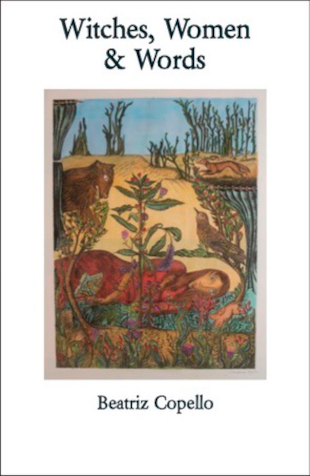
Witches, Women and Words, by Beatriz Copello, Ginninderra Press 2022
Unacquainted with Beatriz Copello’s work before (but eager now to catch up) I was drawn to this book because I’m both a poet and a witch. As well, I discovered in its pages, among other things, our shared love for wisteria, the poetry of Neruda and Australia’s ‘Up North’ landscape.
Altogether I found the book fascinating, moving and thought-provoking. It begins with some quotes to the effect that feminists are turning to witchcraft now because it’s a way to claim power, a particularly free and individual power – authority over oneself.
In my lifetime (I am now 84) I’ve seen increasing freedom to do so, from a time when a woman could lose her job and/or access to her children for following the religion of Wicca – not only in the more overtly Christian USA but even here in Australia – right up to the present when, in response to the then Immigration Minister Peter Dutton referring to a woman journalist as ‘a mad fucking witch,’ a group of women and men embraced that label delightedly to begin a politically subversive group on social media with the aim of calling out ‘the bias and lack of truth in most of our mainstream media’ as well as fighting sexism, racism, homophobia, etc. So far they’re getting away with it, and having an effect in practical terms. (I’ve been pleased to note they are perfectly respectful and understanding of traditional witchcraft, and to my mind their aims and actions are not in any conflict with that.)
Even in times when women were tortured and killed on the mere suspicion of being witches – which still happens in some places in Africa! – following that path was a way of acting with autonomy in one’s own life, rejecting the social strictures of patriarchy. However, for many there was a high cost, as has always been the case in patriarchal society.
Witches, Women and Words addresses both the cost and the freedom in following this path – as well as acknowledging that many accused of witchcraft were in fact ‘innocent women / healers and midwives / … independent and self-sufficient’.
Copello pulls no punches. The very first poem, ‘Surrender,’ lists
husbands that cheat abused women
girls fucked by their fathers
among the things which are visible in our society if one only looks.
The second, ‘The Witches’ Brew’ has her throwing into her cauldron such items as
my first communion veil,
my prayer book and
my mother’s wedding ring
soon I stir in two tears
one for her and one for me
going on to add:
my history books
full of men’s tales
and absent women
and finishing with:
The bubbles reflect
on their brilliant surfaces
the portrait of the many
who tried to contort me.
I let the brew burn dry
until the moon announces
the birth of a new woman
a woman who is free.
(What a brilliant word to use here: ‘contort.’ Perfect!)
So from the outset the book is about reclaiming agency and freedom. Indeed, the ‘cost’ I mentioned is clearly not only incurred in following the path of witchcraft – some poems go into detail about the prejudice and persecution of the past – but by simply being a woman in the first place.
Copello also makes a (very witchy) connection with the natural world. In our day, this can’t be separated from concern for the destructive effect humans have had on our Mother Earth. ‘Inferno,’ a poem about the devastation left by bushfires in Australia, is (in the first,’Witches’ section of the book) placed next to one which mentions Inquisition – so I cannot help thinking of the burning of accused witches alongside the present terrible burning of our planet, for both of which she sets the blame squarely on the ignorant in positions of power.
The book has two more sections, ‘Humans’ and ‘The `Social Order or Disorder?’ in which she examines the human condition more widely, yet most often from an individual perspective, usually an unnamed ‘she’. But there are men in these pages too: Neruda, Nikola Tesla, and some who remain anonymous though described with a particularity which suggests personal knowledge.
Her subject matter ranges from the memory of being uprooted from a childhood home, through other kinds of dispossession and disadvantage afflicting a range of people, to celebrations of defiance and the freedom in knowing and claiming one’s true inner self.
By and large, she is struck by the sadness and suffering in the human condition, and displays it without flinching – though also with a deep compassion.
The back cover blurb suggests the poems will awaken our rage. There is certainly plenty of material in them to feel enraged about! There are also suggestions of despair, a response equally appropriate to our present condition, e.g a poem about the ravages of war, called simply ‘Aleppo,’ which says (as the final utterance in the book):
No doors to knock
no ears to hear
the innocent cry.
Yet there are also moments of joy, hope, beauty – even though she admits that hope tends to be hidden and secret these days. In reflecting on the ‘Sydney Siege,’ she notices the
Flowers on the ground
a message of humanity
in this crazy world.
Whether looking at ‘the ebullient and vibrant life / that flourishes under the sky’ (‘Up North’) ‘Ancestral anguish printed in our cells’ (‘Inheritance’) or at ‘a pauper poet / and a wheelchair, / witness of pain’ ( ‘My Friend the Poet’), Copello never loses her own humanity, nor her connection both to other humans and to the natural world we’re part of.
These poems deserve much re-reading and pondering, and that will be a pleasure for me. They take me deeper with each reading.
– Rosemary Nissen-Wade
——————————————–
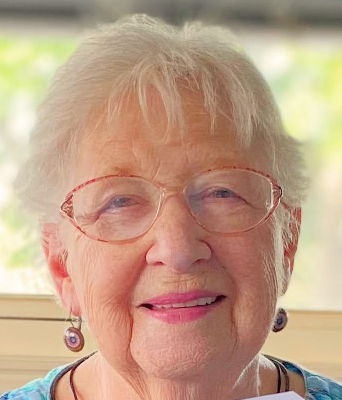 Rosemary Nissen-Wade, formerly Rosemary Nissen, started making poems in childhood. She was a widely-published performance poet in Melbourne in the eighties and a teacher of Professional / Creative Writing. Some major life changes brought her to live in the Northern Rivers region of NSW in 1994, where she interacts with local writers and has embraced the online poetry world. She was also a psychic and magical child, until adults persuaded her it was (merely) her ‘wonderful imagination’ and she suppressed it. Later in life it wouldn’t stay suppressed; she realised she was and had always had been a witch. A former librarian, she has now worked many years as a Reiki Master, Tarot reader and professional psychic medium. Her most recent books are ‘The Pentridge Trilogy’: Breaking into Pentridge Prison, her memoir about introducing poetry workshops there in the eighties on behalf of the Melbourne Branch of the Poets Union, and Letters to a Dead Man, a chapbook spin-off from the memoir; plus a new edition of Blood from Stone, the anthology resulting from the prison workshops. Next, she is working on some collections of short verse and a memoir about the psychic/magical aspects of her life.
Witches, Women and Words, by Beatriz Copello is available from https://www.ginninderrapress.com.au/store.php?product/page/2451/Beatriz+Copello+%2F+Witches%2C+Women+%26+Words

 Rochford Street Review