
Poetry of Home; The Liquid Amber Prize Anthology, edited by Anne M. Carson, Rose Lucas and Renee Pettitt-Schipp, Liquid Amber Press 2023, was launched on-line by Jennifer Harrison on 20 November 2023.
Thank you to Liquid Amber Press for the invitation to launch this anthology – and to the editors Rose Lucas, Anne M. Carson and Reneé Pettitt-Schipp for such a wonderful job selecting the poems. It’s a long time since I’ve enjoyed reading an anthology so much and I’m still not sure if it is the thematic intrigue of writing about home that makes this book so appealing, or if this unique group of poets has come together so prismatically the place of home in our lives cannot be better illuminated. I’m rather sad that I won’t be able to mention each poet by name, or quote from their work, but please know that I value every single poem in this book. Congratulations everyone.
I’ll begin with definitions of home. I’ve just returned from a conference in Vienna where I spoke at the Freud Museum the day after war broke out between Israel and Hamas, and a soldier was newly stationed outside the Israeli library in downtown Vienna. At the reading hosted by the World Psychiatry Association’s Sections of Ethics Art and Literature a young man spoke about genocide in Kurdistan. These traumatic violent global conflicts affecting the homes of millions are a long way from Australia but the news and family connections bring them very close to us. The 1989 United Nations Convention on the Rights of the Child defined the key rights of a child to safety, identity, education, play, protection, ‘having a say’, and a home. The poems in this anthology address violation of these rights but also celebrate how home protects and nurtures those who live in the light of safety. Many poems reference international family culture but another lens through which we understand home in this country is through the voices of the stolen generations, how the 1997 Bringing Them Home report was so powerful, with its 54 recommendations to redress the impacts of Australia’s removal policies, and the ongoing trauma that is not yet salved or translatable to outcomes. A good home allows children to culturally thrive. Home is also a political and ethical construct.
I was not prepared for the humour and humanity of these poems. Their sheer excellence. It’s fitting that the book begins with Carolyn Abbs shortlisted poem ‘Polar Bear Hideout’, an ekphrastic poem about the 2022 Urban Wildlife Photograph of the Year which depicts polar bears exploring an abandoned meteorological station as habitat in Kolyuchin, an island in the Chukchi Sea in northern Russia. The photograph is one of a series taken by Dmitry Koch by drone (some of you may know the photograph which was exhibited in Geelong). Employing imagery that is by turns confronting and humorous (as Abbs writes: ‘another / bear leans out a window like a woman / shaking a duster’), ultimately the poem gives us an image of planetary cohabitation. These bears ‘arrived like refugees on icebergs’ and they reference the demands we make on wildlife for adaptation to what we do to the planet. I appreciate the poems in this book which decentre home from the human and here I’ll mention Susan Hawthorne’s tiny poem ‘epiphytes’, John Bartlett’s ‘watersteady eyes of swans’, Jenny Pollak’s shortlisted poem ‘Literacy in the New World’ in which we are invited to remember to listen to nature and Rachael Wenona Guy’s poem ‘How to shelter a bird’ in which she tells us to ‘erase ourselves for a moment’ to put aside our worldly concerns – to ‘inhabit attention’.
I said on the back cover, though, that homes are peopled. Wars are fought by people over boundaries, and home is very much about the relationships that make a home. Here, we encounter relationships that don’t go well: family violence as in Anthony Mills’ shortlisted, heart-breaking poem ‘Broken-winged’, or the rural violence of killing a wether for a family to eat, as in Peter Lach-Newinsky’s poem ‘Winter Blade’. Homes generate spaces where new selves emerge, as in the second-placed poem by Isabella G. Mead, which is about bringing a new-born infant home, or Ann Shenfield’s poem ‘Constellations’ with its surprising line where she suddenly finds herself, displaced but home, ‘then I took myself home in my mother’s body’. This poem unfolds around loss of family, and the place of art as a means of fixing memory, leaving us with the powerful image of the poet ‘drawing marks / with an eraser into black charcoal.’
I want to mention two superb poems, both written in an interesting boxy form, as though the formal rigidity somehow contains the ambivalent emotions of the poems: Oz Harwick’s ‘No Place’ with its bleached memories, including that of a grandmother ‘speaking / like the ring of a porcelain bowl’ and Alana Kelsall’s ‘the held breath’ which ends with the lines, ‘I learned / from him that hurdles matter that you have / to think about overcoming that wish to prop / instead of leap’. I really liked the independent, strong-willed child/adult in this poem. Both these poems address ambivalence frankly, yet also address what is learned at home from rearing practices, from flawed parents.
And can I celebrate here the absolutely brilliant poems by the awarded emerging writers, Belinda Calderone and Luisa Mitchell? Congratulations to these marvellous poets. Belinda’s poem about silencing and fear, ‘The Soundless Hour’, took my breath away with its powerful restraint and Luisa Mitchell’s ‘Salty Plum’ is an absolute tour de force of unbroken language, First Nations celebration of humour, deep relationship to country and the pure joy of coming home. Thank you so much to both these poets.
In the anthology the poetry styles are quite varied and I feel that the forms chosen best represent what the poet wants to say. Here I think of Angela Costi’s wonderful haibun forms, which bring together Greek and Japanese poetic cultures beautifully, and the experimental lineation of Paris Rosemont’s ‘Casting for Answers’ with the placement of the line towards the right edge of the page, which in itself suggests the physical aspects of cultural displacement.
Two fantastic poems in the collection use extended metaphor, not so much to define or describe home but to embody it. The first of these is Brett Dionysius’ shortlisted poem ‘At Night the Mullet Punctuate’. I loved this poem and was led by it to thinking about how much ‘home’ as a construct is related to one’s own personal experience which is, of course, different for all. For me, the mullet as an extended metaphor for the working class, ‘the commoner species’ resonates with my childhood (the battler culture), yet also speaks to the freedom I experienced in the outdoors, particularly coastal beaches. The images in this poem are wonderful – that ‘tribe of tiger prawns opening like a parachute just beneath the tide’s horizon’, I know too well. It is me.
And now to the prize-winning poem of the collection. Lesh Karan’s ‘Twenty-One + Answers to Your Question’ is another extended metaphor poem which explores the idea that identity is made of up many places, many roles, many selves all filtered through the reiterative assertion ‘I am from’, which also evokes the corollary: ‘where I am not from’. The endlessness of this list suggests that ideas of home are multiple and real but home is also a post-modern phantasm (pin me down if you like – just try). In this poem I also loved the poet’s nod to other poets. That you are from their words too. That you find home in the poetry that speaks to you.
What more is there it say about home? It’s made up of comings and goings. The shoes, Sharon Rockman, with which we enter a home; the things, Robyn Rowland, that signify home as we remember it, whilst at the same time we are creating our own new homes with new things. I loved Robyn’s two poems included here, ‘Between’ and ‘Reservoirs’, her search for home’s identity where ‘Nothing holds, something wanders’ between Australia, Ireland and Turkey.
I also delighted in the humour of a poem such as ‘Fishbowl’ by Allan Lake, which caused me to laugh out loud in response to its laconic banal truths – and the simplicity of a poem such as Marcia Jacob’s ‘Did you Know’, which recalled my own mother calling out to me when I was a teenager trying to sneak in late at night – “Is that you?” And Cathy Altmann’s poem about Arthur Boyd’s home which, interestingly, caused me to reflect not only on his artistry but also on how often women are unacknowledged as they sit historically behind the patriarchal idea of home.
Is there an Australia of home? I recall someone saying once that we are a nation writing out towards the ocean from our verandas. True, we are made up of islands, but we also hold many variations of homeground: multicultural understandings, émigré and refugee enrichments, the intergenerational aspects of home handed down to us, and the preciousness gifted to us from the original and ongoing custodians of country. I finished reading this anthology looking at my own home in a different way. I wish I had a poem in this collection and if I were here, I hope that my ekphrastic poem written in response to the work of First Nations bark Tiwi artist Garawan Wanambi, a work which hangs in the hallway of my home, might represent me, my Irish acknowledgement of home’s preciousness.
Thank you, Liquid Amber Press, thank you United Nations Convention on the Rights of the Child, thank you poets and all your shawls, bathroom tiles, muddy inlet fish, memory-bone soup, button-fly Levis, iron bark chairs, parking spots in the city, challenges, horrors, joys and gifts . . . thank you for your words.
– Jennifer Harrison
——————————————
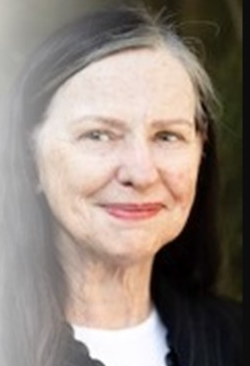
Jennifer Harrison has written eight books of poetry, most recently Anywhy (Black Pepper 2018). A new collection Sideshow History will be published in 2024. She is Chair of the World Psychiatry Association’s Section for Art and Psychiatry and received the 2012 Christopher Brennan Award for sustained contribution to Australian poetry. Recent work has appeared in Australian Book Review 2022, Best of Australian Poems 2022, Australian Poetry Journal 2023, Rabbit 2022, The Hyacinth Review 2023 (France), Unusual Work 2023 and The Fourth River 2023 (USA).
.
Poetry of Home is available from https://liquidamberpress.com.au/product/poetry-of-home-the-liquid-amber-prize-anthology/
.
 Rochford Street Review