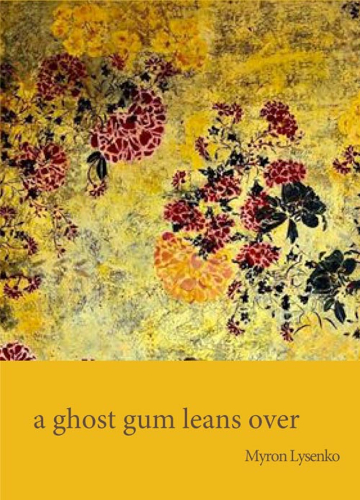
A Ghost Gum Leans Over by Myron Lysenko, Flying Islands Books 2020, was launched by Alice Wanderer on-line from Melbourne University on 1 November 2023
Myron’s haiku are sparse, highly disciplined and written directly from his experience. Each can be read as a whole poem, but four of the five sections in this collection also loosely combine to tell stories. The fifth consists of occasional haiku and includes 33 haiku each dedicated to specific friends.
Sarcoma, the series which begins the collection, presents some of the most significant points across ten years of his daughter, Lucy’s, experience of bone cancer. Generally, it does so through descriptions sharp as photographs:
closed pink coffin –
her bald teen friends
cry together
or bald reports of states of affairs:
low platelets
her immune system
is zero
Occasionally, there is a nature reference
black orchids
the pain in her knee
is still there
The austerity with which this series of haiku avoid the direct expression of his no doubt intense emotion shows a careful recognition that, while a parent’s experience of a child’s life-threatening illness is extraordinarily difficult, it is child who bears the full brunt of the horror and the dread.
Although many of Myron’s other haiku contain a seasonal or nature reference, – an element that is often considered obligatory in haiku – it is the interpersonal and intrapersonal not the natural world that is his main focus. A few of his haiku are restricted to natural description:
dying fern –
roses in a vase
drop their petals
the leaf falls
against a fence
foggy night
newly laid egg
in the chicken coop
a trapped sparrow
But even here Myron does not use nature to distract the mind from its human concerns. All three come from the long selection titled Project 365 (2016) which charts the unravelling of a marriage. In context are objective correlatives, conveying the nuances of grief, dread and entrapment.
There are also some haiku that largely serve to drive the story forward:
someone else
buying her drinks
I go home
It is easy therefore to rush your way through this book, reading the various stories for their narrative. A slower reading allows Myron’s often deadpan observation of incongruity to fully hit home.
Melbourne Show
her first show bag
full of bags
It’s what’s in the bags that matters. Or is it? The repetition of both the words “show” and “bag” is clever. Show implies what you see is what you get. Bags often hide their contents. Or worse they can be empty. So, a bag full of bags? Anticipation? Disappointment? Anticipation-disappointment-anticipation-gratification? Anticipation-disappointment-anticipation-disappointment? This is a” first show bag” – probably Myron’s younger daughter Zaidee’s first show bag. Does this haiku commemorate a rite of passage, or a tiny step in the road from innocence to experience? Are they separable?
Puns or implied puns are one of his signature tactics:
woodchips
I’ll give him a piece
of my mind
Here the set up with its suggestion of generosity (“I’ll give him”) makes the animosity of the punchline, which deftly works with the implied pun of spitting chips, all the more ferocious.
A punchline can also be used to deflect from the full force of the punch:
aged birch
my father beats me
at chess again
This one appears as the last of five haiku about Myron’s not always easy relationship with his father now in aged care. Since some rivalry over chess has already been mentioned, the pun on “birch” and its connection to beating, might be missed by a reader intent on the events and atmospherics of the story.
On the other hand, too slow a reading might miss the subtleties of the story itself. The haiku that introduces that group of five is
stumbling toward
my sixtieth birthday
cool change
His father in aged care, Myron too feels the chill of his own approaching final years. But this is handled very lightly. After all, a cool change in the weather is usually a most welcome thing.
Some of Myron’s haiku use the beauty of nature to underline the poignancy of loss. The penultimate poem in Project 365 is the tender:
romance
this bruised plum was once
a blossom
Once again, there Myron subtly thwarts the reader’s conventional expectation – here the expectation that a bruised plum was once a juicy ripe plum so good and tempting to eat.
He also uses the beauty of the natural world to point toward the mystery and beauty of those he loves:
new trampoline
a rose petal bounces
under the clouds
her face
after make-up
a tulip
And also, despite the generally depreciatory tone of his self-portrayal, he is able to celebrate himself:
a plover glides
over the cliff face
my open heart
If a ghost gum leans over records some years of challenging experiences, often combining to form an absorbing narrative, it does not lack an occasional touch of surrealism
haunted house –
the murdered wife’s grave
under my mattress
Or some political commentary:
Australia Day
a huntsman vanishes
under the desk
Chornobyl –
what seemed to disappear
has returned
In this collection, Myron presents a dynamic web of personal relationships, moods, beliefs and preoccupations and shows how these go towards making a life. Impressively, this complexity is conjured in less than 300 very sparely written haiku. Like the tiny stars that comprise our vision of a galaxy, they are simply points that sketch a much larger whole. The white of the empty page stands for the dark matter that can only be guessed at.
child cemetery
a ghost gum leans over
the graves
– Alice Wanderer
———————————–
Alice Wanderer lived for many years in Japan and has been engaged with haiku since 1995. Her PhD on Sugita Hisajo and her haiku is available through Monash University. Her small volume of translations Lips Licked Clean was published by Red Moon Press and won a Touchstone Distinguished Books Award in 2021. Alice’s recent chapbook, Flow, a collection of 23 haibun is available from Ginninderra Press.
a ghost gum leans over is available from Flying Island Pocket Poets https://flyingislandspocketpoets.com.au/product/a-ghost-gum-leans-over/

 Rochford Street Review