
The Birth of the Universe. A poem by Ivy Ireland
Tide by Ivy Ireland, Flying Island Books 2024, was launched by Brook Emery at the Watt Gallery Space on 6 April 2024 as part of the 2024 Newcastle Writers Festival.
I’ve read and admired Ivy Ireland’s three previous books of poetry. This afternoon, simply, subjectively, in five minutes, I’d like to share with you five reasons why I keep reading Ivy’s poetry and why you, too, might enjoy the poems in Tide.
First of all, the poems strike me as ‘real’. By that I mean that they come out of acutely lived and felt experience. I believe the connection they forge between word and world. Eliot thought poetry an escape from emotion. Ivy, on the other hand, thinks about and through feelings which cannot be escaped.
Secondly, and related to the first reason, there is a sense in which there is a ‘need’ or ‘necessity’ driving the poems. They are not safe, neat, complacent observations. They have an edginess to them. M C Richards has a sentence somewhere which reads, ‘Life lies always at some frontier, making sorties into the unknown.’ For me, this describes Ivy’s work, especially if you substitute ‘poetry’ for ‘life’: Ivy’s ‘poetry lies always at some frontier, making sorties into the unknown.’
The third reason, bound inextricably to the first two, is that there is always something happening in Ivy’s poems. There is no marking time. They have somewhere to go and they move around restlessly as they forage to find emotional and linguistic connections between disparate subjects. You can’t predict the end of a poem from its beginning. Simply, they keep me interested, on my metaphorical toes.
The fourth reason is that I like the mind I am in contact with when reading the poems. Ivy is not afraid to tackle big cosmological and spiritual questions. Neither is she afraid of the quotidian or everyday. To mirror this movement her language can pivot suddenly from the abstract and esoteric to the bluntly colloquial. This is surprising and exciting.
The fifth reason is the quality of the lines themselves, the way they flex and play off each other, and fall on the ear as though they were inevitable. American poet Kathleen Fraser describes the linebreak as ‘the primary defining place, the site of watchfulness where we discover “how” we hear ourselves take in the outside world and tell it back to ourselves.’ Ivy’s ‘how’ is manifest in her lines. This involves an interplay between syntax and line so that the movement from line to line is eventful, not dull, stale, or arbitrary. The critic Donald Wesling talks about ‘calisthenics’ within each line. In this regard, Ivy is an acrobat.
I’m almost finished. I’ve been general. All I’ve done is state my enthusiasm. To be a little more specific, I will say that the governing metaphor of Tide is, well, the tides, with all they imply of movement, of ebb and flow, highs and lows, departure and return. The first poem in the book is ‘Passage’. I’ll read only the first nine lines. Obviously, nine lines can’t do justice to the totality of the book but, to my mind at least, they set up the concerns of the poetry and should immediately give you a sense of the strength of Ivy’s writing.
Hair threaded silver with spiderwebs,
wandering down waysides best forgotten,
lurking along ley lines long left for dead.
Others ignore the byways and bifurcations –
the ruthless pull of the fork – why can’t I?
The only way out, now, is through
lantana, bats and owls,
yet passage demands exchange. What can I give,
considering all that has been taken away?
I hope Ivy has time to read the whole poem. It’s a cracker, full of implication; it gives more each time you read it. And can I suggest to you that once you’ve read ‘Passage’ you might consider jumping straight to ‘Birth of the Universe’ which, in a sense, both complements and contrasts with ‘Passage’, and is a really interesting poem in its own right.
Beyond ‘Passage’ and ‘Birth of the Universe’ Tide holds surprises in subject and form I haven’t had time to touch upon. You will enjoy this collection.
This little book is, in every way, a big book.
– Brook Emery
———————————
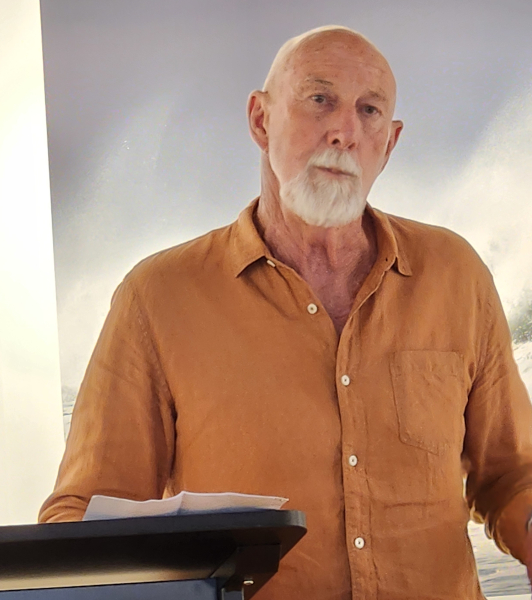 Brook Emery has published six books of poetry, the most recent being Sea Scale: New and Selected Poems (Puncher & Wattmann, 2022). He has won the Judith Wright Calanthe Prize at the Queensland Premier’s Literary Awards and been short-listed three times for the Kenneth Slessor Prize at the NSW Premier’s Literary Awards.
.
.
Tide, by Ivy Ireland, is available from https://flyingislandspocketpoets.com.au/product/tide-by-ivy-ireland/

 Rochford Street Review