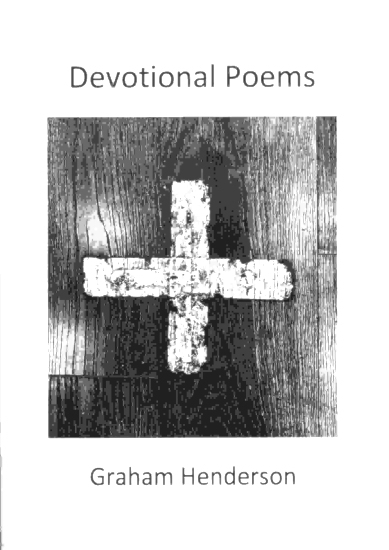
Devotional Poems by Graham Henderson, The Lover’s Press, 2024.
In 2021 I reviewed Solace, Graham Henderson’s last poetry collection, an anthology compiled from forty years of poetry. I am now pleased to be able to review Devotional Poems, Graham’s latest book, published this year. Graham, who I missed out on meeting due to his ill health, is a friend of Kieran Carroll, a poet/playwright friend of mine. I launched Kieran’s first book of poetry in Sydney many years ago and despite him living in Melbourne and me living in Sydney, with all the artistic disparities this can entail, we have stayed connected ever since. Kieran made the switch from poet to playwright early on. Graham, as I mentioned in my last review, received much past acclaim for his novel The Mountain. Apart from this and poetry he has also written short stories, novellas and a number of plays.
This whole preamble to the actual review, while seemingly irrelevant, is important. It goes to the heart of why I am reviewing this book. Reviewing is one way of memorializing and poetry needs all the help it can get. Over the past few years, through Kieran, Graham has entered my orbit of people who have devoted themselves to poetry and literature in general because of a strong, shared sense of its importance to society’s cultural health. These friendship commitments between artists are extremely important at a time in history (has it ever been different?) where serious art is seen as trivial and trivial art is treated seriously. Maybe this is an overstatement but not far from the truth. A poetry launch I recently attended was mainly populated by the poet’s family. While there was a lot of love in the room it would have been nice if the love was accompanied by more people and higher book sales. But that, as they say, is the way it is.
Devotional is a difficult collection to read. It is dark and pessimistic. But many lines, like the ‘fire’ in black opals, glint with beauty.
Consider the first poem in the collection in its entirety:
The House of the Dead
The house of the dead sleeps on
And on until the moon is crimson
And the earth is flooded with blood
The coma of the mountains is ice
Here nothing will grow
The lids are open
But the whites are rippled with sleep
Sleep is cheap but daylight is rare
Prussian blue the sky
And indigo the night
Who will slaughter the ox?
Who will carry the weight?
Who will see the eclipse?
Who will wake the dead?
While one might question the enjambment running from the first to the second line, or the rhyming of “sleep” and “cheap,” (matters of taste?) there are marvelous, resonant and surreal moments such as, “The coma of the mountains is ice,” and “The lids are open/But the whites are rippled with sleep.” And there are these biblical sounding lines suggestive of an impending Armageddon, “…the moon is crimson/and the earth is flooded with blood,” and “Who will slaughter the ox? /Who will carry the weight?” Devotional is not for the fainthearted.
Unlike Solace, the presence of God is palpable in this collection, particularly in the poems Under God’s Earth, Infinite Remembrance and Maria Zammit. These are just a few of the lines which demonstrate Henderson’s faith: “None are forgotten by God,” “God the Infinite Remembrance,” “God the Infinite Love,” “I hope God takes away his pain,” God’s seasons are Infinite,” “God’s love knows no Seasons.” Henderson even refers to, “An extraordinary poem,” by Les Murray, Murray famously having dedicated all his books to the glory of God. But attractive to me, in the same way that certain poems in Solace are appealing, is the way that Henderson creates little poetic narratives which introduce enigmatic themes and characters. For example, the poem Maria Zammit:
Maria Zammit
‘God Bless our food’
Said Maria Zammit
Maltese, Kind and stooped and beautiful
With her years
One of the Blessed
In Love
Desperately in Love
Laughing and everyone loves her
And she loves everyone
God’s work has begun
And the Messiah’s
As my friend, Colin Robinson, poet, wrote:
‘There is Balm in Gilead’
Where is Gilead?
Where is the Balm?
But The Messiah is Here, and Now
The Second Coming
Holy Holy Holy
“Jesus asked for water
And they gave him vinegar, bastards’
As Maria Zammit said
We were all children once
Knowing God’s time
God’s playful Universe
The years unroll us
And the Messiah’s World is Here
Firstly, who is Maria Zammit and is it important to know?
In my opinion, this is what makes the poem so engaging. That she is not specifically identified. Henderson begins by stating that she asks God to bless their food so it would be reasonable to assume that she is a religious person, but one in a position of caring for others. Maybe a religious nurse or nun. Henderson then goes on to reveal that she is, “Maltese, Kind and stooped and beautiful/With her years/One of the Blessed,” and, “One of the Blessed/In Love/Desperately in Love/Laughing and everyone loves her/And she loves everyone.” Note that she is, “stooped and beautiful,” not beautiful despite her stoop. Henderson seems to be implying here that the stoop is intrinsic to her beauty, that it has been caused through her striving and efforts and sacrifices. She is disfigured but her character transfigures her. Note also that that the word “love” or “loves” is repeated four times within the first nine lines of the poem. The poem is infused with love.
Henderson then declares, “God’s work has begun/And the Messiah’s.” This seems to imply that Maria Zammit is a kind of archetype, embodied goodness, a message of love. But simultaneously, because of her physical frailties, is also ultimately one of us.
I also enjoy how Henderson, right after mentioning the Messiah, refers to something his poet friend Colin Robinson wrote i.e. ‘There is Balm in Gilead.’ I researched the meaning of Gilead but will not go into it here. I think it is something the reader should look into themselves. But suffice it to say, it adds richness and depth to poem.
These juxtapositions are among many instances where Henderson mixes the extraordinary with the ordinary and indicative of one aspect of his work which I find fresh and unpredictable.
Graham Henderson’s poetry is not fashionable. Religion and God aren’t fashionable. If the truth be known I am an atheist at most, an agnostic at least. But I prize Henderson’s courage, much of his imagery and his experience. And throughout Devotional Poems I trust that he is leading me to places which, while sometimes strange or disorienting, I will gain from through visiting.
– Mark Mahemoff
————————————————————-
 Mark Mahemoff is an Australian poet, critic and psychotherapist. He has published 6 books of poetry and his work is represented internationally in a variety of journals and anthologies. His most recent book is Beautiful Flames (Flying Islands Press, 2023).
.
.
.
Devotional Poems by Graham Henderson is available from https://rochford-pressbookshop.square.site/product/-devotional-poems-by-graham-henderson/216?cp=true&sa=true&sbp=false&q=false.
Or scan this code:

 Rochford Street Review