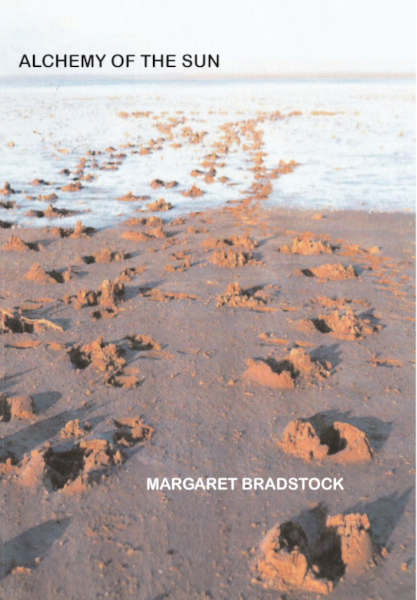
Alchemy of the Sun by Margaret Bradstock, Puncher & Wattmann 2024, was launched by Marcelle Freiman at the Friend in Hand Hotel in Glebe, Sunday 19 May 2024
In Margaret Bradstock’s ninth book of poetry Alchemy of the Sun one notices at once the ways in which its this volume’s thematic threads intersect, compound, and grow as an overlay or web throughout the thoughtfully arranged four sections. These sections – Deserts of the mind, Turning back time, Warming, melting, dying, and Going viral – include poems which, read sequentially, make connections beyond the wholeness of each individual poem, and then beyond the volume’s parts to its entirety.
The overall impact of reading Bradstock’s deft, mature work is of a poetic finesse and clarity in poems engaging with the overriding importance of time – as different manifestations of time – and of place and exploration. Exploration here might be historical – about actual explorers – but it’s also about a continuing curiosity of mind, imagination and creativity. Poetry becomes an engagement with change such as in travel, or the griefs of watching our planet’s human-imposed changes. There are poems of darkness which, through their language, imagery and details, lift into a space, or place, of light. Yet this poetry is firmly grounded: no matter how far the poems range in their ideas, so often they will bring the reader back into the familiar embodied-ness of experience – swimming in the ocean, walking, making sandy tracks at tidelines, the love of the coastal areas the poet lives in, as well as the physicality of deserts, rocks, animals, oceans, specific places.
In the first section, ‘Deserts of the mind’ we meet the nineteenth-century explorers from the poet’s research into their journals and writings – and what exploration meant historically, for Australia. Exploration, then, is not only ‘where they went’ or attempted to go, but a deeper look into their ventures – in hindsight, and with sharp observation and critique. Here are the well-known European explorers, their aims of mapping what they perceived as ‘empty land’, of placing themselves, their names, onto country and into history. The poems capture (and undermine) how these men saw themselves – their ideas about their own ‘heroism’ – but it also imagines and infers how it really was, experientially – from their language and through reading between the lines of their journals and letters. One example of how the irony does its work so effectively is in ‘from The Explorers’ Tree’, the section on William Wills:
And so we come to our explorers’ tree
the “dig” tree left by Brahe, a blaze on the trunk
a small supply of food, and the pleasing information
………of their departure. What were they thinking of?
Encouraged by the sound of crows ahead,
………………the sight and smell of smoke, we start for
the blacks’ camp, thinking to live with them
learn their ways and manners, but they’ve moved on.
Reduced to starvation now on nardoo cake,
……..by no means unpleasant, but for the weakness felt,
I sense the darkness tumbling in… the silence of letting go.Near daybreak, King sees a moon in the east, a haze………
…………….of light stretching up from it, declares it to be
quite as large as our own moon, and not dim at the edges.
I am so weak that any attempt to get a sight of it
was out of the question; but I think it must have been
……..……..……..Venus in the zodiacal light….Nardoo is no fit food for white men.
But there is more than ironic critique going on here: it’s the revelation to the reader of just how questionable the perceptions of these explorers were; the wild conditioning of colonial thought. These are the ‘deserts of the mind’ – the section’s title, taken from the last line of the collection’s epigraph poem, an ekphrastic poem by Bradstock titled ‘Temptation of St Anthony’ responding to Sidney Nolan’s painting of St Anthony’s ‘mind’ – his visions – in the desert.
This idea of ‘deserts of the mind’ characterises the minds of particular explorers in these poems – but it also extends beyond them, to another side of the idea: the emptied out spaces from which creativity is born, if not by these male explorers, then by creative artists – other poets, painters, sculptors, and women – as we see in poems such as ‘After Brett Whiteley, Fellow Countryman: Gibson and Compass’, and the ekphrastic poems on Julia Featherstone’s photographic artworks, ‘After Julia Featherstone, Gibson’s Compass video stills, 2010-2014’ and ‘After Julia Featherston, Alchemy of the Sun, video stills, 2014’, the title of the latter cueing an overt dialogue between poet and artist. When I write ‘we can see’, this is exactly the way to describe the language of these poems – their capacity to elicit visual experience. The female artist photographer and the poet, explorers both, casting their gaze onto those desert places appropriated by the entitled agendas of male explorers, vividly speaking back to them, as in ‘After Julia Featherstone, Alchemy of the Sun, video stills, 2014. Great Sandy Desert’:
Here, elements of nature transform
…………………………….the desert ground, energy
and mass of winds shake vegetation,
…………………………….push clouds across the sky.
Nothing stays still.
…………………………….As wind shapes the spinifex,
opposing forces – fire/water, earth/air
light/shadow – in multiple frames
………………………………………sculpt the desert.“Private Property”, “No Entry” signs appear,
……………………….dunes and plains crisscrossed
with wires, resonators, detectors.
…..Fracking ports and pipelines now endorsed,
gas will be extracted, burned
……………………….for energy, transmuting metals
into buildings, more machines. Mist
from explosions lies across country,
………………………………………an alchemy of loss.
Exploration does not stop with historical expeditions; rather, it is the underpinning of a poet’s observations of everything. In the poem ‘Peeling off the skin’, where the poet’s act of observation – viewing sculptures by Antony Gormley at Lake Ballard in WA – perception itself becomes an act of exploration:
You weave among standing statues
………………………crunch of salt crystals underfoot
like snow, your footprints crisscrossing
trails of early visitors, a tracery
…………………………………..of interconnected lines.
By mid-morning, the sculptures
……………………………dissolve in mirage, sky flares,
the gaze of a circling hawk.
Desert explorers might have dreamed
………………………………………….this silent infinity.
The second section of Alchemy of the Sun titled ‘Turning back time’ thematically focuses towards personal memory, relationships, and other experiences in poems where descriptive detail and imagery renders time past as vividly present – a re-living of things in which, behind description, lies barely-stated, but compelling, emotion. Here, remembering being ten years old in the poem ‘The bike with no brakes’:
The boy is there again, faun-like
………………down in the reeds by the river,
just watching, smoking languidly
cigarette held to his lips
as a shadow falls across the afternoon
…………..and the mountain range draws in.
Words gather, heavy as fish,
……………………the river’s ripples no longer
a pillow for her head.
Throughout this section, time expands, as in the poem ‘Valley of the Cycads’, where time broadens and deepens to geological time, or in ‘Kata Tjuta’ where it both expands to deepest ancient time, and then refracts to present perception of the smallest detail:
Standing in the Valley of the Winds
…………..just before sunset, we gaze and gaze
humbled by soaring monoliths that glow,
…….change colour with a chameleon landscape.
Overwhelmed, the younger boy
lies face down on the boardwalk
…………………………………staring through cracks,
watches in wonder the forward march
of a trail of desert ants.
In these poems, time is memory, time is tidal; time also means grief at its passing and what it does to us and to people we might have been close to: in ‘Somebody that I used to know’ ‘The wall-clock measures time/ in slow-moving blocks, as though holding it/ to ransom’, and in ‘Bloom’, time’s passing is dark, but in the language of the poetry, also beautiful:
The years folding around her
…………..bring winter wars, where sound
is frozen, the tell-tale creak
……………..of tree limbs, glimmers of ice
in a bare landscape.
Each death is your own death,
…………………..each tally yours to come,
its shadow dogs you
………………..like greyhounds of the hunt.
In the book’s third section titled ‘Warming, melting, dying’ we read poems of oceans, of travel – this time to Antarctica, and of climate change, warming, marine pollution. It’s here that we meet the ‘alchemical sun’ of the book’s title. While these poems link to time that is becoming depressingly hastened, the poetry’s penetrating language – its life – arrows the message home, alchemy being the process of both darkness and the light of creativity; poetry’s language encompassing the vastness of destruction and change too large to apprehend under an alchemical, indifferent sun. In ‘Sea Fog’:
Black as carbon, the molecules
…………………………..drift slowly down the coast
stretched out from the breakwater
………………………………….beyond lines of sand
like a final curtain.The sun didn’t fall from the sky
………………………………..sensing an apocalypse
but shone down as always
…………………………….on celadon green water.
Swimmers swam on, caught between breaths
diving past memory’s shoals
…………………………………the mist impenetrable
fish absent, inflatable plastic unicorns
riding the waves.
And in the poem ‘Arctic Tern’ we read of the melting glaciers of the Antarctic Peninsula, habitat of the soaring Terns:
The waves are rising, great floating chunks
…………of ice, growlers, breaking off the shelf
……………………………………………..like thunder,everything warming, melting, dying.
In this section, language encompasses the unbearable. In ‘Woolemi National Park’, dated December 2019:
Black branches
…………form melted ribbons, thin
frond-like leaves
are burnt-out filaments,
…………………….embers whirling like fireflies.
Smoke plumes the hillsides
verticals of rusted red and black
……………………………..the graph of loss.
Then later in the poem, as its conclusion:
Tonight the city’s
alight with fireworks, burns out
………………….all knowledge and regret.
Ice tinkles in celebratory glasses.
……..Amnesia deforests the past, the light fall
of leaves. Soon you will forget
…………………………………..there were parklands.
This is poetry that places responsibility into the everyday-ness of our lives – not only in this poem, but others too – and often, it’s their endings that cut through.
‘Going viral’, the volume’s fourth section, engages with life under Covid lockdown, but it also extends well beyond that to include poems on wars that have currency at this time, and their effects on populations beyond our borders – wars which are, and should be, ours too in terms of our humanity. At the end of this section the poetry focuses in once more, this time to close family, the volume ending with two stunning poems of the intense humanity of close, intergenerational ties.
In Alchemy of the Sun Margaret Bradstock has produced poetry that moves and informs readers through its clarity of mind and poetic finesse. It is the work of a poet writing at the peak of an impressive and sustained career.
A significant voice in Australian poetry: Louise Wakeling on Margaret Bradstock’s new poetry collection ‘Alchemy of the Sun
Margaret Bradstock: 3 Poems
P76 Issue 9. Margaret Bradstock – ‘The Homecoming’
– Marcelle Freiman

Marcelle Freiman is a poet and researcher. She has published three volumes of poetry, the most recent Spirit Level with Puncher & Wattmann in 2021. Her poetry has appeared in anthologies and literary journals, including Antipodes, Australian Poetry Journal, Axon, Cordite Poetry Review, Mascara Literary Review, Meniscus, Meanjin, Transnational Literatures, Southerly, StylusLit and Westerly. Her current poetry project is a verse-memoir of growing up as a white child and young adult in apartheid South Africa, and her own family’s history.
.
Alchemy of the Sun by Margaret Bradstock is available from https://puncherandwattmann.com/product/alchemy-of-the-sun/

 Rochford Street Review