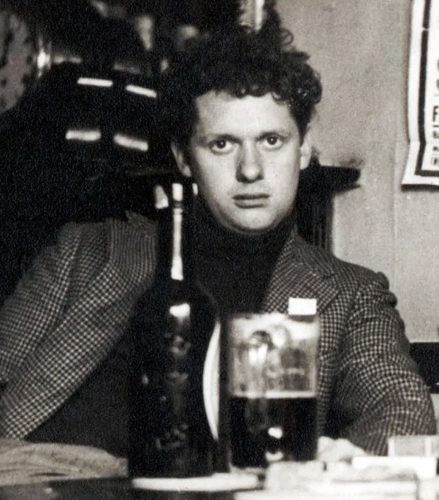
Dylan Thomas was born 110 years ago. When he died in 1953 he was recognised in the English speaking world as one of the great modern poets.
I fell in love with his writing as a teenager. Like Thomas, I was born in Wales. I was born the year he died. In my youth I felt a deep connection with him on many levels, including, a shared Celtic blackness and a liking for grog. In my very small library I have a copy of Deaths and Entrances, two early editions of Collected Poems 1934 – 1952, the definitive The Poems of Dylan Thomas (with a CD of Thomas reading some of his own work), Under Milk Wood, Dylan Thomas in America and Fitzgibbon’s The Life of Dylan Thomas. I confess to having named my daughter Caitlin after his wife.
I can still recount, in my best mock Welsh accent, random lines of poetry. “Now as I was young and easy under apple boughs”.
I recently reread his Collected Poems 1934 – 1952 and was left underwhelmed. Was my mature and 30 years sober 70-year old self a better judge of quality than my teenage self? Or was I just jaded and overly familiar with those few favourite poems?
This collection of 89 poems (selected by the author just before his death, and supplemented by a verse prologue) is how most readers know his work. It really is just a selection of his completed and published verse. It should be called his “Selected Poems”, for it omits 80 or so poems which are collected in the later The Poems of Dylan Thomas. This definitive collection runs to 163 poems, 2 unfinished poems and 26 poems from his teens not previously seen.
Cyril Connolly, perhaps damning with praise, wrote: “At his best he is unique…”
Philip Toynbee said: “Thomas is the greatest living poet in the English language…”
Seamus Heaney wrote: “Thomas meant much to me and my generation, he is still singing in his chains like the sea…”
The reputation of Dylan Thomas rests on a small body of work resulting from his untimely death age 39; but does that does point to the quality of the writing? Plenty of poetic reputations rest on small bodies of work. Robert Lowell’s enormous reputation rests a small body of work, ignoring the 300 plus sonnets he published in the 1970s in Notebook. Elizabeth Bishop only published 120 poems and is recognised as a great American writer. Sylvia Plath has a dedicated following based largely on the poems in the collection Ariel, ignoring most of the rest of her small body of work.
The Poems of Dylan Thomas begins with more than 100 short poems which, to me, are not identifiable as his. They have the early 20th centuries pre-occupation with faith, death and love. Most of these poems could have been written by any competent poet of the time. One exception is ‘The gossipers’; here is the incisive observer of real life creating a poem of quality. I think it is this link to the real world, so evident in Under Milk Wood, which captures my attention and interest. It is precisely this which is lacking in much of these earlier poems. Yes there is a real world, lyrically described, but populated by symbolic rather than real figures. The Poet is there, but he is not Thomas, but some construct of Thomas’s mind.
It is useful to compare Thomas with his near contemporaries. Both Thomas and W B Yeats wrote poems dealing with the Leda myth. Thomas was almost certainly aware of the W B Yeats poem ‘Leda and the Swan’ published in 1924 when he wrote ‘The morning, space for Leda’ in 1931. It would be amazing if he did not. Leda’s rape by Zeus in the guise of a swan is a myth recurring in many forms of art. Thomas revisited this theme in two later poems Request to Leda and in the conclusion to A Winters Tale.
How does Thomas stand up against Yeats?
LEDA AND THE SWAN
By William Butler Yeats
A sudden blow: the great wings beating still
Above the staggering girl, her thighs caressed
By the dark webs, her nape caught in his bill,
He holds her helpless breast upon his breast.How can those terrified vague fingers push
The feathered glory from her loosening thighs?
And how can body, laid in that white rush,
But feel the strange heart beating where it lies?A shudder in the loins engenders there
The broken wall, the burning roof and tower
And Agamemnon dead.
Being so caught up,
So mastered by the brute blood of the air,
Did she put on his knowledge with his power
Before the indifferent beak could let her drop?THE MORNING, SPACE FOR LEDA
By Dylan Thomas
…Between the rising and the falling
Spring may be green –
Under her cloth of trees no sorrow,
Under the grassy dress no limbs –
And winter follows like an echo
The summer voice so warm from fruit
That cluster round her shoulders’
And hid her uncovered breast.
The morning, too, is time for love,
When Leda, on toe of down,
Dances a measure with the swan
Who holds her clasped inside his strong, white wing;
And darkness, hand in hand with light,
Is blind with tears too frail to taste.
The Yeats is a great poem on so many levels. He captures the rape of Leda by Zeus in the guise of a swan, with disciplined incisive writing. He captures the carnality of the bestial rape of the virgin; “laid in that white rush….a shudder in the loins engenders there the broken wall.”
What Dylan Thomas attempts is slightly more ambitious; more than just a recounting of the tale in verse. He posits a man in or at the bed on a woman who may be his lover. With the morning’s passion rising the poem resolves into congress of sorts, coy even for the time, where the Leda myth is entwined. I find it confusing to equate the morning’s passionate embrace with the mythic rape of Leda.
I have always loved the audacity of the poetry of Dylan Thomas. “The heron priested shore…” and ”…Never until the mankind making/Bird beast and flower/ Fathering and all humbling darkness/ Tells with silence the last light breaks/and the still hour/is come of the sea tumbling in harness…”
But there is little to startle in the early poems. It is not till ‘Poem in October’ we get the identifiable voice of this Welsh poet.
To hear Thomas read his own work is to hear the dominance of BBC English cancelling any Welsh accent as was required and expected at the time. The landscape of Wales depicted in the later poems is rural idyllic populated by birds, especially water birds, along the coast at Laugharne; not much of the gritty reality of the South Wales I was born to in Cardiff with its docks and steel works.
Much is made of the sing-song Welsh voice. But where is it? And how does it compare to the English Gerard Manly Hopkins? There is so much more going on in, for example;
THE WINDHOVER:
By Gerard Manly Hopkins
I caught the morning morning’s minion, king-
Dom of daylight’s dauphin, dapple-dawn-drawn
Falcon, in his riding
Of the rolling level underneath his steady air, and striding
High there, how he rung upon the rein of a wimpling wing
In his ecstasy!….
When Thomas writes in the same mode the result is derivative at best.
PROLOGUE
….seaward the salmon, sucked sun slips….
….reverent rook
Coo rooing the wood’s praise
Who moons….
When I had finished reading The Poems of Dylan Thomas I was hard pressed to understand much of his life. There is nothing of the boozy carnality which became his later reality. There is the Poet dealing with the great issues without the nitty-gritty. There is nothing of his domestic life, his wife, his children all born during the period during which the poems were written. There is very little of the war which raged around him as he moved frequently between London and coastal Wales during the early 1940s. Three poems only. Yes there is the loss of family members, the fodder of most poets’ output: but although ‘Elegy’ (incidentally, unfinished) is a poem dealing with his father’s death it tells us more about the Poet than the poet. Is this just my, and the modern, preoccupation with lived reality? If so, maybe his time has passed for me.
IN MY CRAFT OR SULLEN ART
By Dylan Thomas
In my craft or sullen art
Exercised in the still night
When only the moon rages
And lovers lie abed
With their griefs in their arm,
I labour by singing light
Not for ambition or bread
Or the strut and trade of charms
On the ivory stages
But for the common wages
Of their most secret heartNot for the proud man apart
From the raging moon I write
On these spindrift pages
Nor for the towering dead
With their nightingales and psalms
But for the lovers, their arms
Round the grief of the ages,
Who pay no praise or wages
Nor need my craft or art.
I find this ars poetica pretentious rather than authentic.
Prologue, especially written for Collected Poems 1934-1952, is an attempt at introducing the reader to his work. Its content is mainly linguistic pyrotechnics of no great substance. I was only slightly more interested to discover its elaborate rhyming scheme where the first line in the first stanza rhymes with the last line of the second stanza, the second line of the first stanza rhymes with the second last line of the second stanza and continuing so the first stanza ends with farms to rhyme with the first line of the second stanza arms.
I am left believing Thomas wrote a few good poems (think ‘Fern Hill’, ‘Poem on his birthday’, ‘Poem in October, ‘The Conversation of prayer’ and ‘After the funeral’) and lots of great lines (think “And death shall have no dominion” and “Do not go gentle into that good night/Rage, rage against the dying of the light.”) Perhaps he would have created a more substantial body of work had he lived to combine ‘In Country Sleep’, ‘Over St Johns Hill’, ‘In the White Giant’s Thigh’ and the unfinished ‘In Country Heaven’ into one great poem. But I’m not sure. He could never approach ‘The Wasteland’. Give me Heaney any day, and Yeats and Lowell and Eliot.
– Michael Witts July 2024.
——————
 Michael Witts is a Welsh born Australian poet. He has published four collections: Sirens, South, Dumb Music and 28 Sonnets. He won 2nd prize in the 2023 Proverse International Poetry Prize ( single poem ) and is a finalist in the 2023 Proverse Prize for his manuscript Some Dualities.
.
.
.

 Rochford Street Review