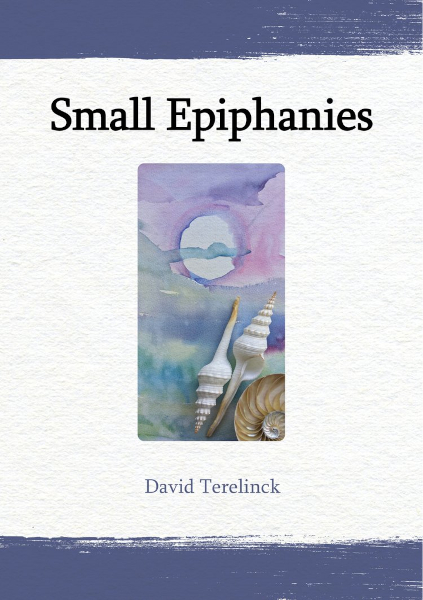
Small Epiphanies by David Terelinck, Calanthe Press 2024.
David Terelinck’s first book of poetry, Small Epiphanies, is exactly what the title promises to be: a collection of poems which observes and records daily life. These poems show readers that the examination of the daily is where meaning lies. Within the lines and images are themes of the influence of religion, God (which, in these poems, is not to be conflated with organised religion), nature, and people, with the general conclusion that in the interactions of all of the above, we humans discover more about our existence.
The strength of these poems lies in the clear voice which is created by the deliberate use of verbs: “A sloop mast groans / as a swelling breeze gossips / with the canvas…”. These lines from near the beginning of the title poem, which is also the first poem in the book, create a contemplative tone for the remainder of the book. The last lines of the poem are stunning:
…………..This place
where small epiphanies are found
…in the creak of a midnight hawser,
a quicksilver moonbridge that links
…seawall to shore. And it’s enough
……to make you almost
………………………(almost)
……believe a man
…………could walk on water.
Here is the general tension of the book – a speaker who wants to believe in something more than the physical world, but who doesn’t quite let himself go.
Terelinck’s ability to capture imagery and also to set it on the page is worth noting. It’s what keeps the arch between the poems creating a cohesive book. At times, the ontological uncertainty of the speakers’ own desires becomes a bit didactic,
……..There is no fault-finding here.
………………..No sins that need
forgiveness. No crucifix to focus prayer,
…………..just lichen-crusted twigs (“A More Earthy God”, 26-29)
but it is also plaintive, authentically human, and thus understandable. How to reconcile all of the systemic messages that humans receive in life with the organic natural world which surrounds them? From this persistent questioning, small epiphanies indeed occur:
….in this place of ancient spirit
you can pluck the body of Christ
……from any tree
…………and it will always taste
…………of native plum and mango.– ‘A More Earthy God’
Ultimately, the tone that moves throughout this book is one of loss, great loss, and then small gains, creating movement and initiating a kind of reckoning. It is an approach to poetry (and thus to living) that readers might recognise from the American poet Mary Oliver’s work, which offers a model for epiphany poetry and illustrates the tension between, self, nature, word, world, and the spirit. Indeed, Terelinck has a poem towards the end of the book, “Evidence,” dedicated to Mary Oliver, which is a moving tribute to her poetic legacy:
A world away, yet I still see
the trees & empty orchard branches
that she wordsmithed.
I have felt the cool
of her shadow
as we knelt together
to observe the smallest
nuance of life.
Like Oliver’s poems, Terelinck’s poems ask questions. They probe. And they mourn. But they also move along and reveal; somehow, they keep going, creating surprising optimism and bringing the reader along.
– Kimberly K. Williams
——————–
 Kimberly K. Williams (she/her) is a poet from Detroit who now lives in Queensland, Australia. She has three books of poetry and one book of translations of the Mexican Poet, Benjamin Valdivia. Her second book of poetry, Sometimes a Woman (Recent Work Press 2021), won the 2022 WILLA Literary Award for Poetry. Her third book of poetry, Still Lives (Gazebo Books 2022), won a Canberra Critics Award in 2023. She is a lecturer at Central Queensland University.
.
Small Epiphanies by David Terelinck is available from https://www.calanthepress.com.au/books-and-authors/david-terelinck

 Rochford Street Review