A Precarious Safety
In Sydney the friend of anyone shares her kitchen.
Two men fleeing the thick stench of war
find a short-time sanctuary in her small room.
During the day while she’s at work
the men take turns
sleeping in the bed of the good woman.
The little window of her second storey unit
surprises them with a northern sun.
At night while she sleeps
they keep watch and study English.
The past has proved impossible
and, baffled by the future,
they start with the verb to be,
the present imperative, considering
how a family that should have been
has become a modal auxiliary.
**…..**
Caring
There’s not a lot of choice
for either of them.
It’s love in action
looking after him,
thinking for them both.
It’s just what she does
on top of everything
and underneath,
invisible.
**…..**
Mary
Mary was standing in the doorway
in her dressing gown
breathing in a bit of midnight fresh
when she saw the man
on the path
with a stocking on his head.
What got into her she couldn’t say
but not knowing what else to do
she called out would you like a cup of tea
and he said yes
so she made them both tea and toast to calm down.
They sat at the table and she told him
I don’t like the stocking.
He took it right off
put it in the bin and smiled
not much more than a boy she thought
and he said don’t tell the cops will you
and she said no.
After
it played on her mind
making friends in the middle of the night
she wasn’t used to it.
She told her daughter.
Mum, you’re mad
we’re going to the police
no Mary said
yes we are!
so they did
and question, question, nothing but questions
although Mary couldn’t or wouldn’t.
It’s a bit far-fetched the policeman told the daughter
take her home he said.
Mum you’ll be the death of me
said the daughter
and got the locks changed.
Mary didn’t know what to believe after all
until it occurred to her about the stocking.
She went and looked
and there it was.
She got it out of the bin
and washed it nicely.
When it was dry
she put it in the drawer by her bed.
Later she got up and put the stocking
on her head
to see what it was like.
**…..**
Rice
At the bus stop outside the supermarket
a man and I carry the same sort of rice.
Pakistani it is, with the coloured writing
on top of the bags.
On special, I say, and we smile at our rice
because it had been nicely reduced,
and we feel cosy sharing that
late afternoon sun, waiting for no. 44
and the man starts telling me a slow story
about walking from Bhutan:
twenty-seven of us, he says,
who are not wanted any more,
have been told to get away or be killed.
I wonder
is that fair warning? Stay
so being killed will be your own fault.
I don’t know who is doing the killing.
I don’t ask. I look at my feet.
Killers come to do their work and often
there is no time to ask exactly who they are.
Now the man tells me they walk together
out of Bhutan and into India
but more killers come
and say move off from here
or you will be killed because,
these people do explain,
there is no food
for stray wanderers from Bhutan.
The man and his group have no food,
they begin to starve but keep walking
slowly, through India
where they can be killed
by people doing their killing work.
The man says they walk to Nepal
and here they are given rice water,
beautiful white water he says,
that rice has been cooked in,
and they lie down now
with their stomachs happy with rice water.
The man tells me that the next day
they wanted more than rice water,
they wanted the rice.
They were given rice
and they lay down with their stomachs happy with rice.
We look at our Pakistani rice, sagging
a little in the top of our shopping bags.
You know what will happen after this,
he is now telling me.
The next day we will want vegetables
with rice and then meat and sugar,
we will start wanting sugar and
somewhere to sleep, he tells me,
on the seat waiting for the bus,
our only company a silent boy
and two wasps hovering.
**…..**
TRACED
It might be a moth, wing embedded in rock,
an unnamed creature dying in wet sand
before the great transformation.
How to tell what will leave a mark,
which struggle will be recorded?
Aeons of fractured water fling and rattle
sun-warmed stones, grey and golden
wave-smoothed, heaped beside the sea.
I reach for a token to walk with me,
comfort my hand, form a bond
between surfaces, mine and rock,
skin and weight,
oxide-etched
trace of once a moth
and my desire to possess is stoked.
I want to own this offering
set it on a ledge above my kitchen sink
draw from a soft compressible insect
rock-solid endurance.
_________________________
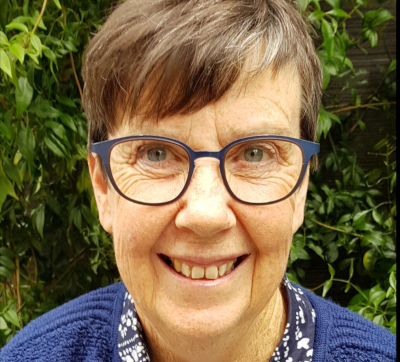
Helen Swain lives and works in lutrawita/Tasmania on the foothills of kunanyi/Mt Wellington. Helen has been a performer in Theatre in Education, worked in Community Theatre, was a High School English teacher and for many years taught English as Another Language with new Migrant and Refugee arrivals. She is currently a Poet in Residence with Inscape Arts working in the public health sector. Celebrating Home (Five Islands Press) is her third book of poetry.

 Rochford Street Review