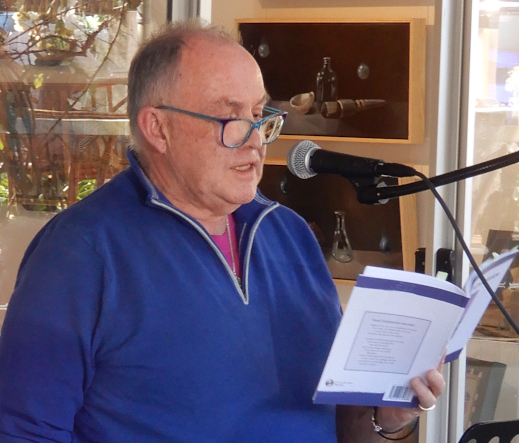
Small Epiphanies, by David Terelinck, Calanthe Press 2024, was launched by Jane Frank at Under the Greenwood Tree Bookshop and Art Gallery, Tamborine Mountain on 25 August 2024.
Good afternoon, everyone. It’s wonderful to see so many of David’s family, friends —especially the ones who have travelled up from Sydney!—members of the Calanthe Press community and other poetry lovers here to celebrate the bringing into the world of David Terelinck’s debut book of poems.
It’s a great honour to be asked by David to launch Small Epiphanies and something I’ve been looking forward to. I met David at my own book launch in this very spot just over 12 months ago and it’s been a pleasure to get to know him through other events and via social media since. David and I got together to talk about his collection a couple of weeks ago and I enjoyed hearing the back story to many poems that day over a glass of prosecco! The thing that strikes me most is David’s passion for poetry and the way poetry permeates his whole life.
Anyone who intersects with David on social media is fortunate enough to enjoy his selection of a poem a day —whether from a collection he is reading or a poem that particularly speaks about his lived experience that day. These poems move us and add to each of our lives in important ways. David is very giving in this way.
I’ve been savouring Small Epiphanies over the last few weeks. Savouring is the perfect word because these poems are intricately layered with sensual detail and richly textured. Gustave Flaubert said that “talent is a long patience, and originally an effort of will and intense observation.” David emphasises that in his Foreword when he tells us that small epiphanies bring “insights that exist in the taken-for-granted minutiae of life. Sometimes these moments of clarity can be transformative and shape our life. Sometimes a gentle nudge to awareness.”

When we were talking, David told me that his inspiration for writing poems is often a single word, or a sound, or a smell or an overheard snippet of conversation – a tiny thing. A wonderful example of this is ‘Clingstone’ that begins, “How softly you hold summer / in your palms, slowly adding each / golden globe to the fruit bowl” — the sight of peaches bringing a vivid memory of youth and Ella Fitzgerald’s crooning rushing into a poem. There is a lot of fruit in the book! Pomegranates, oranges, lemons and of course forbidden fruit! Also flowers! David is drawn to fruit and flowers for their richness, colour and the whole idea of bounty.
But I think it is also because they belong, once picked, to the domestic realm and so many of David’s poems are about appreciation of the intimacy of work and domestic comforts. I think it might be (at 13 lines) the shortest poem in the book but I love the poem ‘Garnish’ which I thought I would read out:
Garnish
Falling leaves drift
from the radio.
I watch her ladle late autumn
into a soup bowl.
A bright orange sun sets
inside her best white porcelain.
No cracked pepper.
No sour cream.
No chives.
She angles the kitchen louvres
just enough
to garnish with a slice
of the full harvest moon.
So, there is abundant domestic detail, whether it’s in the heavily starched Pentecostal white sheets at the Lodge in ‘Folding Linen at the Lodge’ or thinking of his grandmother as he salts the porridge in ‘Doula’.
‘Doula’ begins so strikingly with:
We are nothing without our dead
……………………without the hearsay
and heresy of their convictions.
Their souls remain attached to the vacant sunshine
……………………of every winter morning.
There are a number of poems about grief in the collection and it’s a theme that David returns to again and again. This is, of course, integrally connected to David’s career experiences as a nurse, often working in palliative care. Poems like ‘A Signature Gift’—a poem about organ donation and donation of the eye corneas in particular —record painful experiences of loss and the haunting final lines of that poem have lingered —
Now pressing firmly to calm a trembling hand, she commits her
signature, knowing for the rest of her life she’ll resist the urge to look
twice at each stranger who crosses her path.
Another standout poem in the collection is ‘Blue Mountains Elegy’ – a meditative lyric poem lamenting a family member’s death that begins—
You drive along a sweep of coastal plain
where the melaleuca is bonsaied
by ocean winds and salt. It’s easyto empathise with their distortion
(she was a force to be weathered too)
each turning in upon themselves.
There are a number of poems set in and around Sydney like this one but also elsewhere in the world because travel is a passion of David’s and his late husband Rob’s. Rob would be especially proud of you today.
Mary Oliver’s poetry is an inspiration to David —as well as David Brooks, Jane Kenyon and Robert Frost—and ‘Evidence’ is a very affecting poem dedicated to Mary Oliver that begins:
A world away, yet I still see
the trees & empty orchard branches
That she wordsmithed.
I can feel the influence of Oliver intensely in many of these poems — especially the ones about the natural world which is what David enjoys experiencing so much in his travels. Like in Oliver’s poetry, and to quote Maxine Kumin: David’s poetry also “stands comfortably on the margins of things, on the line between earth and sky.”
Although this is David’s debut poetry collection, he has been writing for a long time, beginning with an interest in tanka 20 years ago. A tanka, of course, is a 31-syllable poem traditionally written in a single unbroken line. There are a number of tanka poems in this collection including ‘Third Altar Boy from the Right’, and ‘Lustre and Shadow’, David’s poem about Wendy Whiteley’s Secret Garden near Sydney Harbour founded in memory of Australian artist Brett Whitely and dedicated to them both. ‘Nocturne by an Unnamed Pond’ uses tanka alternately with stanzas of prose poetry which is so effective in the way it works with white space on the page. David has been writing free verse poetry for approximately seven years.

While this book is primarily focused on small epiphanies, the poems also take on the role of social advocacy and address significant issues like the war in Gaza, religion and race. The poem ‘Strange Fruit’ is about the death of Black Americans, and I particularly like the lines:
I push away my chicken
no appetite for cruel
……………white flesh
history’s pale foot
on the underbelly of black.
Another issue David addresses is the plight of racehorses – an issue he feels strongly about. In ‘Abdication’, dedicated to the fallen, he writes about the “lethal injections and bolt guns to the brain.”
I’m particularly drawn to the ekphrastic poems in this book. ‘A Saint in Cobalt and Ochre,’ after Vermeer, stays anchored in the image, in the life of the milkmaid in the painting from 1657-8, imagining her experience, centred in her own world. A world, the poem reads:
where pouring milk
becomes devotion.
A world where holding
the belly of a jug
(ever so gently)
makes us quietly weep
for the faith we’ve lost.
I’d like to read one of David’s poems now that ties together so many of the motifs and ideas that are central to this collection—
Kippers & Lace Curtains
Ice-chip stars are pooling into dawn
when she sits on a crate on the dock,
spreads the net across her aproned lap.
Fingers, stagnant at first in autumn’s chill,
spider across the net by instinct,
finding and fixing each rent and tear.
Tatting ocean lace reminds her
of the once-white kitchen curtains,
the only thing her mother gave her,
apart from that dubious
first-night wedding advice.
She makes mental inventory to darn
a dozen pair of socks, sew on those missing
buttons, finish knitting his jumper
abandoned months ago.Brackish domestic thoughts are lost
as the breeze ferries the chug of diesel engines.
Beyond the bluestone breakwall,
the sky has lightened. The fleet sits low,
pursued by a persistent interrogation
of gulls and terns.She helps him unload his catch.
For twelve hours they know nothing but
the discomfort of herrings. She splits
and butterflies the silver darlings,
returns their gutted innards to the sea.
Her skin puckers and shrivels, a slipped disc
berates; the usual rewards for bending
and dipping tinselled ocean flesh
into endless barrels of brine.Now past midnight, sleep is far less plentiful
than kippers. She’s been a dutiful wife tonight.
He’s immune to perfume born of vinegar,
the funk of smouldering woodchips.
He snores deeply as her mortar & pestle hip
allows time enough for her to think
about those torn lace curtains
that will never be mended.
You’ll notice the wonderful assonance, alliteration and chiming throughout that poem, giving it such musicality.
Of course, David painted the watercolour that appears on the front cover of the book which adds a very personal touch to the publication. He is multi-talented and his many awards in poetry competitions are listed in the acknowledgements section at the end.
To sum up—Congratulations, David! This collection speaks so much about you – your love of art and beauty, your care for family and friends, your love of adventure and travel, your attention to important causes, your love of the small, beautiful details that bring deeper understandings. This is an outstanding achievement, and it is my great pleasure now to launch this collection of poems – SMALL EPIPHANIES.
——————————
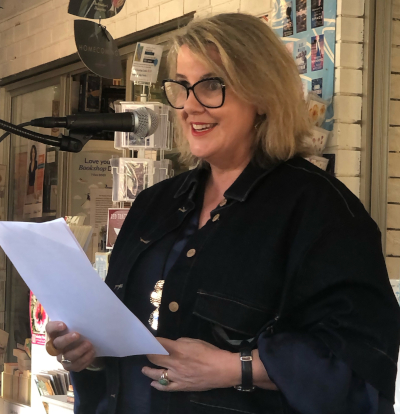 Brisbane poet Jane Frank’s debut collection of poetry is Ghosts Struggle to Swim, published by Calanthe Press in 2023 and she is author of two previous chapbooks. Her poetry has been widely published in Australia and internationally in publications including Westerly, Cordite, Meniscus, Antipodes, The Ekphrastic Review, Shearsman, Poetry Ireland Review and Takahe and has won prizes. In 2024, her poems have been shortlisted in the ACU Poetry Prize, the University of Canberra Health Poetry Prize and the Wigtown International Poetry Prize. She is Reviews Editor for StylusLit Literary Journal and teaches in Communication and Creative Industries at the University of the Sunshine Coast.
Small Epiphanies, by David Terelinck is available at www.calanthepress.com.au.

 Rochford Street Review