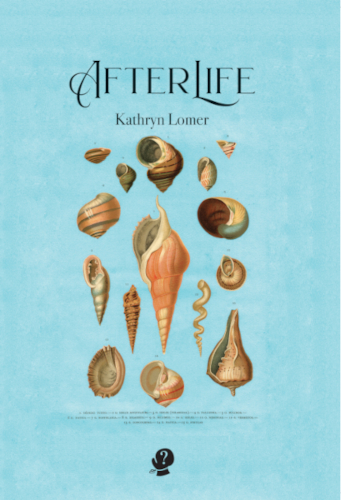
Afterlife by Kathryn Lomer, Puncher & Wattmann 2023, was launched by Adrienne Eberhard at The Hobart Bookshop on 13th September 2023
It is my very great pleasure to launch Kathryn Lomer’s latest collection, Afterlife. As many of you are aware, Kathryn is prolific and talented, writing across many genres other than poetry, including short fiction, young adult fiction and novels. Her work has been widely anthologized and awarded. This is her fourth collection of poetry; the first, Extraction of Arrows, won the Anne Elder Award and the second, Two Kinds of Silence, won the Kenneth Slessor Award, so it’s a very exciting occasion to be welcoming a new work of hers into the world.
I am going to use the cover to talk about the content of this collection, because I think it exemplifies the poems in so many ways. Four ways to be precise: through the pale blue background; through the title, itself, Afterlife; through the image of sea shells; and through the listing of their Latin names. The pale blue background is so evocative of the sea, on which the shells ‘float’, and the sea is everywhere in Kathryn’s poems, particularly the Derwent Estuary; the sky, which in some belief systems is the portal to an afterlife, also present everywhere in this poetry and the sense of light and space it provides; of air and breath, those vital sustaining elements and forces. In the poem, ‘Trick of Light’, the speaker asks:
What happens when you lose someone you love beyond all care?
Are they there beside you, inside you, or are you holding onto air?
We’ve all become, in one way or another, bondmaids and slaves;
the wants and woes of worldliness keep us bound beneath the waves.
But some days it seems almost possible to swim up and up
and climb out into the light.
The title, Afterlife, works in two ways. The first is as a literal afterlife, the kind many different cultures believe in, the life after death that is a kind of immortality. A number of poems in this collection explore this concept and our human need for reassurance that there will be a life after death. In ‘Afterlife’ and ‘The peach orchard of immortality’, artefacts from 3000 years ago are the focus of Kathryn’s gaze, and she describes them in detail, reminding us of their beauty, fragility, extraordinary age, their makers, and the culture of their times, questioning their purpose and associations:
You may have been pure symbol:
A jewel-like blue of undying light
From the sun, moon and stars . . .And that life-giving potion –
Faith, and love.– ‘Afterlife’
Earlier in this poem, Kathryn asks, “How has life not broken you”’, and here we start to see the other meaning of ‘Afterlife’. The poignancy of a 3000-year-old faience bowl remaining intact, when the speaker of many of these poems, has been broken and re-made by the vagaries, losses and great griefs of life. In this way, this afterlife is not the kind the pharaohs believed in, those rulers who “spent their reign/building tombs, preparing for the long hereafter,” the kind that might “stop us living the now” rather, it is a very different kind of afterlife, the sort that comes when a bomb is dropped and the reverberations are felt for miles around, again and again, physical, obvious, mental, emotional, all equally devastating. And it is here, I think, the power of Kathryn’s collection resides, in this version of the title with its implications of what is left behind after loss, grief, explosions, with their ripples, waves, quakes, impacts. How do we recover from these kinds of shocks? How do we become more than the sum of our past selves in the process? This makes me think of Chernobyl, and the aftermath of the radioactive spill – loss, decimation, horror, and the idea of a half-life, difficult things continuing forever, yet with enough time, streets have filled with green-growing forest, wild animals, a blossoming that seemed impossible. This is what we get in this collection. An exploration of loss, grief, longing, and their aftermath, the afterlife, a slow reassembling of pieces, the repositioning, new understanding, forgiveness, and a final position where we have become so much more than our past selves.
Loss is the obvious bomb here. Loss of love, the great-undo-er. Yet it is also the teacher. In ‘The river tells a story’, Kathryn writes: “Loss: it sounds like something small and smooth, a pebble say, to keep/in your pocket, a lozenge to hold on your tongue. It isn’t.” Here we get an echo of the fairy tale, the journey, the innocent protagonist stepping out into the big unknown, the wild world. In ‘Footpath of desire’, she writes,
We follow footpaths of desire,
feeling our way into the world,
into its complex dimensions.
We don’t leave a trail of breadcrumbs,
or torn-up notebooks or rice:
We have no plans to return.
what is the point of doing things twice?
And there’s the rub:
we want the right path, but there’s none.
Only a way forward. One step, another . . . .
[you] must simply trust that where you go
is where you need to go.
This has ‘Hansel and Gretel’ ovetones, with the innocent setting out into the world, where challenges abound and wild creatures lie in wait. It’s not about making it back but setting out. The poem ‘Beginnings and endings’ concludes with “but she’s glad to have begun.” Journeys, protagonists, adventures, dangers, mistakes, more mistakes . . . all the elements of fairytales are here in these poems, and the recognition that life is unpredictable and filled with difficulty. Yet, there’s also the recognition that while there is no going back and starting over, something wonderful is taking place as we suffer and suffer again. In the poem ‘This is what life does’, Kathryn lists all the ways in which life gives, and continues to give, in small ways, gifts that give us the world, if only we could see. Gratitude underscores this poem, a reminder that even in our worst moments there is always something to be grateful for, culminating in,
Life lets you breathe in the ocean air
and wake up your heart which has been
in a coma since its accident in love.
Life lets you know you are lucky. Lucky to be here. Lucky to be here still. Lucky.
Not brave, not clever, not even interesting,
but alive. Lucky to be alive.
I’ve just been lucky
………………………………..– This is what life does
Running through this collection, alongside the devastation and heartache, is a thread of understanding, a slow awakening, of learning that we are all learning, that this is all we can ever do. In the second poem of the collection, Kathryn writes about a life drawing class, arriving at the notion that, “Perhaps it was just our love’s allotted time/in the world’s unfolding’”(‘Drawing Life’). This is the afterlife, too, the understanding and growing and acceptance, the recognition that things are salvageable, that joy can be found anywhere and everywhere. In the poems Kathryn writes about the Derwent River, it is the bird life, the busy, endless, ceaseless movement of the birds that enables a mending to take place:
Soon, I’ll run back to the museum to look after things
Humans think important but every minute here helps.
This might be mere survival but it looks like joy.
And some other species, observing me, might think the same
………………………………..– Lunchbreak at the museum
The shells on the cover are the third element. This is a scientific image, an exquisite drawing of shells, revealing their colours and gradations, their shapes and textures, and their size in relation to each other. They are objects we might covet, like treasure or jewels. In ‘Vapour Trails’, one of the poems Kathryn writes about her home territory in the northwest of Tasmania, she describes the sky:
It’s as if a needle has taken thread from the spool of white
………cloud and is sewing up the blue, stringing clouds together
………………as we once threaded shells at Hawley Beach on strands of catgut.
Here are the shells of the cover. And again in the poem, ‘The before midnight scholar’,
First he attaches her toes,
smooth brown cowries in two rows
of descending size.
And later in this same poem, “He replaces her ears with abalone shells,/silvered and glinting in the full moon’s shine.” Anyone who knows Kathryn well, knows that she is a shell collector, a collector of all things natural and talismanic. They are accretions of calcium, slowly formed bit by bit. Sometimes they end up with barnacles attached, or broken bits. They reflect the impacts of life, just like us. But look closely at the cover image. Shells are what are left behind, the aftermath, the afterlife, once the creatures that have made them have moved on or died. They are exquisite forms with hollow centres, symbolic of the loss of love, of life. They are what is left, what lasts, but they reverberate with what has gone. And yet, the hollows at their centres fill with air, the breath of the sea. We hold shells up to our ears to hear the sea, to catch the whisper of something bigger than them, bigger than ourselves. And this is true of Kathryn’s poems. They provide us with images of great beauty – 3000-year-old bowls, geodes, shells, sculptures, places, waterbirds, and they shore up the past, the problems, the difficulties, the reverberations and detonations that are hope and love, but they move way beyond this. There is a distillation of everything Kathryn has learned in these poems and is still learning. This is not a ‘look at me and what I know’, it is a deeply-felt knowing, a hard-won knowledge about who we are, our time here, the things we inhabit this astonishing world with, the past and all its wonders, the here-and-now.
Beneath the shells on the cover are their Latin names, and this is the fourth element I want to discuss. Language, languages, communication, words, these are Kathryn’s deepest loves. She speaks French and Spanish, some Italian, is learning Greek and knows sign language. Kathryn is endlessly fascinated with language and how it works. Poem after poem in this collection, makes reference to language and communication, our successes and failures, and they play with the eroticism of language. ‘lingua franca’ is an exploration of tongues and their uses, most vitally, in speaking. Kathryn writes:
Have you seen them in butcher’s shops
And wondered how ours would look
Stretched out on a plateIt can howl like the screech owl
Loll like a mollusc
While writing about language, she is playing with language effortlessly, beguiling our ears and hearts. The reference to butchers’ shops makes me think of Harold Bloom’s kidney, and suddenly there is James Joyce pushing language to its limits, and Molly Bloom’s monologue about love. The following poem, ‘In Spanish’, is a love poem that connects physical love with learning a language: “All my life I’ve wanted love in another tongue,/one which gave back cadences and questions,/one which kissed with soft syllables.” And the poem arrives at a new discovery, not just about language but about love:
Spanish puts a question mark
at the beginning as well as the end,
bracketing everything in interrogatives,
preparing you for the end.
We exist between them:
The question is beautiful;
We don’t desire an answer.
And here, we have it, I think. The secret at the heart of this collection, whispered to us by the title, the shells, the Latin names, the colour blue. To exist between – between birth and its non-remembering and death and its not-knowing, this is what Kathryn reminds us of again and again, through the language the tongue makes possible, through the antics of waterbirds on the river, through the descriptions of the faience bowl, the geode, the GOMA man, through the marvellous tree and the trees after ee cummings, quicksand and music, through drawing and singing, through making love, making bread, doing yoga, the poems remind us that life is about living, that we need to live our grief and our fear, our love and our loss, the big bombs and the little bombs, and in living, we need no answers. In the final poem of the collection, Kathryn writes about women on a beach watching, honouring the dawn:
The day’s work has begun
Snakes shed skins from the mouth out;
These women shed from every cell,
Leaving behind an old self,
Bearing witness to a new beginning.
Where have they been all their lives?
But I want to finish, actually, with the first poem in the collection, ‘A Hummingbird in Italy’ because, of all the poems, I think this one exemplifies Kathryn’s poetry best. It is a long poem about love, travel, compatibility, escape, birds and animals, understanding and misunderstanding, and it is both troubling and hilarious, by turn. In it, we see Kathryn’s curiosity about the world, her acquisition of knowledge, her recognition of the beauty to be found in unexpected places, exploring love and loss and human nature with a kind of virtuosity, underpinned by humour. We see her wonderful capacity to ‘skewer’ the world, and to look at things slant on. And we see her focus on language and on love, which is, I think, ultimately, what this collection is about:
[Birds] hear infra-sounds of thunderstorms.
………..Intuition: our senses working overtime
but we never trust it. ‘It’s the lore of the jungle’, you say,…
………..Spelling it out in case I don’t get it.I try to tidy up my mind:
………..Hippocampus for mental maps, amygdala for fear,
cingulate gyrus for attention, thalamus . . .
………..I was never good at housekeeping.Oh, where is my hummingbird harbinger?
………..‘Friends, freedom and reflection’, you said, ‘It’s Epicurus.’
So many ‘f’s I thought. What’s that about?
………..Words I love: eros, Thanatos;….
………..Elephants never stop growing (like whales);
free to be as big as they can be.
………..My love for the world is like that . . .
I’m going to end with those lines. I think they perfectly sum-up the effect of the wonderful poems in this collection and Kathryn’s all-encompassing and deeply-moving vision of life, and love.
– Adrienne Eberhard
—————————————-
 Adrienne Eberhard is a writer and teacher. Her sixth collection of poems, is currently being translated into French by Catherine de Saint Phalle, and will be published in Paris in April 2025.
.
.
.
Afterlife by Kathryn Lomer is available from https://puncher and wattmann. com/ product/ afterlife/

 Rochford Street Review