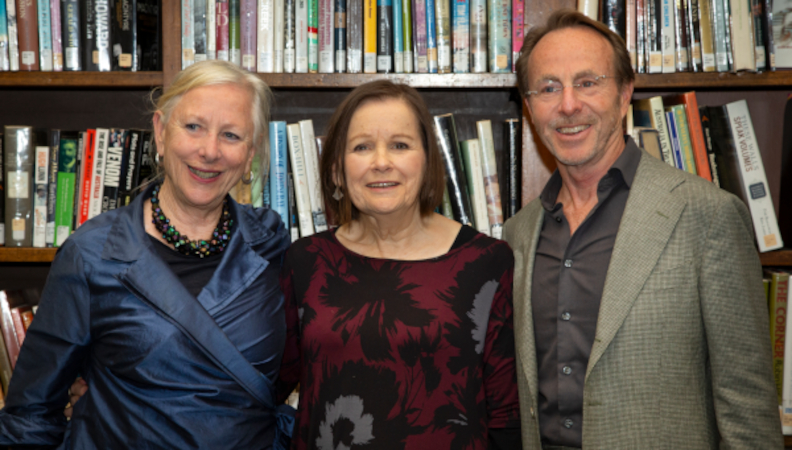
Anne Carson (left), Sue Lockwood and publisher Mark Tredinnick at the launch of The Flowering Dark
The Flowering Dark by Sue Lockwood, 5 Islands Press, 2024 was launched by Anne Carson at The Atheneum Library, Melbourne, on Saturday 31 August 2024.
Sue and I first met 25 years ago, and we have been talking and critiquing each other’s poetry ever since. I attended a creative writing class Sue was teaching. I’d given up trying to write, but in the very first session Sue gave me tips enabling me to break through my writing block and I’ve not stopped since. Not long after, she asked me to join “Io”, a local writing group of which she was a founding member, and we met for over a decade for writerly conviviality and keen critique. Since then, Sue and I have continued to talk poetics and appraise our poems together. It’s an absolute delight and privilege to be launching her debut collection The Flowering Dark witnessed by her colleagues, readers, friends, admirers and of course her loving family.
The Flowering Dark is a materially gorgeous book with a wonderfully evocative cover, and I congratulate the publishers, Mark and Steve for the revamped (and warmly re-welcomed) 5 Island Press for producing such a beautiful holding-space for Sue’s poems, and for choosing Sue’s book to relaunch the press.
Sue brings lithe eloquence, lyric originality, and psychological and philosophical acuity to these poems. She draws on glimpses and murmurs, things half seen or heard or thought. Her wait to publish in book-length has enriched the poems in depth, maturity and mysterious numinosity. Time’s fragmented archaeology, memory, the evocation of mythic and imagined realms, grief and loss, the wisdom of others all feature. But what I read and most appreciate in The Flowering Dark is an intimate chronicle of Sue’s deep embodied kinship with the world via the word.
It’s not easy to know how to act ethically in our fraught world. It can feel puny to be human right now. And yet there’s something in lyric poetry’s form of address – often personal, intimate – that’s particularly needed to give us courage, inspire our imaginations with hope, to care for our world and its creatures and restore elements of human dignity. Psychiatrist Ian McGilchrist writes that “Attention is a moral act; it creates, brings aspects of things into being.” So, I’d like to introduce Sue’s book of poetry to you today, mindful of our current climate, and through the lens of poetry’s attention as a moral act.
The Flowering Dark is not just Sue’s exploration of her own embodiment and the challenges of being a thinking, feeling, creative being, although this is certainly one through-line in the collection. She recognises and celebrates the embodied world itself, through deft and particular use of metaphor: the “lawn’s apron”, ranunculis “bedded down”– the heads of seedpods lolling about, conversations the wind has, and creeks with “tongues all calling out at once” for instance.
Her personification (if that’s the right word) doesn’t domesticate the natural world, but importantly, establishes reciprocal kinship relationships. Judith Beveridge (who writes a singing endorsement for The Flowering Dark) writes elsewhere of metaphor as “an almost ritualised observance of precise aspects of the physical world. Sacred spaces” she continues, “come into being when we perceive relationships and apprehend interconnections.”
This exploration of kinship is held in so many of Sue’s poems, and in the metaphors she skilfully uses to link aspects of material, metaphysical and meteorological worlds, to her own curious, alert, creative consciousness. For instance, in “Dissolution becomes her” (a poem I remember workshopping) she writes,
… Things coalesce, as if
the orange pekoe, camelia bushes
and rich loam prove a glossary
of inter-relatedness. Wisdom has a way
of being ordinary composed of both animaland vegetable. ….
This “glossary of interrelatedness” is the source, I’m suggesting, of Sue’s originality, giving The Flowering Dark great lyric strength and reach.
In the poem, ‘Time as ever’, Sue writes “Gauze between the trees holding the world together,” That gauze, permeable and yet with substance is like Sue’s own creative consciousness. But in the poem it is metaphorically another aspect of “interconnectedness”; not just the space between trees, but all the domains Sue’s poetics straddle – space between humans and the world, between the different faces of time, between imagination and material reality, all the betweens that hold the world together. The liminal register or space is a place Sue’s poems so often inhabit, here, between the trees, between the calling birds, between the house and garden, the world is held together by connection, interconnection and kinship, as a kind of gauze.
For all the seriousness of Sue’s poetics, there is the leavening of a wonderful light laconic touch, as she views the world, from “the veranda of the day”. I’ve always admired Sue skill in capturing life’s slippages, whether, emotional, imaginative or temporal. Slippages bring elements of whimsy or dry humour, even sometime surrealism to her work. Her cheekiness peeks through for instance in lines such as: “the sun at its zenith/poking out its tongues.”
In the poem ‘Time as Ever’. She writes:
Sunset, you think time has buried itself
in the Miscanthus,
but when you part the tufts
you cannot find it.
The idea of ‘time’ having body enough to bury itself in a clump of ornamental grass, and searching fruitlessly for it, is both witty and metaphysically intriguing. Dexterous use of ‘slippage’ is another poetic means of establishing interconnection – the space between not fixed but mutable and capable of transformation.
This mutability shows up in the notion that poems themselves are not just the province of humans, but also seen as creations of the natural world. In a haiku in the haibun, ‘River’, Sue writes:
pale grass gone to seed
is a poem written on air
to read through winter.
The slippages of creative practice are rich loam for Sue’s poetics – snippets of dreams, phrases from other poets as epigraphs, encounters with birds, not ratchetted together but flowing, fluidly, elegantly. From the previously mentioned ‘River’:
A butcherbird comes
into the bend of my mind
reminds me to sing
and from ‘Language of Landscape’:
…………….My mind opens its wardrobe of adjectives,
searching for a collar.
Our culture is so human focussed, so anthropocentric, that we think intimacy is at its highest pinnacle between humans, but Sue’s poetry explodes that myth, exploring multitudinous intimacies, and giving the same status, courtesy and respect to compost (mentioned 3 times), and a maggot-ridden body of what she calls a “bird-rat”, as she accords humans.
The Flowering Dark honours the seasons, the seas, soils, and weathers of life, ultimately invoking fertility. Sue writes: “Seed envelopes arrive—love letters to a future in flower”. I’d like to finish by invoking Sue’s future in flower, declaring The Flowering Dark, launched.
– Anne Carson
——————————–
 Anne M Carson’s poetry has been awarded and published widely including shortlisting in the Society of Women Authors New South Wales Poetry Prize (2024). Her latest book is The Detective’s Chair: prose poems about fictional detectives (Liquid Amber Press 2023). Her PhD (2023, RMIT) received an Outstanding Dissertation Prize (AERA, 2024).
.
.
The Flowering Dark by Sue Lockwood is available from https://www. 5islandspress.com/ product-page/ the-flowering-dark-by-sue-lockwood

 Rochford Street Review