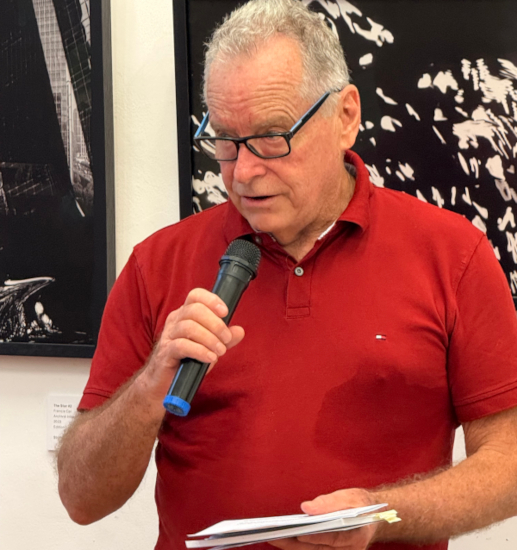
Some Dualities, Proverse Press 2024 and 28 Sonnets, PressPress 2024, by Michael Witts were launched by Mark Roberts at The Shop Gallery, Glebe, on Sunday 16 March 2025
To start I would like to acknowledge that we are on the unceded lands of the Gadigal people pay my respects to their elders past, present and emerging and I would like to extend that respect to any First Nations People here this afternoon.
I am honoured to be here launching these two collections by Michael Witts. Interestingly, I recently discovered that Michael and I spent our teenage years in the same area of Sydney, around the Gladesville/Ryde area and, while we didn’t actually attend the same school, there is good chance that at some stage, we were both on the same double deck route 500 bus travelling into the city at same stage.
But back to poetry – I first became aware of Michael’s work back in 1982 with the publication of his third collection, Dumb Music, by Fling Poetry. In particular I was impressed, as a young poet, by the long sequence ‘Looking into the Sun’, an extended poem in 17 sections about a work party of men looking after a newly planted plantation pine forest. After that I hunted out his earlier work, Sirens (1977) and South (1979) of which I have a signed copy! We are not very good at looking after our literary, and particularly poetic, heritage in Australia, but if you can find copies of Michael’s earlier works I recommend reading them.
Between Dumb Music and the two books we are launching today there is a substantial gap. Talking to Michael about this he told me a familiar story – work (Michael is a lawyer) – family and the pressure to keep one’s head (and those around you), above water – these struggles can make finding the time to think and write difficult – something many of us, including me, can attest to. Fortunately, a little over 10 years ago Michael returned to poetry in a serious way and here we are today …
Starting with Some Dualities, a title I think that is perhaps a little deceptive as I found quite a few dualities … the first obvious duality is, perhaps. the two different periods of Michael’s poetic journey – the first three books and now these two books (and the ones that will follow). Then there is the duality of the migrant – Michael was born in Wales but migrated to Australia when he was five, and there are many poems in both collections about family and his memories of Wales. Then there is his current family, there are a lot of personal poems in both Some Dualities and in particular, 28 Sonnets, and these provide a contrast, sometimes direct, sometimes suggested, to Michael’s memory of growing up and his experience of being a father and watching his own children maturing. A good example of this can be found in the poem ‘Photo-realism’ from Some Dualities. Here a memory prompted by a photograph of a childhood event on a beach, where Michael’s father sculptures a car out of sand for him and his twin brother:
the photo is proof
I sat smiling on that forlorn strand
in a car sculptured
by my father’s hand
perched on the front seat
T\triumphant yet again
over my younger twin
banished to the sand car’s
cramped dickie seat
Is repeated decades later on a Queensland beach:
now as my young son sits
on the hot tropical sand
Noosa air think as treacle
the day ….as likely or not
recorded on multiple devices
remembered this time
I begin by burying his legs
with no great purpose
slowly I begin to sculpt
a car around him
The link between these two events, these dualities, is highlighted in the final section of the poem
the continuum stretched halfway
across the world ….halfway
across last century….
This poem introduces a number of themes which run through these two collections – there is the personal, the memories of the poet’s parents and childhood together with his own role as father. Then there is the link between past events and current, the attempted recreation of a memory – more dualities!
It is this second theme which lays at the centre of one my favourite poems in these two collection, ‘Dear Ken’. The Ken in the title is Ken Bolton (hinting at another link to his earlier books – ‘Winter Solstice’ in South, is also dedicated to Ken). ‘Dear Ken’, starts playingfully in the style of a poetic correspondence, referencing Ashbery and O’Hara and written in almost a Boltonesque style:
when Ashbery wrote “hand me the orange”
was he slyly referencing O’Hara’s
“Why I am not a painter”
was this the orange he wanted
or would another do
was he craving the cool dimpled skin
the juicy flesh
explaining what happened to Frank’s orange
why do we assume he means
the fruit not the colour
Then a few lines later:
maybe he was just hungry not ironic
Witts then moves from Oranges and the New York School to Mies Van Der Rohe’s Barcelona Pavilion. Here a bit of context is perhaps required. The pavilion was the German Pavilion for the 1929 International Exposition in Barcelona and is a critically important building in the history of modern architecture, known for its simple form and its spectacular use of extravagant materials, such as marble, red onyx and travertine. Despite it’s importance to modern architecture the original building was only ever considered temporary and was demolished in 1930, less than a year after completion. Then, between 1983 and 1986 the pavilion was rebuilt using the original specification and adhering, as close as possible to the original. All this is obviously in the back of Michael’s mind when he writes:
does it matter this structure is
the 1986 re-construction
how authentic is this
set down millimetre perfect
to site specified stone in it’s construction
what is more important
the plans and specification or the building
is one just language and the other the thing
where does the idea manifest itself
As in architecture so to in poetry as Michael writes:
nothing is as it seems
is your poem the same read
as heard by you ….or me
your sparse flinty words
scatter the light
The poem ends with a the equivalent of a cheeky poetic wink by returning to the opening O’Hara reference and declaring to Ken:
maybe that is why you are not an architect
There is much to read and enjoy in Some Dualities, the poems are often witty, nearly always insightful and often honestly personal. For those of you aware of his earlier work you will find echoes in poems such as ‘For Steven’ and ‘Honest Toil’. But these are fresh views of landscape and agriculture carefully and skilfully articulated with the benefit of lived experience.
While Some Dualities highlights the breadth and depth of Michael’s work over the last 13 years or so, 28 Sonnets reflect a more concentrated poetic study. Michael has told me that he didn’t write much during COVID but suddenly, in 2023 he produced almost 40 sonnets, 28 of them went into this beautiful PressPress chapbook.
The poems in 28 Sonnets are largely autobiography. Michael’s twin, for example features in ‘Processional’ where his 99 year old mother reminds him on his birthday that
…… she misses her other son
my twin thereby darkening this day
The sonnet ends
I spent so much time staring at you
staring back at me we merged
one life till life snapped back into two
Here, perhaps, is the source of the duality which became the title of the larger collection.
These sonnets explore, in an almost fragmentary nature, the poet’s life, from a sixth month isolation in medical care when he was 4 years old in Wales due to TB, to migration to Australia by ship in 1959, the arrival through the heads in Sydney captured perfectly in the sonnet ‘Poms’
my twin sees nothing of interest announces
this does not look promising
To childhood holidays, queuing on the pacific Highway heading north “in the back of the family ford”, to poems about his father.
I will conclude, perhaps by reading ‘Home’ the final sonnet in 28 Sonnets which. I think, brings together a number of the themes which flows through these two collections;
back to an imagined half remembered world
hemispheres away in time and space
returning as a stranger in search of a past
recalling a stile I needed help to cross
into the blackberry wasteland
our young parents on their Sunday walk
hand in hand gloved against the cold
milky sky closed over winter in Glamorganthere is the fence and there the stile
where it should be
but beyond the blackberries
the scar of the motorway
roaring like torture
not as I remember it at all
These are two fine collections and I congratulate Michael on their publication. Without further ado I therefore declare 28 Sonnets and Some Dualities launched, may they be read far and wide.
– Mark Roberts
————————————-
 Mark Roberts is a writer, critic and publisher living on unceded Darug and Gundungurra land. He is co-editor, along with Linda Adair, of Rochford Street Review. His latest poetry collection, The Office of Literary Endeavours, is forthcoming from 5 Islands Press.
.
- Some Dualities is available from https:// www.amazon.com.au/ Some-Dualities-Recent-Michael-Witts/dp/9888833936
- For information how to order 28 Sonnets go to http://www.presspress.com.au/contact.html
,

 Rochford Street Review