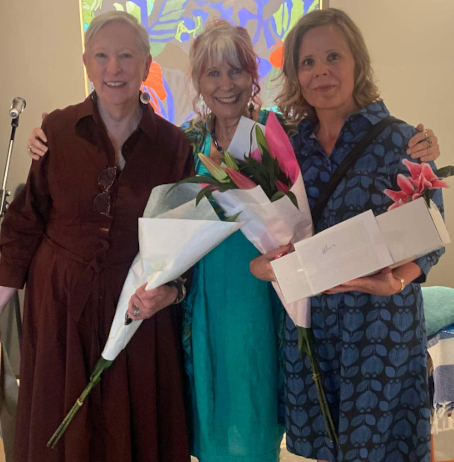
Carmel Macdonald-Grahame (left), Robyn Rowlands (centre) and Maria Takolander at the Geelong launch of Steep Curve
Steep Curve by Robyn Rowland, 5 Islands Press 2024, was launched by Maria Takolander at the Boom Galley, Geelong on Saturday 16 November 2024
I am absolutely delighted to help launch Robyn Rowland’s new book of poems—this book, Steep Curve –– with its stunning cover, which is well-and-truly matched by the poems inside.
Robyn is the author of twelve books of poetry, and her bio claims that she’s been publishing for 50 years. What this half-a-century-long record speaks of is a profound commitment to poetry, an attitude to poetry as an article of faith, an approach to poetry as a vocation.
Alas, poetry might not be something widely appreciated or understood in this country, but we can take heart from the fact that in Ireland, where Robyn has spent so many years of her life, where the government has experimented with paying artists a basic wage, Robyn was warmly accepted by the locals as a poet. Which is to say, it was accepted that being a poet was her job.
And Robyn’s embrace of the work of the poet is something that comes across in the professionalism, the skill, the assuredness apparent in all of her collections, and especially in this new book, where she takes things to a new height.
Her assuredness shines through in the extraordinary craft of the poetry—the handling of line, image, enjambment, phrasing, not to mention her voice. But it’s also there in the book’s subject matter, which might be regarded as somewhat remarkable in today’s landscape for its indifference towards the faddish. What I mean to say is that Robyn’s poetry delves, in its assured way, into universal phenomena like aging, family, love, grief, which are explored, of course, from her own deeply personal perspective. She is an historian of the intimate and everyday life, which is a life each of us live.
The poet invites us to share in her experience with a generosity and honesty that I found especially significant and moving, perhaps because it reminded me of all that we have in common, as creatures of the everyday, as beings of fragility. And I couldn’t think of a better time to have been reminded of that.
One never reads a book in a vacuum, and I happened to have read this book in the divisive lead-up to the US elections, during which Trump supporters and Democrats lined up against one another, and during another awful war between Israel and Palestine. These conflicts also brought to mind, for me, the ways in which an identitarian politics has risen, hand-in-hand with the forces of social media, coercing us to identify ourselves as one thing or another, making it easy for corporations to know exactly what advertisements to send into our feeds. The phrase ‘divide and conquer’ has a new resonance in our digital age, such that I’ve begun wondering: might it be that the most radical thing we can do is refuse to be labelled? Might it be time for the reassertion of what we share as human beings?
Robyn’s book, for me, came across as a quiet intervention in this noisy field, speaking of a loving daughter and an aging father, of ants and dragonflies, of flowers and the sea.
So let me turn, finally, to the particulars of this special book.
The poems in Steep Curve tell the story of the poet, returning from Ireland to her childhood home in the Illawarra to care for her aged father during the ‘The Great Pause’ of the Covid years.
We learn a lot about the poet’s father, an ordinary but also extraordinary human. He was pulled out of school at the age of 15 to undertake an indentured apprenticeship as a fitter and turner, before going on to other feats, including starting an aged care facility. It is one of the book’s ironies or jokes, though, that Norm Rowland, the poet’s father, doesn’t want to turn himself over to the aged care facility he himself started.
And so the poet takes up the position of carer, looking after her father at home up until the ripe old age of 102. As the poem called ‘Trick or Treat’ reflects, ‘We Rowlands—we just won’t be pushed off’.
The poet has given up a life in Ireland to be with her father. She’s left a house between ‘two loughs’ and by the ‘Wild Atlantic’ on the Irish west coast, a place in which she felt at home. ‘The land,’ the poet writes in ‘Bruised,’ ‘was the shape of my body, my soul.’
And the work for which she has come back to Australia is by no means easy.
The return to her childhood home brings about an inevitable return to the past, which is described as a ‘sticky webbing.’ She finds herself trapped in it from time to time. The house, full of furniture the poet’s father has made, sinking into a state of disrepair, strikes her as—quote—‘a stockpile of death-traps from shock or falling.’ She injures herself constantly, but there is also the threat of uncovering deeper and older wounds.
There is also the difficult work of caring itself. A poem called ‘For the record’ lists all the jobs the poet performs daily as she tends to her father’s health. As the epigraph reveals, the poem is written ‘for a brother who rarely comes, saying “well you wanted to do it”.’
But the poet isn’t seeking to be a martyr; she isn’t seeking praise or recognition. Notably, she often understands her role in relation to the natural world, thereby infusing her role with a remarkable sense of both pragmatism and humility. In ‘Minnamurra Moment,’ the poet sees herself in an ant that is doggedly dragging a giant piece of golden biscuit ‘forty times its size.’ She writes: ‘Overwhelmed repeatedly…sometimes it runs from its task . . . then hurries back.’ There is work to be done, no matter how difficult.
Nature is unforgiving in its demands. Life and death are not for the faint-hearted. We see this time and again in Steep Curve. In a poem called ‘Dragonfly stalled,’ a ‘careless breeze’ drops and traps a dragonfly ‘in our peg caddy.’ Trying to save it, the poet crushes it. In another poem, called ‘They had it covered,’ the poet tries to rescue a baby magpie from a feral cat, but her intervention only makes things worse. Thus the poet repeatedly skewers whatever hubris she might indulge. Life and death are phenomena beyond her control.
In Steep Curve, as the title suggests, the poet learns about life and death, and we, as readers, are privileged to learn about these things with her. We are also reminded of a profound truth about love—that it is not as an abstract idea but an action. The poet cares for her father as she once cared for sons, tending to his hunger or the mess of his body, entertaining him with poetry, singing with him, staying by his side until he falls asleep. Love comes from the doing of these things; it is from such actions that we develop unyielding bonds.
Running parallel to the present-day story of a daughter caring for her father is the story of the father who cared for his daughter—and what a reliable father Norm was. This story of his parenting is presented to us through historical poems—called ‘Backspaces’—that provide insights into moments from their past, when the poet and her father were together in vastly different circumstances.
The sense of other selves, the sense of time passing, is poignant, sometimes even devastating, but the poet, in her wisdom, is always attuned to the need for balance and grace. In ‘Unblinkered,’ the poet, struggling with the work that she does, decides that ‘Each day, just one lovely thing will be my ballast.’ Loveliness, it turns out, is abundant on the Illawarra coast. There are rainbow lorikeets; crimson rosellas in the callistemon—quote—‘so red, they become the flower itself’; green grass parrots in the ‘strelitzia flaming orange.’ Then king parrots arrive, boldly declaring themselves, as the poet writes, just ‘in case amazement had forsaken me.’
The sea too provides an ever-present source of consolation, with its ‘diamonds scattered,’ ‘silver lamé,’ ‘the blue of everything.’
Steep Curve is a book of extraordinary skill, intimacy, generosity, and beauty. It is a book for us; it is a book written for readers. So let’s hear some of it now from the poet herself, some of Robyn’s lessons in life, death, love, and poetry.
– Maria Takolander
——————————
 Maria Takolander is the author of four poetry books, the most recent of which, Trigger Warning (UQP), won the 2022 Victorian Premier’s Literary Award. Her short-story collection, The Double (Text), was a finalist in the 2015 Melbourne Prize for Literature. She is also an independent scholar and a regular reviewer for The Saturday Paper. Her website is mariatakolander.com
.
.
Steep Curve, by Robyn Rowlands is available at https://www. 5islandspress. com/product-page/steep-curve-by-robyn-rowland

 Rochford Street Review