
Steep Curve by Robyn Rowland, 5 Islands Press 2024.
The narrative arc of this collection captures the three summers following the poet’s return from overseas to care for her father in his final years. The collection is dedicated to the poet’s father Norm. Rowland returns from Ireland in December 2019 and cares for her father until his death, aged 102, in February 2022. Interwoven with this narrative are many strands. The past is illuminated by older poems as ‘Backspaces’. The dense weave of this collection deals with the nature of love; home and belonging; past and present and loss.
Although most of the poems deal with intimate and personal events in an approximately chronological order, there are many diversions, which change our perspective and illuminate wider concerns.
At the opening we know where the tale will end. What we don’t know, and what the poet did not know, was quite how long it would take to reach this inevitable conclusion. The arrangement is quite open ended when he first
falls into my caring
as if into an eiderdown
But this is not just a diary, and perhaps not a diary at all. It does record the end of a remarkable life. But the collection is so much more than that.
Lest we think of this as some saintly exercise, the poet is keen to set us straight. One gets the sense that she embarks on this course not through some obligation but by love, lack of choice, or both. Equipped, or not, she takes on what could realistically have been months of full-time care that turns into years. Although she was clearly close to her father (they used to skype each day when she was living in Ireland) there is really no alternative to her coming home. This leads to “the steep curve of learning” referred to in the title and the namesake poem.
There are hints that the family relationship had been challenged during its long course. Backspace 1 Construction speaks of an estrangement as the younger poet
….emerged essay-waving
the flag of my independence,
thrusting Vietnam between us
a bayonet of unforgivable assumptions.
The collection is infused with place. Home, for the duration, is the near South Coast of NSW, where the Rowland family had been for a very long time. Port Kembla, Jamberoo, Kiama and Minnamurra will be familiar to many. Rowland returns to the house her father built. This is “the ink well of my first twenty years, all memory written out, I thought.” How mistaken the author was in this regard. Coming home opens up a rich reservoir on which she is able to draw.
It turns out by their third summer Rowland and her father had reached some “warm content” (‘Change in Outlook’). All this “not genes or gender”, but by “finding my pathways daily through the puzzle-maze of caring.” (‘Bearing the Steep Curve of Learning’).
In ‘Between‘ she quotes by way of epigraph, a line by Christian Morgenstern: “home is not where you live, but where they understand you”. For some indeterminate time, home is not “my Irish home beside the choppy Atlantic” nor, “my home in the Blue Room of Alesta Hotel Turkiye.” Home is the house her father Norm built and extended (‘Backspace 1 Construction’). This reservoir is one deep well; the site of the poet’s loss of childhood, under the house, under the weight of the older neighbour pressing this eleven-year-old into the damp and cold. This is the “twisted scrimshaw”.
Home is haunted by its past. Her long dead mother appears, as does her grandmother, on whom the fifteen-year-old poet practiced her awkward caring as, perhaps, a rehearsal for the present. Home is, as Robert Frost pithily noted, “the place, where when you have to go there, they have to take you in”.
Her mother, makes many appearances, particularly in The Clasp of Memory. But her mother is not part of this narrative: she is used to illustrate the contrast with the poet’s contact with her father’s body. This is seen in ‘There are intimacies’
washing my mother, lifting her bare breasts
was soothing. Women dying
mid-sixties are undulous, pendulous
her body was the map of mine.
My father is unchartered skin
She catches herself checking her father is still breathing, as she, and I suspect most of her readers, have done with their own infant children. So much of this collection speaks of a common humanity we understand.
This collection explains the intensity of the bond between this daughter and her dying father. In ‘Backspace 3 Coming’ of Age Rowland deals with the special nature of the father/daughter bond. They are not like lovers, children, family. “No, these are the fathers of the middle age….not the ones we knew when we were young.”
Throughout these poems there are houses and gardens falling into disrepair, nothing escapes aging. However, there are items crafted by Norm which endure, such as the cedar table hand crafted from a cedar log that had fallen in the forest and took three months to extract. The legacy endures. The body is perishing but some things survive. There is the fig tree next to the house Norm built, that the daughter takes to with saw and blade. The fig’s appearance in ‘Dismantling and Disrepair’ takes on greater significance. It is almost an allegory for her father, but not quite. There are parallels with the daughter and her severe pruning of the fig, her realisation it may not survive to fruit another season, and the surgeon excising parts of Norm’s ear and face in ‘Excisions in the “Key of Glory”’. But Rowland is too fine a poet to content herself with such an obvious connection. Rather, to use a term coined by Martin Duwell** in his online Australian Poetry Review, this has more to do with “autobiographical resonances” than allegory. This is the stuff of poetry and what makes it such a joy to read and re-read the collection.
Such resonances can be found in the poems about Norm’s younger brother Stan. Younger, but still 98. Stan is the uncle of the “respite beach house” and death in Covid times. In ‘Unwelcome Fixity’
Once a week my respite in this old family
beach house my uncle built nearby, and
him buried last May with his ten watchers
We are subtly reminded this story unfolds during COVID-19 restrictions, with all their challenges. COVID is a presence in a number of these poems with social distancing and isolation.
Stan’s passing is one of the rehearsals for Norm’s inevitable passing. In ‘Trick or Treat’ the prankster father appears to have “passed” only to rouse.
Ahh, so sorry, has he passed?
No. He’s reciting ‘Clancy of the Overflow’
waiting for the kettle!….
Four times this trick or treat will happen.
But his death must come and it does in ‘Last Things’ on February 5th 2022. Rowland, the poet, stays masterfully in control while the daughter experiences the loss
he stopped, and everything stopped.
…..then, eruption – keening unleashed, shocking,
Cawing from my gut, the old Irish way
The unbelieving: “yet again I feel for his pulse”.
This is a collection brimming with life, love and humour. These poems assert their independence while acknowledging their cohesion. They are parts of a greater whole. But while the voice is consistent they are not all the same. They do stand in subtle contrast to the tone and form of the ‘Backspaces’, which only highlights their unity. But there are multiple shifts in focus and perspective. In ‘Woman in a park’ we are confronted by a woman crying long before we realise the woman is indeed the daughter/poet. Perhaps this is the only way this could be expressed without sentimentality. In ‘Memories of a Room’ we have a history from the rooms perspective. I love that the room remembers Leonard Cohen’s ‘Songs of Love and Hate‘ being played. There is also the superb lyric of ‘What undoing’ and the quintessential Australian poem in ‘The quiet perspective of the street’. Here is a poet fully in command of her form and content.
*This handsome collection, launched in Thirroul in November 2024, is one of the more recent publications by 5 Islands Press now under the stewardship of Steve Meyrick and Mark Tredinnick, carrying on Ron Petty’s legacy.
**Martin Duwell is past editor of Makar Press. He is probably the most perceptive critic of Australian Poetry working today. Look out for his reviews of poetry on the first of each month in his website Australian Poetry Review.
– Michael Witts
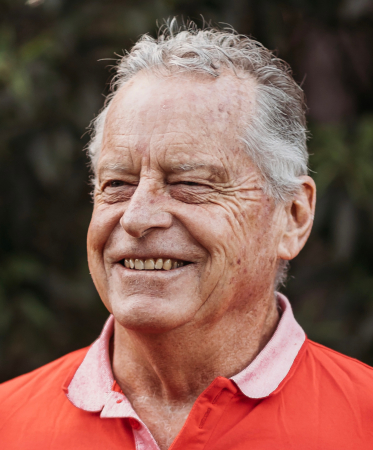 Michael Witts is a Welsh born Australian poet. He has published five collections: Sirens, South, Dumb Music, 28 Sonnets and Some Dualities. He won 2nd prize in the 2023 Proverse International Poetry Prize (single poem ) and won the 2023 Proverse Prize for manuscripts for Some Dualities.
.
.
.
.
Steep Curve by Robyn Rowland is available from https://www. 5islandspress.com/product-page/ steep-curve- by-robyn-rowland
.
 Rochford Street Review