Electroreception
(n.): the sense of detecting electricity.
The hues that resurrect the sky from night
are not St. Elmo’s fire, but a span
of pylons, lightning-struck and out-of-sight
from where you’re watching in a campervan –
her jiffy pop, familiar and adored,
a promise of the gossip to be spun,
some scrabble pieces strewn across a board
from games well-fought and others soon well-won –
these pleasures will be yours, but they can wait
for here in Gort, the puddles glow despite
the rain you hide from yet appreciate
as each new fork and epileptic strike
like a camera flash delivers thrill
and keeps you grounded there, together still.
**
Meeting with an Unknown Ancestor
Aunty, you will survive your famine –
how else could we be meeting now
among our doubts, blackened as potato shoots
under rain only the Irish sky
can sustain without revealing how.
I’m not here to regale you
with our leaving and returning tales –
of creaking mines in murky seas
or cousins who left us on the steps of
orphanages with no birth details –
I am here because you are the proof
I have endured all this before –
witness my hunger, Aunty, tell me
its thrumming will not be my unravelling,
I need to hear you reassure
that it won’t yet make an animal of me.
I haven’t come to see how you get by –
how you chew bog oak until it turns
iron-bitter like blood from a blister –
I’ve come to be reminded why
we must inherit a bruise, keep it safe
without hiding it from the world,
become the kinds of custodians
a pain bigger than ourselves deserves
so we can pass it on one day, pearled,
into the skin of someone still nameless
who has our nose, the rift
in our chin, our pockmarked tongue,
someone who, like us, won’t be ready
to understand it is a gift.
You doubt that I am real, Aunty,
but know I hold your life inside my spine.
Our realm is in-between, like rain smoke.
I can prove you will survive your famine;
please teach me how to survive mine.
**
Mine
My grandfather was only a boy
when he took to an Irish Sea
littered with mines from the war
to meet his grandfather,
Worcestershire’s pride and joy.
This man had cut them off.
Marrying a catholic in those days
was laying a charge
made to sink a lineage. But
death had made the old man soft.
My grandfather could have refused.
Into that dimly lit room
he walked, the ailing man
planted a kiss on his forehead.
And all was defused.
**
A View of Chateau Impney
I spy its coloured spires, fleeting between trees,
turn off the motorway and ignore the Private Property
sign until some steel bollards halt my descent.
Now it is completely hidden, this house
of my great, great, great grandfather, leased
by the Salt King in the years before the war.
I’ve asked my grandad; the details are a haze.
With my Dictaphone, I watched him trying
to bring names and dates into focus, this grey-
haired man who I struggled to unblur.
The smell of his house was vaguely strange.
He obliged my questions with the polite air
he was known for on company boards – they
still had him answering calls in his 80s.
Once, I called by his double-gated
home, but he apologised down the phone,
said he had a memo to phrase.
The Chateau is now a hotel, says Google,
closed down for renovations.
I sit in the forbidden carpark and ogle
its grand architecture through a screen,
imagine its carpets, shades of old-world hue.
Another time, I lie, and turn out of the drive,
the manor not so much leaving my rear-view
as having scarcely been there in the first place.
**
Congestion
At a hospital in Kathmandu
the patient shows his disability to me.
Attempting to thank him humbly,
I think of my grandmother. In the days
she could only utter a single phrase
after her stroke, I’d stand, on cue,
embarrassed and waiting
as words got lost in her frontal lobe,
leaving us to try and probe
what she was trying to say,
a stuttering panic in her way,
my patient grandfather translating.
Dad said she was once tall and grand,
a woman of quick wit; but at the table
I avoided eye-contact, feared the unstable
twitch at the edge of her lipstick,
petrified that she would pick
a moment to suddenly demand
I look at her. The Nepali who
has lost the use of foot and hand
now struggles to understand
what I’m trying to say to him.
So, I repeat her phrase on a whim
and hope it will still ring true –
“It is lovely to see you,
It is lovely to see you.”
—————————–
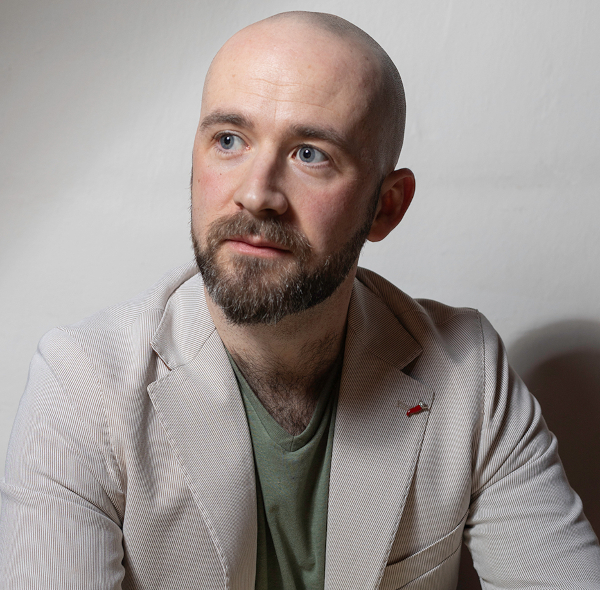
Luke Morgan is a poet from Galway, Ireland. His third collection Blood Atlas is new from Arlen House in 2025. He is the recipient of the 29th Lawrence O’Shaughnessy Award. He can be reached at www.lukemorgan.ie, @LukeMorganPoet

 Rochford Street Review