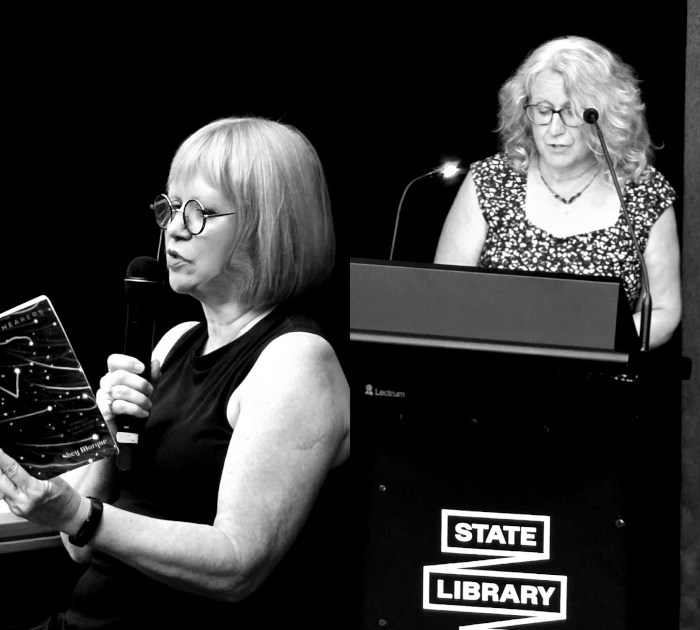
Shey Marque (left) and Lucy Dougan at the launch of The Hum Hearers
The Hum Hearers by Shey Marque, UWAP 2025, was launched by Lucy Dougan at the State Library of Western Australia on 30 March 2025.
I’d like to acknowledge that we’re gathered on the land of the Whadjuk people of the Noongar nation and I pay my respects to elders past, present and emerging.
I am delighted to be with you here to celebrate the launch of Shey Marque’s The Hum Hearers, Shey’s second full length collection and her fourth book. It’s a privilege to have been invited to say some words on this moving and accomplished new collection which I regard to be a very significant arrival…much louder than a hum. You know when a new book arrives and you feel its substance, the graft in its craft, its reaching back and its casting forwards? – well – here it is.
Shey has a distinguished track-record of short-listings and publications. The Hum Hearers was short-listed for the Dorothy Hewett Award, individual poems have been noticed in the Gwen Harwood Poetry Prize, the Woorilla Poetry Prize and the Bruce Dawe Poetry Prize, among others. Along with her first UWAP poetry collection, Keeper of the Ritual, she also has two chapbooks published internationally. Shey is an active and generous member of the literary community both here and on the East Coast, contributing in peer reviewing, serving on boards and mentoring fellow poets, as well as coordinating the national Hospital Poets Program. She is also a much loved and valued member of the long-running Hubbles poetry group.
Professionally, Shey has had another life in clinical haematology and as a research scientist. It is this scientific training, this other life, that remains central to her poetry-making and to her compelling thinking about what shapes and drives us as humans. More on this as we go.
The Hum Hearers is a profound body of work rich in its thinking and making, with much reading and research behind that. The scope of its references are truly exciting: from Ukranian poets Vasyl Holoborodko and Lesky Panasiuk to Terrance Hayes to Poe to music hall to Roxy Music to First Nations American thinking on the space-time continuum to note but a few coordinates and frames. I love a book that sends me to the dictionary and I love a book that sends me to the work of other poets. And I also especially love a book that riffs on out from really big and complex ideas about being human. Like all profound bodies of work this project has deep roots both in terms of the time of its inception (from way back in 2008 when ancestry research began) and in the thinking and influences that formed it. Shey eloquently traces some of this for us in the her excellent introduction accompanying the book and also in a recent interview with Maria Kakani which you can find on the UWAP website.
The central organising principle of The Hum Hearers comes from Shey’s fascination with epigenetics. In her introduction she writes that her book ‘explores the post-genomic entanglement between the body and environment through epigenetic inheritance, or celluar memory’ and later that ‘[w]e are essentially a symphony of particles and light, an energy that’s never destroyed, only transformed, and can transcend space and time…Our DNA carries a vibrational energy (I’m calling it a hum), measurable by experiment, which may be influenced by distant triggers.’From the poem ‘Inhabiting the tesseract’:
We are entangled, she & I, the way in which nothing really dies, woven into the same fabric of the next dimension.
And from ‘Always Running’:
I am the bearer of your unuttered shock, affairs, shame, sin, rumour, anything at the edge of the unsayable. Let me carry this whole ancestral load like a pilgrim on an endless journey, gathering firwood, milking goats, picking berries and planting seeds until the end of time (and fast forwarding a little in this wonderful poem)…‘We don’t remember most of our own lives yet my body remembers your trauma. I’m stuck in the wrong neural neighbourhood.
Spending time with The Hum Hearers led me to a musing on the strong and lasting connection between science and poetry as disciplines, now so very well established that there are prizes and journals devoted to that pairing. In an excellent article published some time ago in The Guardian, “The science of poetry, the poetry of science”, poet Ruth Padel explores this ancient partnership, noting its “parental relationship…Poetry was the first written way we addressed such questions as what is the world made of” and that “both depend on metaphor’.“1 Padel reminds us that Keats abandoned medicine for poetry, that Darwin carried a copy of Milton on his expeditions and that above all “both [poetry and science] arrive at the grand and abstract (when they have to) through precision…Scientists and poets focus on details.” When Shey talks in interview about one of the poets, Paul Hetherington, whose own work influenced her book, she says: “He pays attention to the small detail brimming with what it is to be human”. Padel also notes that Darwin “spent seven years on barnacles before tackling a general species book”. When you read The Hum Hearers pay attention to that eye for detail: “printed flowers” on a housecoat are “like little blue gods”, a painted mouth is imagined as “a tiny crimson dianthus in a meadow”, hair is described as “a russet pelt of foxglove laid on a white sheet”.
So, this book is a marriage of studies in science and studies in poetic form. What I feel deeply in Shey’s work – in its craft and in its textures – is that because of her strong professional grounding in another discipline that she came to poetry (16 years ago) understanding that it was going to be work, understanding that it was in its own artform with traditions, conventions and specialist knowledge with a tool box tested through time. When I read about Shey’s story of changing tack I was reminded of the anecdote children’s author and illustrator Anthony Browne tells about his own leap into the arts:
I worked at Manchester Royal Infirmary for 3 years painting delicate watercolours of grotesque operations. It taught me a lot more about drawing than I ever learned at art college, and I believe it taught me how to tell stories in pictures. I thought it was probably time to move on when strange little figures started appearing in these paintings.’2
As Shey made the transition from scientist to artist, ‘little figures’ – her ancestors deep from within the family crypt – started appearing too. Quoting Shey from the introduction to The Hum Hearers:
When I started to hear a bit about my family history, I got really interested in the anecdotal stories I was hearing from my mother. I found myself developing a sort of affinity with relatives I had never met, from generations ago. I felt that there was something else in it, something connecting us physically. I thought ‘It’s this epigenetic memory, the cellular memory coming into play.
But this is not only a leap from one discipline to another. I think when a poet experiences a body of work and a new book as a formal leap – as it has been for Shey into mainly prose poetry here – then it’s very exciting. And other things attend around a formal leap: a new confidence in expressive possibilities and also the capacity to find a formal means to carry emotions and ideas. In essence, this is what form is for. It’s exciting to track her influences, Paul Hetherington mentioned above in that eye for the clinching detail, and Cassandra Atherton strongly in terms of an inventive and atmospheric style, that patina of the past that Shey also uses to create the imagined lives of her ancestors:
From ‘The Fear of Hands’:
He wears a boater, holds on tight to his boot, you singing his lyric, black & blue, red hot & blue. But tell me more of this night, of the backroom where you slip dance pumps over white silk tights, of that short satin dress, & mostly the hat of feathers
And going back some times in Australian letters and also back into the history of a forerunning project to The Hum Hearers, the influence of the late great Dorothy Porter is there in how one might weave remnants of the past into a verse novella form. I think it’s wonderful to see the work of a dead poet carried on in that of a living one. This is also a passing on of things carried around in a body from another time, is it not?
I want to say some words about this stunning new collection overall. I think the decision to focus on prose poetry for the ancestral material works so well. As Shey notes, these are nonfiction narratives, and also because that elastic, inventive form creates the sense of entanglement, the sense of slippages and blurrings, and the porosity between past and present that both the subject matter and the concept demands: that twitching ‘voile’ between spaces in “Inhabiting the tesseract”. I found the formal flow of the whole collection fascinating as it moves from the ancestral work in prose, to poems closer in time and space, to a series of exquisite elegies to the poet’s mother in a sinuous free-verse – these are written out in very deep water – and on into its final frontier: a series of sonnets and experimental sonnets that reveal cosmic dimensions. The collection’s title poem (when you get there – you’ll see/hear/feel it) is a gorgeous release into the kind liberatory of dance that’s there in all of our bodies. Those four words picked out in italics here resound back through the whole book: vibration, synchronicity, embodiment, fluctuation.
Shey, I intuit that maybe you are too modest to accept your tutor’s remark from way back that an earlier incarnation of this project was courageous but it is, so very much. I also intuit that your mother/your connection to your mother is the beating heart of this book (certainly for this reader it is) so I want to read these lines from ‘Meanwhile, genes are deciding if they want to be read’:
She was there with me prior to speaking, there before I learned to speak, there long before my lungs functioned as air. Her name is the sound of morning meditation. Sometimes when no-one’s paying attention she’s the spirit who wanders off to bask in the sun…
Never was it truer to say of a book that we don’t write on our own…because by its time bending logic we are always being written (quoting from ‘Arguments Yard’):
Our feet have been walking away with the top surface of the walkway for centuries
……………………………………………………………………………………….. – Arguments Yard
My sincere congratulations to you on a knock-out second full-length collection, Shey. My congratulations also to John. I said at Lisa Collyer’s and Al Fyfe’s launches, I’ll say it again: partners and families who support poets rock. I’m glad you made this powerful connection with your ancestors and that this has been such a grounding experience. Poetry with thinking in it like this matters so much for the current moment… and in this moment right now I declare The Hum Hearers launched in Perth/Boorloo at the State Library of WA on the 30th of March 2025! … and I’m looking forward to the conversation and the films. Brava Shey!
1 https://www.theguardian.com/books/2011/dec/09/ruth-padel-science-poetry
2 https://www.anthonybrownebooks.com/about
– Lucy Dougan
————————————–

Lucy Dougan is a widely published award-winning poet. Her books include Memory Shell (5 Islands Press), White Clay (Giramondo), Meanderthals (Web del Sol) and The Guardians (Giramondo) which won the Western Australian Premier’s Book Award for poetry. With Tim Dolin, she is co-editor of The Collected Poems of Fay Zwicky (UWAP, 2017). Her latest book is Monster Field (Giramondo). She is currently working on an edition of Anne Brontë’s poetry for Cambridge UP and is poetry editor for Westerly.
.
.
.
The Hum Hearers by Shey Marque is available from https:// uwap.uwa.edu.au/ products/the-hum-hearers

 Rochford Street Review