
The following is a translation by Peter Boyle of Jordi Doce’s Preface to A altas horas de la madrugada/ In the small hours, Nautilus Editions 2025
Poet and translator of poets, Peter Boyle (Melbourne, Australia, 1951) began publishing relatively late — he broke the ice at the age of 42 with his book Coming Home from the World — but since then he has not looked back, completing more than 11 poetry books and being equally prolific and generous as a translator of Spanish-language poets. He first great work in this regard was The Trees (2004), a magnificent bilingual anthology of the Venezuelan writer Eugenio Montejo. He has also translated four books by the Cuban poet José Kozer, the “stream-poem’ Jasmine for Clementina Médici by Marosa di Giorgio and, more recently, an anthology of the Spaniard Juan Carlos Mestre. This sustained interest in Hispanic poetry — not very common among his Anglo-American colleagues — lies in large part behind his book Ghostspeaking (2016), an anthology of eleven fictional poets from Spanish America, France and Canada that includes interviews, fragments of poetics and biographic sketches as seductive and intriguing as the poems themselves. Prominent among his apocryphal characters are the Argentines Ricardo Xavier Bousoño and Elena Navronskaya Blanco and the “eccentric Mexican poet of Bulgarian and Turkish origins” Lazlo Thalassa. The result is an imaginative and dramatic prodigy in the broad sense of the word: a “drama between people” in the style of Pessoa yes, but with a far more pronounced ludic accent and, above all, the ability to incorporate into the English language tradition styles and poetic tonalities that conflict with it and enrich it.
I first met Peter Boyle through letters –or more precisely emails — more than two decades ago, around 2002-03, when Eugenio Montejo put us in contact to help revise the translations that later appeared in The Trees. It was very enjoyable work, especially because Boyle’s versions — apart from the occasional error or slip, very easy to correct — possessed a sonority equivalent or analogous to the rhythmic and musical grace of the originals, those melodies of a modernist bent that Montejo knew how to filter through the sieve of the avant-garde. To translate poetry is a question of voice, of tone of voice, and demands a musical ear, the ability to listen to a poet’s distinctive accent and recreate it in another language. And Boyle could not have had a better ear in his versions of Montejo. I wrote then that his work captured “in a subtle precise English the musical elegance of the poems and their conversational tone”. Rarely has a contemporary Hispanic poet been so well translated into English, but the qualities of Boyle’s work had less to do with his undeniable professionalism and technical ability than with his gift for putting himself inside the skin and voice of another poet: a talent that depends on the imagination, on what — for lack of another word — we call empathy.
And these are precisely the qualities Boyle exhibits in his own writing, his way of covering the distance between home — that place of one’s own that sometimes turns alien — and the external world — that alien element we try to turn into a place of our own. Or to put it another way: this poetry is the logbook of someone who is lost in the world and tries, as we all do, to return home. We are always far off, always on the way, and returning home is the method we have of representing, of codifying, our ever more desperate attempts to achieve understanding, to give a meaning to life.
*
The persona of these poems often appears before us at night, unable to sleep, with the sensation of being far from or outside the world, outside of life. So, for example, in the first poem in this book: “It’s three a.m. in the morning/ of a day you won’t enter for so many hours . . . Outside, the city is restless . . . At fifty-five I know so little how to live”. Or in “Rain at Midnight”: “A delicate thin rain/surrounds the house where I write/ perched on the edge of nothingness”. To write implies accepting that we are outside of life, separated from it by words and by the awareness such words encode, and in this regard even the rain is “a pure eloquence/ the other side of human speech”.
Moments of illumination, of sudden comprehension, are brief and fleeting, but we must cling to them, hold tight the thread they offer, because only in that way can we find rest. Hence the necessity of poetry. In “Robert Frost at eighty” the lines the great poet dreams of writing “have the lilting accent/ of a house I saw but never entered”. If “sometimes, but almost never,/ we touch what we desire”, poetry will be our way to capture the moment and pin down the lightning. Something similar is expressed in the delightful poem “Apologizing to Unicorns”, where these mythical animals give Boyle the distance necessary to indicate the feeling we have of “our not belonging, our poor talent for letting the miraculous be”.
The tone of Boyle’s poetry is slow, reflective, but underneath flows a current of unease, of profound existential anxiety. So, for example, in “For a beautiful Polish lady”, which resembles an allegory of life as it recounts the hours spent in a country house (“a vast summer palace by the lake”). If at the start the elements of the garden “shine in midday sun” and one of the figures in the painting grows “like a wheat stalk”, the ending evokes the sombre, almost gloomy atmosphere of that other allegory The Swimmer (the film, but also the original story by Cheever) to portray a landscape where “the wind turns fretful, the sun deserts the tarnished terraces . . . and half-bitten cherries/ stain the snow.”
This poem underlines another important aspect of Boyle’s work: its elegiac character and the importance given to love (“you say that love is what is left: it is the last emotion to die”) as a force that ignites and galvanizes the world, spreading a veil of care and attention over things. An important part of this book consists of poems of grief, poems that sing and commemorate with contained emotion the absence of the beloved. In “Thoughts in a café”, for example, the vision of an everyday reality numbed by grief (the characters persist “in their glassy being”, people “stand or drift”, the cafe where the poet waits is “the very edge” of life) leads to the image of Orpheus descending to Hades to recover Eurydice, but in these lines the underworld is an interiorized space, a place that only exists in the poet’s mind:
My mind lifts to see your face
on the threshold of the corridor that descends,
goes on descending through
the mind’s still centre:gone gone utterly gone
Nevertheless, as Boyle says, “nothing is lost”. I am moved by the presence of this line, this phrase, which is the same as the title I gave to an anthology of my poems in 2015, exactly ten years ago. It is a central idea of this writing, perhaps of all writing: the faith that the creative act keeps alive the presence of everything we have loved, everything that has been part of our life. “Nothing is lost”, indeed; it lives in a latent state, waiting for the sign that summons it and wakes it from its lethargy. Thus, in “Waiting” the voice of the absent beloved, that “voice I am waiting for” at “an imaginary table” that has been “laid bare”, seamlessly equates to “your being here still// in this world”.
Poems like “Requiem” and “Becoming Tree” (or “My Birthdays in Reverse” which closes the book) release into flight grief’s ‘butterfly of ash” against a background of images that repeatedly surprise the reader. Because the reflective or meditative tone of this poetry, while not renouncing imagism’s austere minimalist lesson (consider the fragments of Enfolded in the Wings of a Great Darkness), coexists with the occasional taste for unexpected comparisons and playfulness (taxis are “golden birds/ waiting for the crumbs of dawn”, the tree mouths “the one green syllable”) and wildly imaginative hypotheses: What do unicorns think of us? Why would a tree have the ambition to become an ant? What would happen if we could enter the frame of Las Meninas and live alongside the figures in the painting? Can we imagine a library as a long canal lined with bookcases, a city half drowned in water where the readers move about in skiffs?
All this and more can be found in this anthology by Peter Boyle which is but an illustrative sample of a far more extensive oeuvre filled with unsuspected riches, which looks equally at the world of nature and the realm of art and literature — not to mention the journeys that were so important for their author. A work which sketches a portrait of human beings as creatures obliged to reconcile themselves to their lack of solidity, their ever more ghostly condition, that defining inability to be in accord with oneself or one’s surroundings. The hour has come for the reader to enter these poems with the same unreserved ease the poet feels on entering Las Meninas: to inhabit them, to be one with them and let the excess of life that gave birth to them find its “residence on earth”.
– Jordi Doce
—————————————
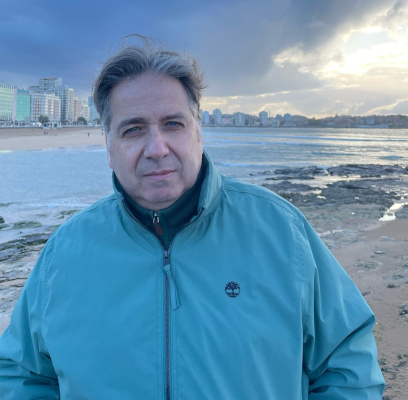 Jordi Doce is a Spanish poet, translator and literary critic. He has three volumes of poetry published in the UK by Shearsman Books: Nothing is Lost. Selected Poems (2017) and We Were Not There (2019), both translated by Lawrence Schimel, and Master of Distances (2023), translated by Terence Dooley. He had a brief stint as Language Assistant at the University of Oxford (1997- 2000). Currently he lives in Madrid and works as poetry editor at Galaxia Gutenberg.
A altas horas de la madrugada/ In the small hours is available from https://libros.cc/A-ALTAS-HORAS-DE-LA-MADRUGADA.htm?isbn=9788410241664
.

 Rochford Street Review