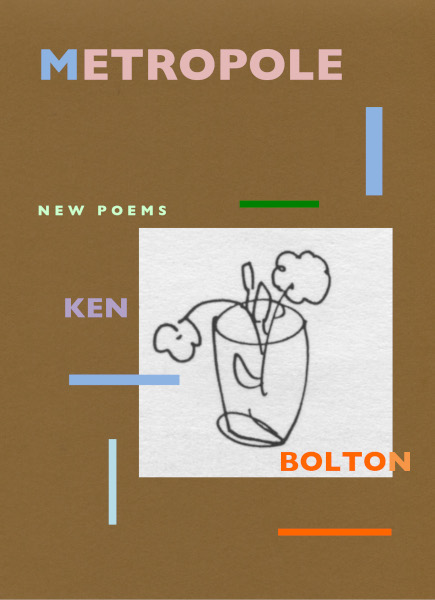
Metropole by Ken Bolton, Puncher & Wattmann, 2024.
When I compare Ken Bolton’s back catalogue to his latest work Metropole, I’m struck by the remarkable consistency of his style. In the inner southern suburb of Adelaide where he now lives, Ken Bolton is still writing almost the same poem he was over forty years ago, and that is not a criticism but a compliment. That poem is a first-person ramble among his favourite subjects: his family and friends, pubs and cafes, art history and criticism, jazz, letters, cinema, philosophy, and the lives and writings other poets. There is a melancholy humour at play (“if you see a leg pull it”) and seemingly plenty of time for a wander – don’t expect short lyric poetry from Ken Bolton, or metaphor, or playing around with consonance or assonance or half rhyme, though there is a bee-bop kind of musicality to the rhythm of interruptions and distractions and self-inclusion revealing the thinking behind the lines. In this, his influences from some American poets such as Frank O’Hara are clear and don’t need to be rehearsed here.
The title of Metropole doesn’t come from T.S. Eliot’s meeting place with Mr Eugenides in the Wasteland or from the rickety old hotel in Katoomba, but from an Adelaide city watering hole, The Metropolitan. It is the location where Bolton begins one of two significant elegies in the book to poets he has known. ‘An Australian Afternoon – Faces at the Metropole’, starts with Bolton at an outside table, observing people and observing his own observing. Like so many Bolton poems it begins by being located somewhere, with views out and around from that place, and then a meta-view about the poet’s own looking and writing. The poem then branches out to a surprisingly cutting literary analysis and elegy for the late John Tranter:
HE WALKED LIKE A GOD AMONG US
…………………………………which made us wonder, Why is he
doing that?
……………………& laugh and mutterHis self-regard, the implied, undisguised
low-estimate of everyone else,
were irksome.
Bolton has form here, though usually directed against the other side of the so-called poetry wars in which Tranter positioned himself as a general. In Untimely Meditations, Bolton delighted in throwing darts at Les Murray. He hilariously described him as belonging to the “Mystic wing of the Country Party”. As a fan of Les Murray’s poetry, I often wondered if Bolton’s antipathy was personal, political, or he just didn’t like Murray’s subjects or style – what Bolton called Murray’s “dinkum verities” of rural Australia. To be fair, Bolton also has praise for Tranter among the barbs.
The other elegy in Metropole is for Kate Jennings. It’s sad, funny and terrific. The poem introduces an undercurrent in the book where Bolton is starting to think (without too much sombreness) about his own mortality, which is fair enough as he’s now in his mid-seventies:
Do I want to talk about any of these
things? – Death, fragility, ageing,
failure:
………..insights, suicide? (Jazz?) –or do I just want to talk,
late morning/ early-arvo style
because, ‘aeolian’, I seem
‘open to suggestion’? the clouds, lyingone moment flat above the sea’s horizon,
then massing, bright
but freighted with a reserve of grey
……….– the controlled burn-off of days ago –
over the sea.
Those lines also show that while Ken Bolton usually prefers language that sounds like a telephone call between smart friends (or should that be a telephone call to himself?) he’s also very good with visual imagery, though always liable to undercut anything he feels is getting too lyrical.
Occasionally some of the rambles feel a bit long (so many side streets!) and as a reader you get foot sore/ brain sore following the trail. That said, I have often looked up references to poets, artists and films I didn’t know who have appeared in Ken Bolton’s poems, and I’ve learnt something. In this collection he introduced me to Bernadette Mayer’s Midwinter Day via a walk through his home suburb to do a school pick up. A critique of Mayer’s writing is interspersed with random meetings on the walk.
‘Night Thoughts’, the biggest work in the collection, is twenty-one pages long and covers a hell of a lot of famous artists (as well as B grade actors!) It begins with Bolton trying to recall the name of an artist (R.B. Kitaj) who painted a great picture of Walter Benjamin sitting at a table in Paris in the company of others in the 1930s. It conjures up themes of art, exile, and the rise of right-wing dictators leading to war. Times frighteningly like today:
spies, fear, forces of Left & Right – the foreigners
– like Benjamin, who’d seen it
before – calculating,
taking the air, thinking ‘Paris’ –
must get out soon.
Among a long list of other artists, Bolton also invokes Philip Guston, seeing himself as one of the sleepless, big-eyed characters in a Guston painting:
What else
have I been worrying at? Like a Guston character –awake, staring down the barrel, thinking
…………am I going to end my
…………days critiquing Tranter?
And later
……………………..America’s descent into
…………mad self-delusion.
…………(There is that to worry about, for me
…………if not for Philip Guston.
I don’t have much ‘leverage’ there exactly. Where ‘exactly’ do I have?’)
A good question for a poet to ask in these Trumpian days with murderous regimes in Russia and Israel, and enough climate worries to keep many of us awake at night thinking about the future for our children and grandchildren. Bolton ends ‘Night Thoughts’ with a daytime vision of his family at the beach as they might be painted by the artist Stewart MacFarlane, and then a beautifully unironic statement:
precarious – as I never want to see them be. I love them.
By my count, including his collaborations with John Jenkins and Peter Bakowski, this is Ken Bolton’s thirtieth book. His writing is still sharp, full of ideas, and shrewdly entertaining. His fake biography on the back cover – “the affairs, the court appearances, the bad teeth…” is a send up of those boring poetry biographies which are so common – basically a name and a list of awards (like a bunch of scouts and brownies showing off their badges) so he’s probably not into lifetime literary awards, but really someone should give him one.
– Mike Ladd
 Mike Ladd is a poet, essayist and reviewer who lives in Adelaide. He’s published ten collections of poetry and prose and in a previous life was the producer of Poetica on ABC Radio National. His Now Then, New and Selected Poems is due out from Wakefield Press this year.
.
.
.Metropole by Ken Bolton, is available from https://puncherand wattmann.com/product/metropole/

 Rochford Street Review