
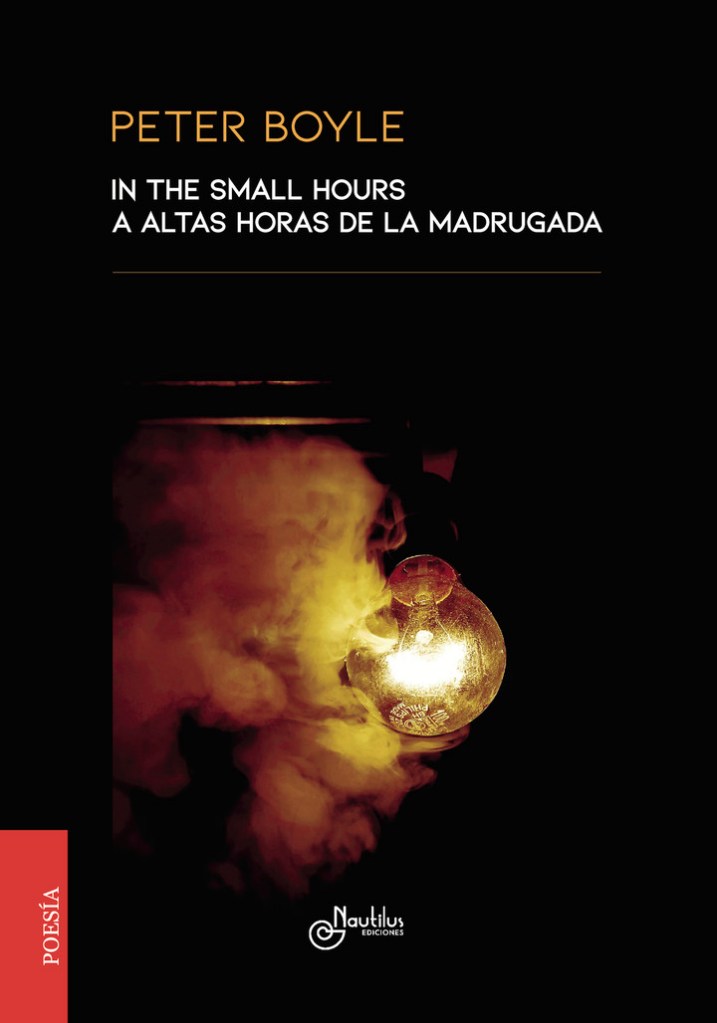
IN THE SMALL HOURS
It’s three a.m. in the morning
of a day you won’t enter for so many hours.
Where you are
yesterday’s sunlight still bathes your feet as you walk
and tonight hearing your voice
I worried that one day
I’ll lose my images of all those I love.
Outside the city’s still restless:
taxis alert and shiny as golden birds
waiting for the crumbs of dawn.
At fifty five I know so little how to live.
In cafes across this city
lovers still hold hands
and cups balance on the edges of tables.
Darkness falls around me like soft snow.
Beside the narrow bed
my night-light is staring right into me.
I will hold your voice inside me as long as I can.
When I sleep you’ll go on walking
through a steady explosion of white flowers.
— originally from What the Painter Saw in our Faces (2001)
**
FOR A BEAUTIFUL POLISH LADY
Now that Death is dreaming
in his vast summer house by the lake
and the floating pools of iris and of nenuphar
shimmer in midday sun
a dancing girl takes the boat ride
with her protector’s son.
Timid, her weary hands gripped close together,
she is free in the day’s rare stillness
and delights in these curved bridges flung against the sky,
in ornate walkways of a vanished Tsar,
in this slow lightly dipping boat
circling where the swans lie down and love.
Over them a white-haired destiny
endlessly tosses a tennis ball to a dog
on the balcony where speech has died:
this red-faced figure in a hunchbacked jumper.
Bleak stones are growing moss
and the dainty slippers of the dancer
skim the black-rimmed water
as she crosses.
On the brief jetty to the rosegarden
her feet pause and arch.
Freckle faced and proper
the boy beside her,
growing like a wheat stalk,
basks in her shadow’s warmth.
And now the wind turns fretful.
The sun deserts the tarnished terraces.
Turning back then
you, the dancer, look about
and say
that love is what is left:
it is the last emotion to die,
even later than resentment or envy,
out in the wasted stone hills beyond the palace walls,
in the wilderness where gardens end
and half-bitten cherries
stain the snow.
— originally from Coming Home from the World (1994)
**
APOLOGISING TO UNICORNS
Apologising to unicorns is problematic. They rarely understand our purposes. Tenderness will often be seen as the manipulative gestures of a fear that seeks death – for itself and others. Unicorns sleep most comfortably in heavy traffic where the hum of self-absorbed commuters leaves them invisible. To find a unicorn in a forest is like falling asleep in English and waking up fluent in Pashtun. Someone may well have done it. Unicorns sense above all our uncertainty of ourselves, our not belonging, our poor talent for letting the miraculous be. Stripped back to primal desecration, our hearts still yearn for unicorns. We trail our clouded mirrors in the waters of sky-stretched ponds. Although they will never look to us for food or shelter unicorns are reluctant to abandon their legend of our existence. Our one virginity is that we are not yet born.
– originally from Museum of Space (2004)
**
THOUGHTS IN A CAFÉ
Day and world on a road that leads beyond.
I pass them by
and it’s good to know
sparks left behind have lodged
in the leaves of the chinaberry tree
I saw in a photograph of a Cuban sidewalk, circa 1912.
Nothing is lost.
Sitting beside a mirror that runs
the whole length of this café
I wait at the very edge
of a double life. Every person,
every table, cup and plate
persists in its glassy being
and the tree outside, the buildings of the street
swim towards me, ignorant of death.
Men and women lean into each other,
stand or drift. The stillness
of a Sunday without end
muffles their voices. We have
all the time of that unmoving cloud resting
above the shoulder of the young girl
with her far-away smile and long long ponytail.
My eyes lift to see your face
on the threshold of the corridor that descends,
goes on descending through
the mind’s still centre:
gone ….. gone….. utterly….. gone.
– originally from Ghostspeaking (2016)
Peter Boyle is a Sydney-based poet and translator of poetry from Spanish. He is the author of eleven books of poetry, most recently Companions, Ancestors, Inscriptions (Vagabond Press, 2024). He has published nine books as a translator of poetry from Spanish. His poetry collections have won numerous awards, including the New South Wales Premier’s, the Adelaide Festival Award and the Queensland Premier’s Poetry Award. After teaching for many years with TAFE NSW, Peter completed a doctorate in Creative Arts from the University of Western Sydney.
 Rochford Street Review