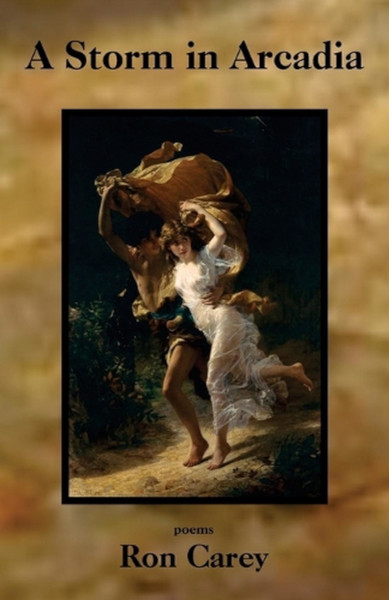
A Storm in Arcadia, by Ron Carey, Clare Songbirds Publishing House 2025, was launched by Maurice Devitt on 8 May at the Teachers Club Dublin
Good evening all, and welcome to the launch of A Storm in Arcadia, Ron Carey’s sparkling new collection. It is a real honour to be asked to launch the collection as I’ve been a great friend and admirer of Ron’s poetry since we first met over 10 years ago and I’ve really enjoyed watching the dramatic development of his work since then. Ron’s first collection in 2015 was the now iconic Distance, which of course had the distinction of being nominated for the Forward Prize Best First Collection in the UK and Ireland. It also included this epigraph, (alongside a dedication to his wife Cathy), which seems to me to foreshadow everything Ron has done with his poetry since:
Everyday we measure the distance we are from others in time and space. These poems help bring us a little closer together, celebrating place, culture and people, the local and the exotic.
And with every collection Ron has sought to collapse this distance more and more. His inquisitive and erudite mind seems to thirst for knowledge, his poems a heady cocktail of past and present, myth and day-to-day reality, all of it grounded on a bedrock of love and family.
This complex mix is first evidenced in the title poem which boldly opens the collection, threatening turbulence in the first couplet :
Once I had a dream that we were lost in Arcadia
a storm coming,
and moves deftly between the imaginary world reflected on a ‘crackled canvas’ to ‘booms of thunder arriving late’, and eventually finding solace in the hope offered by the final lines:
The storm faded and I woke, blessed
To have you beside me.
Outside, real birds began to sing, filling
The garden with songs a hundred million years old.
The reassurance contained in these lines establishes a seamless thread that runs through the collection as Ron evinces a sense of intergenerational love and connection, beginning with his parents, Lily and Bill, to whom the collection is dedicated, and who feature most prominently in the wonderfully-rendered, pseudo-ekphrastic poems, ‘Portrait of My Mother as a Surrealist Painting’ and ‘Study of My Father for a Painting by Rembrandt’, as Ron evokes his love of art, to emphasise the influence his parents had on him, revealing the single-minded nature of his mother’s love, with the line, “When she opened the lock of herself it was for love of us.” and remembering how his father, returning from work or a trip:
Would have brought some memento home with him.
Some fake gold plate or wooden crown, something for us
To play with and feed the wolves of our imagination.
Ron also uses the metaphor of art as a significant element in his courtship of Cathy, the poem ‘The Marriage of Strongbow and Aoife at the National Gallery’ opening with the lines
Before we were married, when I lived alone on the South Circular Road
And you with your parents in Rialto, the National Gallery
Often took us in.
And closing with,
On our honeymoon, we chased desire across Ireland,
The landscape a great painting
No doubt ‘the light-skinned beach of Inchydoney’ was one of the places they visited, the prize-winning poem of the same name ending with the almost impossibly romantic,
Though your hand has been in mine all day, I suddenly feel it,
Warm and wonderfully alive, like a little bird in its nest.
Similar to the way he uses art and artists to create a backdrop to some of the poems, the carefully curated musical references create the soundtrack, as in the ‘First Chair’, he declares how
another great composer shows the world
…
What it feels like to be touched by Eternal Love
and in ‘Teaching My Daughter to Write Poetry’, he reminds
her of the times we used to play
Chopsticks together,
while in ‘The House in Rialto’, he describes
Later, at the door of our home, I listen and wait until
You are finished playing Clair de Lune on the old upright piano.
In his previous collection Songs for Older Life, a series of poems inspired by extensive research into the lives of creative people, Ron exhibited a voracious appetite for understanding and learning from the lives of others. He is particularly interested in how different people observe and experience their reality and, perhaps influenced by his burgeoning interest in Quantum Mechanics, how the passage of time affects these perceptions. Ron has carried this thirst for knowledge through to A Storm in Arcadia, providing walk-on parts to a vast array of mythical and historical figures, some famous, some not, all with fascinating stories as in the case of Maria Rasputin, less well-known daughter of a more famous father, a lion-tamer and sometime riveter in the Miami Docks during the 2nd World War (as featured in ‘Maria Rasputin Pulls Double-Shift in Miami Docks’), Pauline Mary Chalifour and her ‘Blue Sandwiches’ or the poem ‘Honeymoon’, which describes the time spent by Charlotte Bronte in the seaside village of Kilkee, as part of her honeymoon, capturing the scene sumptuously:
She wore a Barège dress in the French style, a fantastic design
The colour of green-moss in sunlight
At times she can look tired, though she is still this side
of forty, but she is pretty and petite – in the English way.
All of the stories are suffused with tenderness and humour, as in the poem ‘On Writing a Poem on the Love Life of Walt Whitman Outside the Changing Rooms at Marks and Spencer’ when the poet is distracted mid-flow by
the affable assistant.
Her bubbly personality retails confidence to young and old alike.
Everyone and everywhere is fair game for Ron’s startling and playful imagination, although perhaps his greatest gift is to make the everyday sound remarkable, his arresting imagery fusing perfectly with his natural conversational rhythm.
In ‘The Yellow Wagtail’, he is waiting for a prescription from the chemist and decides to go for a walk by the Dodder:
While waiting for the Pharmacy to dispense
Its temporary absolution, I rounded the park.
Here, where the maps show a river, the fat Dodder
Struggled to fit its winter coat.
While in the simply titled, ‘The Postman’, Ron uses metonymy to succinctly describe the arrival of a new postman, breaking the lyrical rhythm with the sudden starkness of his question:
Our Postman has a new face –
It’s stamped with innocence and all the openness
Of a letter from a grandchild.
‘When is the funeral,’ I ask.
and closing with heart-breaking pathos,
Later I go to check the internet for news of Joe.
Then I realise, I never knew his name.
I could quote from every poem in this collection but I’d better stop now and give Ron a chance. In closing, all I can say is that this is a remarkable collection, filled with wisdom, humour and love, and I am so proud to be associated in a small way with sending it out into the world.
– Maurice Devitt
 A past winner of the Trocaire/Poetry Ireland and Poems for Patience competitions, Maurice Devitt published his debut collection, Growing Up in Colour, with Doire Press in 2018. Curator of the Irish Centre for Poetry Studies site, his Pushcart-nominated poem, ‘The Lion Tamer Dreams of Office Work’, was the title poem of an anthology published by Hibernian Writers in 2015. His second collection, Some of These Stories are True, was published by Doire Press in 2023.
A Storm in Arcadia by Ron Carey is available from https://www. claresongbirdspub.com/ featured-authors/ ron-carey/

 Rochford Street Review