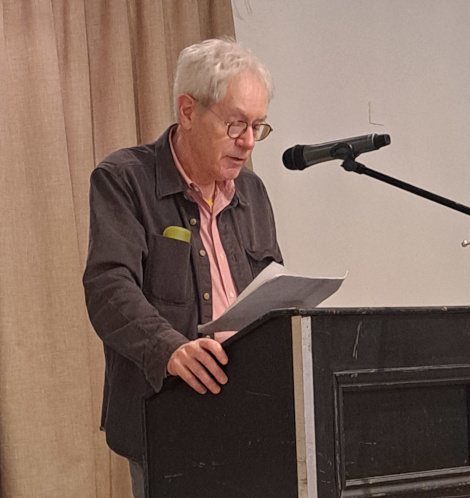
Photograph by Dani Gill
Life Itself by Kevin Higgins, Salmon Poetry 2025, was launched by Eamonn Wall at The Menlo Park Hotel, Galway, Ireland on 27 April 2025.
Good afternoon. Susan, thank you for inviting me to speak at the launch of Life Itself. It is an immense honor. And thank you for editing Life Itself and guiding its journey into the world. And kudos to Salmon Poetry, to Jessie Lendennie and Siobhán Hutson Jeanotte, for making this gorgeous book.
I should say that in addition to being friends and fellow writers, Kevin and Susan, for many summers were our “informal” landlords while Dru and I spent time in Galway. When you search in your thesaurus for a word that best describes Kevin Higgins, neither your eye nor your roaming index finder will alight on the word LANDLORD. If I used this term to Kevin to describe our relationship, his face would open into the widest smile, and he’d answer with Ha, Ha, Ha. We lived in his home. All of us here today lived with Kevin in real time, on the page, or in Galway, which to Kevin was the world, a world nicely shaped in microcosm where the larger issues stood life-size for clearer comprehension. We needed Kevin’s wit and sharp, focused imagination to understand it. In an early poem he wrote:
Your last day at the office gone down the drain,
you’re null and void once again.
On Quay Street nothing but loud-mouthed money.
You live in a city—no a country—
run by idiots you went to school with.
…………………………………………………- ‘By Five o’clock’
We have all endured such days and breathed in that bitter air of failure. Though Kevin steps aside briefly to make the comment and forge the poem, he does not remain there rhyming devilishly. He rejoins as we walk; like all of us, he is a kind of wounded moralist. In Kevin’s case one possessed of the finest poetic gifts that return to us our own stories and our almost primordial fears. Here is an example from another early poem, ‘Remembering the Leaving Cert.’
At times like this; the black
thoughts gathering like jackdaws;
it’s as if, after all these years,
I’m still the same schoolboy revolutionary,|
who’d rather declare war on the free world,
than swot for an honours maths exam.
Alleluia.
These past few weeks have given me the opportunity to re-read Kevin’s books: eight collections of poetry and two books of essays, published from 2005 to 2022. Life Itself marks eleven, a number that Kevin, a soccer fan, would favor. In ‘Status Update at 55 ¼’, a wonderfully disarming and deeply personal poems from Life Itself, the battle for survival as child and man and poet, physically and psychologically, is framed through soccer:
But inside the man with the name
much uttered, typed, and spat
still the boy who moved house
six times in nine years and was always
new to whatever street.
All the evenings I had to concede
the impossibility of playing
table tennis against myself;
that a game of solitary soccer
can still be lost.
The back garden wall sometimes
harder to beat than Leeds Utd with Lorimer,
Norman bites-yer-legs, and Giles
for boys no one wants to know.
Kevin was a master of allusion—the expected and the surprising—where we meet both the human O’Driscoll, Benjamin, and Orwell and are then borne to the place where the human and vegetable collide as in “The Death of Baroness Thatcher,”
She said the word “Europe”
like a woman coming down
from a severe dose of Brussels Sprouts.
The first section of Life Itself comprises poems written while Kevin was a patient in University Hospital where he wrote and revised up until the very end, work that Susan calls “heart-scaldingly honest” in her introduction. Honest and moving, of course, and, as Susan notes, written to communicate with us, and to involve us in this late and terrifying period of his life. This section sent me back to Mentioning the War: Essays & Reviews 1999-2011 where he wrote about childhood memories and terrors surrounding his mother’s hospitalizations for Hodgkins’ Disease. He caught and held onto the tenor and language of hospitals from childhood into adulthood. It is on full display in Life Itself.
In addition to being a gifted poet and essayist, he was prodigious in his output. But when we think of Kevin, we also understand that his publications only account for a part of his literary career. Throughout the seventeen-year span while he was writing, publishing, and promoting his books by giving readings locally and internationally, he was also the co-creator, co-curator, and co-host with Susan of Over the Edge, a creative writing instructor constantly on the move between buildings one of which became virtual, and a reviewer of poetry collections for the Galway Advertiser and other newspapers. Many poets from Galway and beyond who have gone on to publish books have spoken warmly of Kevin’s guidance and encouragement. To use Eavan Boland’s term, Kevin gave many writers, setting out nervously and tentatively, “permission” to be poets, allowing for their voices to emerge from their cores. Irish poetry will be forever in your debt, Kevin and Susan.

The best writing in my view needs to be honest in tone, clear in its particulars, and bedded down into an organic formal structure, one that moves in sync with the voice and heartbeat of the poet. To better understand Kevin’s career and poetics, I looked again at the poets his work reminded me of most: Swift and Pope in particular; two poets to pick two lines from “What I Am Not” in Life Itself who are not “those people who [take their] tea decaf.” All three are best known for their satires though they were also equally adept at other forms. Writing in admiration of Swift’s poetry, Jonathan Greenblatt notes that it is “devoid of, indeed as often as not mocking at, inspiration, romantic love, cosmetic beauty, easily assumed literary activities, and conventional language.” This description is applicable to Kevin Higgins’ work, in many respects. Though his satire could be biting, like Swift wrote about himself in “Verses on the Death of Dr. Swift,” a work that bears comparison the Life Itself in attitude more than execution, Kevin’s intent was artistic and moral rather than simply malicious:
Yet malice never was his aim,
He lashed the vice, but spared the name.
Kevin does not always spare the name; however, his target is the vice rather than the person. Also, like Swift, Kevin Higgins was an outsider. It is the necessary place for the satirist to operate from though, like Swift, he often thought it a kind of purgatory. Swift puts it this way:
The Dean, if we believe report,
Was never received at court.
As for his works in verse and prose,
I own myself no judge of those;
Nor can I tell what critics thought ‘em
But this I know, all people bought ‘em.
Like Swift, Kevin was a popular writer though I have always thought that this word was sometimes used to malign him as a poet. As Alexander Pope wrote “the life of a wit is a warfare on earth.” For sure, Kevin Higgins was a warrior. I admired his independence greatly. Perhaps as someone who lives at a distance from Ireland, I am allowed to ask the question: Why was Kevin Higgins never admitted to Aosdána? Like Pope, another writer writing from the outside, Kevin Higgins was not created by an institution but formed “like a boy gathering flowers in the woods just as they fell in his way,” as was said of Pope. For sure, it explains his independence of thought as well as the wide range of his interests, and the great pot of allusions he bore with him.
Both Kevin and Pope, in their own times and ways, lived by their writings in the broadest sense, were marked by their independence, and were both unique and brilliant and inimitable to their ages.
Kevin Higgins was more than the author of satires. He could also write wonderfully tender and philosophical poems. One example of this is “Confetti,” the poem that opens his first book, The Boy With No Face (2005):
No-one gets to glimpse a finished canvas,
nor views the film in its uncut entirety.
Too much, too much, to lay it all out
across a pure white sheet on a clean spring noon
all in order to be accounted for.
Though this afternoon’s event for me is tinged with sadness and, even if I’m honest, with a kind of overwhelming grief, it is also a cause for celebration. Here we have this wonderful book—Life Itself. It is a gift to the world from Kevin Higgins and Susan Millar DuMars. Like everything they did and achieved, it’s a joint effort, a finished canvas. Thank you, both.
– Eamonn Wall
 Eamonn Wall is a native of Co. Wexford, Ireland, who has lived in the US since 1982: in Wisconsin, New York City, Nebraska, and for the past twenty years in St. Louis. His books of poetry and prose include My Aunts at Twilight Poker (2023) Junction City: New and Selected Poems 1990-2015 ; From the Sin-e Café to the Black Hills: Notes on the New Irish (University of Wisconsin Press. 2000); Writing the Irish West: Ecologies and Traditions (Notre Dame, 2011). Poems, essays, reviews have been published in The Irish Times, The Washington Post, Prairie Schooner, Reading Ireland, Rochford Street Review and other publications. He works as a professor of Global Studies and English at the University of Missouri-St. Louis.
Life Itself by Keven Higgins is available from https://www. salmonpoetry.com/ details.php?ID=630&a=108
.

 Rochford Street Review