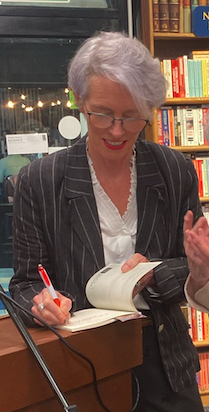
A Bloodless Field by Aideen Henry, Salmon Poetry 2025, was launched by Barbara Geraghty at Charlie Byrne’s Bookshop, Galway on 25 April 2025.
Good evening. It’s such a pleasure to meet Galway readers and writers again in this famous bookshop. Aideen Henry and I have known each other for 40 years since we rowed together for what was then called UCG. This is Aideen’s third collection of poetry published by Salmon; she has also written drama and a collection of short stories. Being asked to say a few words this evening has given me the delightful task of engaging with this well-made, varied and, at times, humorous collection (complimented by the powerful cover by Aifric, Aideen‘s daughter).
It seems to me that themes in this collection include medicine, reflecting Aideen’s work as a doctor; relationships, often bringing the sting of betrayal in their endings; and also, other types of love, particularly the fierce, pure love for one’s children, as well as changing feelings about our parents as they age.
The title poem, ‘A Bloodless Field’, evokes the bright lights as well as the sights, sounds and odours of the operating theatre. The surgeon cuts down into the body — a new kind of poetic digging here — as cauterised blood vessels give him or her a bloodless field to perform the operation.
Another poem inspired by medicine is the dramatic lyric, ‘Signora Eschericha Coli’, where the E. Coli bacterium chillingly describes what destruction she can wreak on the human body.
At a surface level, ‘Culvert’ evokes the dark, bubbling digestive process:
…palisades of villi
plucking nutrients,
pickpockets fleecing a crowd.
but is a metaphor for our deeper lack of control:
You stand on the shore, believing
you’re in charge but you are just witness
aware of aeons of tidal saline sea
spread before, behind and within you.
There is a lot of wit in the collection and ‘A Biteen’ exemplifies this. This poem is structured around the movements of the foxtrot, and shows the two dancers dancing around and obscuring what they do for a living. When the poet asks what kind of work he does, the man replies:
Yeara this and that…
with an upward nod.
A biteen of farming
In turn, she hides what she does by letting him think she’s a nurse.
In ‘The Shared Quotidian’, touch or a withheld glance are more eloquent than words:
There’s nothing wrong
I’m good, we’re good
could be the truth or a cover up.
Whereas … diminished
interest in the shared quotidian,
all suggest we’re not.
In ‘Making a cat or a mouse of it’ a powerful and vivid simile of the deceit that destroys a relationship is central to the poem:
…Discovery of deceit ripped down,
shredded, muddied the fine cloth
of all I loved about him.
Like orange pollen from a lilly
settled on a sleeve; moleculed
wedged in the space between the threads,
trying to brush it away just drives it deeper.
Though the final stanza offers: “Faith in something trumps faith in nothing” the poet chooses “I’ll have faith in nothing, please.”
There is humour amid disillusionment in ‘Last Night the Folded Polyester T shirt on his Pillow sat up and spoke to me. The T-shirt analyses and defends its owner : “You see, like me, it said, he is a man of great complexity” It continues:
…I hold his sweat/ I house his fitful/ breathing…
And/ he doesn’t have it to give.
In ‘Star’, a mother and children sleep on the floor of the mother’s room after the death of their father, but where grief is waiting when they return to their own rooms.
‘Defensive Wounds’ sympathetically portrays a mother suffering the sneers of her teenage children:
I understand now the faraway look
my mother bore, as each of us
lambasted and castigated her.
In the face of youthful rage and self-righteousness, she does not assert herself:
Surrounded, outnumbered,
retreat, her only option.
Only longer experience of life allows this kind of recall and understanding.
We think and say that there is a book in everyone, and there may well be, but only a few learn the craft of self expression. Fewer still work every day at facing the love risked and returned or rejected and express those experiences and feelings in skilful lyrics. Still fewer rewrite, and have the bravery to put their poems before others by publishing them. Aideen Henry has done all this. In this collection, the reader gets to share rich experience expressed intensely and courageously.
 Barbara Geraghty taught tutorials in English literature at undergraduate level in the University of Galway in the 1980s. Tiring of working five part-time jobs, and full of the spirit of youthful adventure, she went to work teaching English in Japan in 1989 “ for a year”and spent nine years there. Part of that time she spent studying Japanese language and culture. Curious to see Ireland in a time of prosperity, she came back in the year 2000 and got a job teaching Japanese at the University of Limerick. She taught Japanese language, literature and comparative literature there for 23 years and is now retired.
.
A Bloodless Field by Aideen Henry is available from Salmon Poetry

 Rochford Street Review