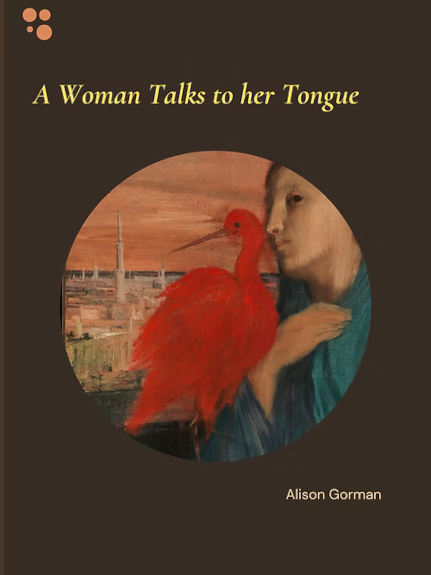
A Woman Talks to her Tongue by Alison Gorman, 5 Islands Press, 2025.
This very beautiful book is a credit to the design flair of Gerhard Bachfischer and the editorial work and fine production values of Mark Tredinnick and Steven Meyrick at 5 Islands Press. It is itself a beautiful object and a triumph for Alison Gorman as her debut collection.
The book opens with a quote from Robert Frost. It should be enough to pay homage to a poet who dares to rhyme “suppose” with “knows”. But this epigram does so much more, introducing, as it does, one of the central themes of this collection; secrets around which we all dance. These restrained and studied poems echo and reverberate with secrets.
The collection opens with a prologue poem, Telling Will. This poem captures a mother and growing son sharing a Thai meal. An ordinary but special event. It is a musing on growing up and family. This is something both seem to recognise, if Will is indeed the speaker of the words “You don’t have to tell me.” There is the question to do with the speaker’s father, who is otherwise “not on the menu”. She tells him but not us. “Absent family always present”. The result is the son walks around to hold his mother. Someone covers her mouth with both hands in surprise. Probably not the speaker but the birthday girl on an adjoining table. Such deliberate ambiguity sets us up for what is to come in a most tantalising way. An enticing introduction.
Gorman here writes with confidence and without sentimentality. The intensely personal, handled with restraint and assurance, is where Gorman is most successful.
This collection is broken into four named sections. Each section takes its title from a poem within that section: I About Secrets, II A woman talks to her tongue, III After 39 years, a photograph speaks, IV Ulysses. I’m not convinced of the utility of these divisions. In a general sense the division in this work is between those based on family, past and present, on the one hand and those which exist in another reality, on the other. All the family focussed poems speak directly of remembered events and identifiable family members. Some visit and revisit the same events from different perspectives and times. These poems are where Gorman shows her real skill.
I About Secrets
The poems in this section are generally softly spoken but deeply felt.
‘Ghosts’ establishes the family tree. A blended family of parents who have each lost a partner and five girls. Each child has lost a parent. The father confronted by a photo of the lost dad. The mother, “lips, frozen in a red line” (not to be crossed) confronted by the lost mum “with soft rolls of hair”. Conceptually this is spot on. But the prose fails to excite; especially in contrast with the variety of poetic forms in the rest of the collection.
‘Handbrake’ cleverly sets up two young sisters in a car, one makes to release the handbrake. We know not to worry because she is only feigning release and the poem has established
……………………………..…The road is flat,
like it’s been eyeballed with a spirit level.
This collection is full of very many striking images. All this so the girl in the poem will
……………………..…close my eyes
and scream, my throat wide open like the foxgloves
that bloom years later in your garden,the day you tell me what our father did
to you.
That is the real crash, which echoes through other poems, details not shared but all the more powerful for that.
‘Carnage’ is the very real car crash given metaphorical meaning by the introduction of “a man t-boned by truth”. This is one of two poems which attempt a concrete structure to add to the narrative (the other is ‘Fractured’).
‘Dinner Party 1973’ (another prose poem), with its “paisley culottes and “devil’s on horseback”, so perfectly captures the time. It sets up the family dynamic of the hard working mother tending to her multiple tasks and the father mixing martinis, who “with the plop of an olive” completes his one job.
‘Sister Villanelle’ is, as the form requires, a complex interweaving of past and present; her son’s front teeth and her sister’s illness. Here Gorman uses form to successfully take the intensely person and move beyond it.
‘Forged’ where the tight bond of three sisters is rendered against the backdrop of family rupture when “our father lit a flame”.
‘English Scenic’ where the gentle rustic scene of the family seven-piece dinner set is fractured by the father’s absence and the mother’s departure. Such a clever conceit.
The section ends with ‘About Secrets’ a poem about what can and can’t be told. The poem’s title seems to make the section title redundant.
…………………………..…I can’t tell you what
she told me about our father, when I knocked
my cup, tipped my tea so it pooled on the carpetin a large brown stain.
There is a clear linkage to the poem ‘Handbrake’. What Gorman is telling us is the caustic nature of secrets.
II A woman talks to her tongue
In a collection as diverse as this, with defined and distinct sections, it is inevitable the reader will respond to some parts more than others. I struggle with this section. It exists in a world far removed from the other poems. In part historical, in part expository. A mix of content distant in time and place from the other sections. The opening poem ‘A woman speaks to her tongue’ explores Gorman’s career as a Speech Pathologist. The poem contains some stunning images including “tongue as oily sardine” and “rolling a sea anemone in your mouth”. But the form cannot sustain the content and when we start dealing with “fasciculations” and a taut “frenulum” this becomes a stretch too far (pun intended).
There seems no overarching theme beyond the fact most of the subjects are female. I’m as interested as the next person in the artistic endeavours and challenges facing Zelda Fitzgerald, Frida Kahlo and Georgia O’Keeffe; each living in the shadow of an unreliable artistic male; each living in a broken relationship fractured at both ends in most cases. But beyond that, these poems read like exercises. It’s not so much the content, as the execution. The final sequence ‘House of Vesta’ although populated by dominant males, (Father and Pontifex) is really a cry by Aemilia the virgin in search of her mother. This does end with the strong final part ‘Buried alive’. This is a wonderful poem in its own right and gains nothing much from the prose sections which precede it.
III After 39 years, a photograph speaks
This is a grouping of poems often involving photographs but not exclusively. It is a bit of a miscellany. Some parts work better than others.
‘Onion’ brilliantly conjures the speaker’s mother from the smells of the kitchen and allows her to address, with regret but not sentimentality, “the years we didn’t speak”.
‘Storm Boy, Bully’ and ‘Cherry’ are interesting, but they are stories in search of a structure. ‘Bully‘ contains the complex response of the speaker thanking her childhood bullies for good preparation for dealing with her own self-harm and self-bullying. This seems to find an echo in the young girl thinking her abuser may not have heard her uttered “No”. This is a complex blending of innocence and abuse.
The section closes out with some poems about the father.
In ‘Urn’, as his ashes are carried out in the equivalent of a shoe box, the speaker’s response is to be amazed at how heavy he is still. A physical and metaphorical realisation I suspect.
In ‘After 39 years, a photograph speaks’
……a father’s noxious secret seeps
invisible as hydrogen,until a sister lights a match.
This is life and death at its most emotionally complex; a recognition life has many layers or shades.
IV Ulysses
The extended closing sequence returns to more poems of family past and present. All these poems are assured and rendered.
‘Coming Home’, the first poem, makes the section title redundant. It reminds me a bit of Seamus Heaney’s poem about jetting home from America in ‘Flight Path’.
‘Ocean Pool‘ puts together the parents of two growing children and gives them one of those special moments parents crave as a couple. The speaker completes her swim, her partner waits “ruddy and breathless as a new love”.
“…flat as leaking lilos” must stand as one of our quintessential national images.
‘Cowlick – for Will’ is a beautiful meditation on mothering and growing up. Proof if needed that Gorman writes best of those things closest to her. It’s not in the poem, but, I have an enduring image of a mother wetting her hand to tame her son’s unruly mane. When that finally stops the move to adulthood can occur, but not before.
‘Glamour Nails’ is an intriguing puzzle. Mother and son together again, as with the opening poem. A secret is revealed by son to mother, but not to reader.
You tell me something I have always known.
I can think of two possible secrets that parent will always know, but as a reader you are left to ponder. What is important here is not all secrets are destructive. A secret revealed can be its own release.
‘Origin’ returns to the speaker’s mother. It deals with life’s many sliding door moments that go towards creating the crazy mosaic of family life.
……………you wish you had left him. I brushed your white hair
……………….grateful you didn’t.
I have benefited from hearing Gorman read her work at the launch and also at Sydney Poetry Lounge. At the launch in June she discussed her work with Audrey Molloy in an open forum. Judith Beveridge, a Gorman mentor, made some very insightful comments and gave high praise.
Reading and re-reading this collection confirms what a triumph of a debut it is. There is much in this collection to love beyond those poems I have mentioned. I expect this collection will garner the accolades it deserves and I look forward to reading further work from Alison Gorman.
– Michael Witts
 Michael Witts is a Welsh born Australian poet. He has published five collections: Sirens, South, Dumb Music, 28 Sonnets and Some Dualities. He won 2nd prize in the 2023 Proverse International Poetry Prize (single poem ) and won the 2023 Proverse Prize for manuscripts for Some Dualities.
.
.
.
A Woman Talks to her Tongue by Alison Gorman is available from https:// www.5islandspress.com/ product-page/a-woman-talks-to-her-t ongue-by-alison-gorman
 Rochford Street Review