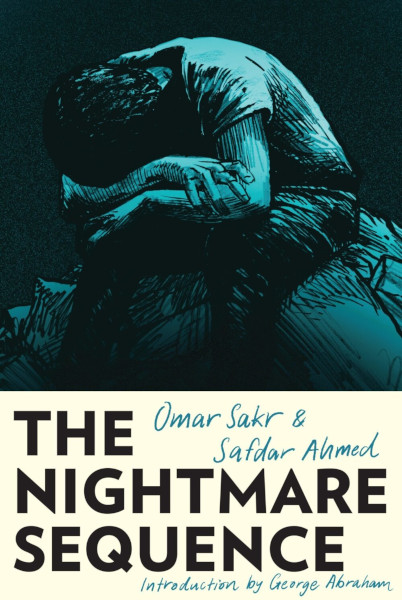
The Nightmare Sequence by Omar Sakr and Safdar Ahmed, UQP, 2025.
The Nightmare Sequence is a profound and deeply moving act of truth-telling created by poet Omar Sakr and artist Safdar Ahmed. It is bravely published by University of Queensland Press, in an almost unprecedented period of censorship in Australia’s artistic and literary scene.
The pro-Israel lobby, which we are told does not exist, has exerted great pressure on our cultural institutions. Artists and writers speaking out about the genocide in Gaza, even if only via social media, have been silenced by the very institutions who purport to champion creative voices. Those institutions include The National Gallery of Australia, Creative Australia, Sydney Theatre Company, Melbourne Symphony Orchestra, Bendigo Writers Festival, State Library of Victoria, and Queensland State Library. There are many others.
After the temporary reversal of Khaled Sabsabi’s selection for Venice Bienale, complex NDAs prevented Creative Australia board members from disclosing who had pressured them into that unpopular decision and why. But subsequent reviews pointed to political pressure on Creative Australia because of the artist’s middle eastern heritage. Even though Sabsabi had not intended to speak about Gaza, those in power didn’t want to risk it. As Sakr writes, in The Nightmare Sequence: “They take out any eye that sees them— / Bullets for the reporter, bullets for the camera / And the cornea, a smothering of power / A smearing of voices that name them true.”
The Nightmare Sequence is almost certainly the kind of thing the aforementioned lobby were afraid of when they moved to silence writers.
Because in the arts, where most people are financially insecure, some will tow the line to protect their livelihood or reputation—but not everyone. Sooner or later a writer was going to stand up. That writer was Sakr. And make no mistake—this is a courageous book. Most collections of poetry and drawings won’t paint a target on their author’s head. This one will.
For a book of political protest, The Nightmare Sequence, is remarkably nuanced. It reflects on the enormity of genocide, what that means for an entire people and their culture, but it also reflects on the smallness of genocide—how the genocide, this genocide, also manifests as personal loss. Someone’s mother. Someone’s child. How the genocide, this genocide, shinks to fit phone screens on the other side of the world. And how those screens announce deaths and disappearances to Palestinians in Australia, people who are physically safe, but otherwise not safe at all.
Sakr wrestles, in this book, with his own worry about being an imperfect witness—what does it mean to bear witness? What good does it do anyway? He wonders if his writing is legitimate. “Some will mutter / This is not your genocide / To write poems about” he says. But despite these concerns, it becomes clear, in the writing itself, that the right person to testify is the one who cares enough to. Sakr does not use these poems to grandstand, or to paint himself as a freedom fighter. His language is simple and deeply felt, never embellished or paternalistic. Where the facts he describes are already so charged, so devastating, only simple language can convey them—and Sakr knows this.
The discomfort Sakr feels, writing of another people in another place, is clear. So he does not limit his condemnation of genocide to this genocide, to Gaza. “I came here for Palestine,” he writes, “The crowds are enormous, we / Stand shoulder to shoulder, heart / To heart. Here my Yemeni brothers / There my Sudanese sisters; / Here my Rohingya kindred / There my Uyghur beloveds; / Here my Congolese uncles / There my Wiradjuri cousins; / Here my Armenian comrades / There my Kurdish aunties; / Here my Afghan elders / There my Syrian blood; / Here my Iraqi family— / I came here for Palestine and found the world.” And surely this is the point? One does not have to be a survivor of genocide, or a descendant of any particular nation or tribe, to be horrified by genocide. One only needs to be human.
Many, especially poets and artists, will have noticed an increased volatility in social discourse lately, where it comes to the specifics of language. The use of the word “genocide” has become particularly polarising. Long before the UN report validated that word’s use in relation to the mass murder of Palestinian civilians by Israeli forces, Sakr had already courageously titled the seventy poems of The Nightmare Sequence, with the word “genocide.” Now that choice is vindicated.
Long before the Australian government moved toward recognising Palestine, Ahmed had already drawn images for this book—bodies lying under the rubble of Gaza, settlers in deck chairs watching the bombs rain down over hospitals and schools, the dead pets, the destruction of trees and parks, culture, art, light. The Nightmare Sequence insists that the fact of mass murder in Gaza, the destruction of lives, must take precedence over distracting semantic arguments. Sakr writes:
Okay I won’t use the word Jewish
And I won’t use the word Zionist
And I won’t use the word genocide
And I won’t use the word apartheid
And I won’t use the word settler
And I won’t use the word colony
And I won’t use the word killed
And I won’t use the word watermelon
And I won’t use the word Palestine
And I won’t use the word resistance
And I won’t use the word law
And I won’t use the word moral
And I won’t use the word men
And I won’t use the word God
And I won’t use the word river
And I won’t use the word sea
And I won’t use the word free
And I won’t use the word children
For the young of _____ are always _____
What are we left with at the end?
A murdered dictionary and field
After silent field of unmarked graves.”
Truth telling is a harrowing task. In The Nightmare Sequence, Sakr’s poems are paired with drawings by Ahmed that are unflinching in the extreme.He conjures in monochrome—images of destroyed homes, of people checking their phones for news of lost family members, searching the rubble. He gives us bombs and evil men. Children without body parts. Dead children. We see middle class settlers in deck chairs, watching rockets descend into Gaza. We see the stranded and dying pets, the murders of civilians at aid trucks.
In one sequence, Ahmed gives us the exact weight of explosives dropped on civilian populations. 711 tonnies of explosives dropped on London in the Blitz, 2326 tonnes dropped on Hamburg by the allies in 1943, 16,000 tonnes (equivalent) dropped on Hiroshima, 85,000 tonnes dropped on Gaza by Israel and counting.
As he does throughout this book, Sakr adopts simple language to convey almost unspeakably monstrous events.
How to identify beloveds in the genocide
By their hands
By the bracelet
By the shape of their absence
In the food line
In the fuel line
By their hands
By the bracelet
By hair peeking out the pile
Do not say they are in pieces
They are everywhere
He describes watching Bluey on TV with his children—safe in Sydney while Gaza burns. And it would be so easy to turn away. To protect ourselves from all that hopelessness and rage. To visit a café or walk the dog, in a bombless park with our living children. But The Nightmare Sequence offers another vision. It evokes the ageless power of poetry and art, against genocide, against colonialism, against empire, against the kind of indifferent privilege that has gotten us into this predicament in the first place. And it asks us how we will answer, when some day our children ask us—what did you do when the genocide happened?
“Today necessity speaks with my son’s face,” Sakr writes, “Asking, Baba, how did you answer the times?”
Buy this book and read it—no matter your politics, no matter your thoughts on Israel or immigration or anything else. Because this is a true story about human beings—how they suffer and fight and rage and endure and doubt and love and love and love. And it is a book that has cost its creators very much. I don’t know what it will take to divert Humanity from its destructive path, but the beauty in this book—dark as it is—provides a counterweight to all that horror. It reminds us that human beings, although monstrous, are also capable of great sorrow and empathy and hope. It might not be grace, but perhaps grace begins somewhere in a poem, in a drawing, in a book like The Nightmare Sequence.
– Judith Nangala Crispin
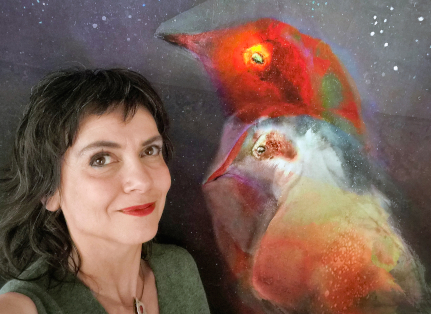 Judith Nangala Crispin is an award-winning poet, academic and visual artist of Indigenous and mixed descent, living on unceded Ngunnawal-Ngambri Country. She traces her lineage to Bpangerang people of the Murray river. Judith has spent two decades working with Warlpiri people in the Northern Tanami, with whom she has forged lifelong ties. She is a proud member of FNAWN (First Nations Australia Writing Network) and Oculi collective. She holds a Ph. D from the ANU and a Doctor of Arts from the University of Sydney. She has published four books Pillars of the Temple (Cambridge Scholars Press), The Myrrh-Bearers (Puncher & Wattmann), The Lumen Seed (Daylight Books) and The Dingo’s Noctuary (Puncher & Wattmann). Her verse novel was shortlisted for 2023 Arles Recontres Dummy Book Prize. Recent prizes include the 2020 Blake Prize for Poetry and the 2023 Sunshine Coast Art Prize. A representation of Judith’s work, At season’s end, fireflies fill the ribbon barks, down by Shoalhaven river. Sunny, lost to traffic, waits all night for dawn, for waking fireflies, and weaves a new body from their glow, was deposited on the Moon’s surface in 2024, as part of NASA’s Lunar Codex.
The Nightmare Sequence by Omar Sakr and Safdar Ahmed is available from https://www.uqp. com.au/ books/the-nightmare-sequence
 Rochford Street Review