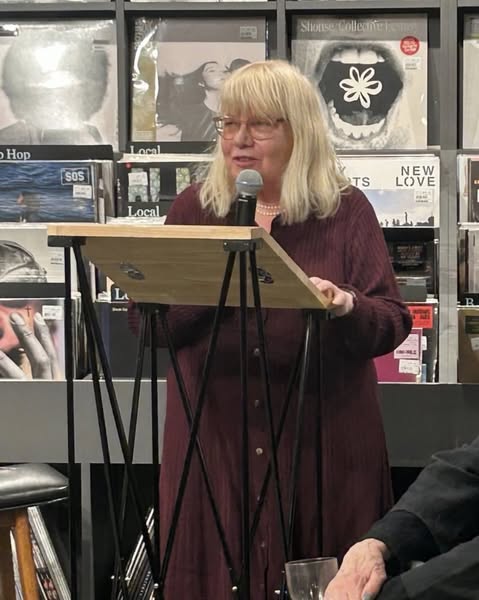
The Wallace Line by Jennifer Mackenzie, Transit Publishing 2025, was launched by Gig Ryan, 4 September 2025 at Readings Bookshop, Carlton
Jennifer Mackenzie’s work is often ekphrastic, inspired by, or growing out from, another work of art. She doesn’t describe that work of origin, as if outside of it, but becomes thoroughly embedded, moving between direct quotation and poetic re-imagining.
Jennifer’s first book explored the architect behind Borobudur, his life and travels, her second book Navigable Ink, was a poetic rendering of Pramoedya Ananta Toer’s life and work, some of which she had translated for her MA thesis.
Now in The Wallace Line, poems are inspired from many sources: novels, poems, music, paintings, all circling around the history of the Malay Archipelago, particularly Indonesia, and its treatments by Europeans, as source of profit for the Dutch, or as canvas for artists and writers such as Conrad. Her poems explore how categorisation, the constructed thing, is placed on top of nature, in a sort of coercive control of nature; the coloniser claims and re-names, translates almost, what is already named. This concern for how one thing might encase, or stifle, another, simply through classification, can be seen most stridently in the Dutch colonisation of Indonesia. But these attempts to conquer, to translate, to acquire, could also apply to art, though mostly positively as an enrichment, as dissemination of culture, rather than negatively as in oppression or extinction of what’s native to a place. That is, in parallel to the destruction of imperialism, is also the fantastic imposition of art, and its ability to absorb and to cross cultures. One section of the book focuses on writers who visited or were influenced by Indonesia’s silk road trade, Joseph Conrad, Rimbaud, Ezra Pound (via his Venice connection – Venice was a major trading power) and others. The Wallace Line which I am glad to have learnt about from this book, is a line through Indonesia’s Lombok and Bali regions, that reveals separation of fauna: to the west the more Asian species such as macaque monkeys, while to the East are the more Australian such as marsupials. The distance between islands was uncrossable hence the division. It was observed by 19th Century British naturalist Alfred Russell Wallace, Darwin’s less famous precursor.
The first Section of the book, ‘Banda’ recalls a genocidal massacre by the Dutch in 1621, which was carried out illegally in order to take control of the spice trade. (Similarly to our own Australian massacres, these were not government authorised) Past and present collapse into each other:
it was cool under the trees
almost cold
we shivered
a damp breeze
it is the presence of the anguished, said our guide
(There’s a rare use of rhyme here too, with an earlier ‘black gold’ , that is, palm oil, spices, etc., chiming with cold, then trees and breeze, then the echoing knife/silent)
& the boats came
would they tip off the edge
of the earth
that edge sharp as glass…storm clouds coming
on the day of the knifekaleidoscope of fluttering wings
the deaths were silent
Every lyrical description is shadowed by past events, time periods overlap, the past is always inescapable. The second section ‘The Silk Road’ transposes some harsh present day imperialisms onto these reveries: the Uyghur singer who must by necessity sing ‘in coded defiance’; the jolt of television news with destruction in Syria and Afghanistan, both reminding us how much of this turmoil comes from colonialist exploitation.
The third section ‘Modernism’ evokes some writers who travelled to Indonesia, or were in some way affected by, influenced by, the spice trade, mostly Joseph Conrad with his doomed characters, such as Kurtz in Heart of Darkness, Almayer in Almayer’s Folly. Their folly is to assume superiority, to the native inhabitants, doomed by both arrogance and curiosity, to reimagine their exploitation as heroic. There may also be the Oedipal sense of the fatal curiosity to go deeper, to explore, to analyse, to label, which is what ends up destroying the explorer, blind to his own exploitation of others he has caricatured as lesser. Other poems follow Rimbaud who briefly joined then fled the Dutch Colonial Army (and according to some writers might even have murdered an underling in what was then the Dutch East Indies), as well as Antonin Artaud and Ezra Pound.
Joseph Conrad, though he exposes racism, has also been accused of racist stereotyping, yet he had also subsumed himself, his Polishness, to inhabit Englishness as a novelist, but his novels enter worlds that always resist being colonised, being conquered, no matter what the appearance or the legal position and where those who attempt to impose their brand of civilisation succeed only in tragedy. Conrad criticises the European arrogance that assumes superiority and ownership, just as Pramoedya’s novels also delineate the Dutch regime’s brutalisations.
Ezra Pound also explored via translation or pseudo-translation, worlds other than his own, and also, like Conrad, became a permanent exile from his country of birth. Rimbaud is another of these deracinated adventurers. These writers all explore, thrive on, foreign cultures. It’s impossible to think of Ezra Pound without thinking of his many translations and interpretations from early Chinese, French, Old English, etc. Each writer has sought some truth, some self-realisation or obliteration, in the foreign (and Jennifer also pertinently quotes Rimbaud’s famous ‘I is an other’). All see travel as both escape and discovery, yet in that, there can also be a sort of contempt for the other, an orientalism of exoticising the foreign that exists only for the visitor’s own supposedly higher purposes. A little like the accessory of ‘emotional support animal’ then, the ‘native’ is reduced, infantilised, enslaved, the foreign becomes mere prop.
The fourth section is ‘The Wallace Line’, and traces Wallace’s wonder at this startlingly rich ‘new’ world, but also his tragedy in destroying what he attempts to preserve:
the white Cockatoos screech
around my hut
drying feathered specimens…regretting the harm I did
too late!
cadavers of my specimens
shriek & flutter
pecking as if I, a
monster corpse.
That is, his discoveries and acquisitions of thousands of specimens, deprive the islands he so treasures.
This section finishes by travelling back to Australia’s centuries’ long history of trade with Indonesia, also reflected in Jennifer’s notes, as well as the recent acknowledgement of Aboriginal men who had settled in Makassar in the late 1800s.
Jennifer has often played with typographies, and though there are fewer here than in Navigable Ink, her previous book, here in the Wallace section she lists the Dutch ship’s menu all in somewhat Trumpian capitals, but as polar opposite to Trump’s use of capitals, she uses them to emphasise bald fact, as the menu lists the luxuries freely available to the European oppressors.
A parallel current to these debilitating incursions is the tantalising capacity of art, such as in local Egyptian-Australian oud player Joseph Tawadros performing Vivaldi with the Australian Chamber Orchestra, or the middle east’s lapis lazuli then used by Renaissance painters. One line that struck me is her description of an Indian painting in the poem ‘Deserts Universal’:
grey silent desert
you open up. and
reveal a city
alive on the draftsman’s table
That is, art has uncannily made real, just as in Homer’s Shield of Achilles, which describes fields being furrowed as if they were real, yet that scene is hammered out in gold on the shield. So Conrad, Pound et al. have invented glittering panoramas for us, worlds other than our own.
This hybridisation, and seesawing balance between inner and outer, eastern and western cultures, is at the core of Jennifer’s richly-seamed poetry, impastoed with conscientious memory beneath vivid impressionist description, with its coolly implied subtle critique of exploitative appropriation running parallel to a celebration of informed and fruitful difference.
– Gig Ryan
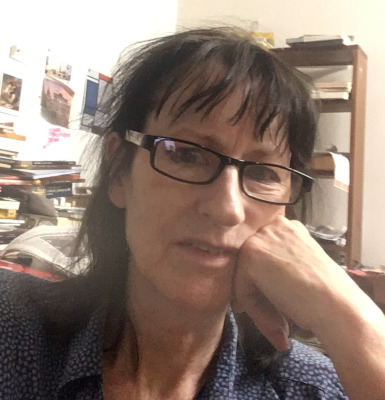 Gig Ryan’s New and Selected Poems (Giramondo, 2011); Selected Poems (Bloodaxe, 2012), was winner of the 2012 Grace Leven Prize for Poetry and the 2012 Kenneth Slessor Prize for Poetry. She has also written songs with Disband, Six Goodbyes (1988), Driving Past, Real Estate (1999) and Travel (2006). She was Poetry Editor of The Age 1998–2016, and is an irregular poetry reviewer, and is finalising her next book.
.
The Wallace Line by Jennifer Mackenzie is available from https://transitlounge.com.au/ shop/the-wallace-line-a-poem/

 Rochford Street Review