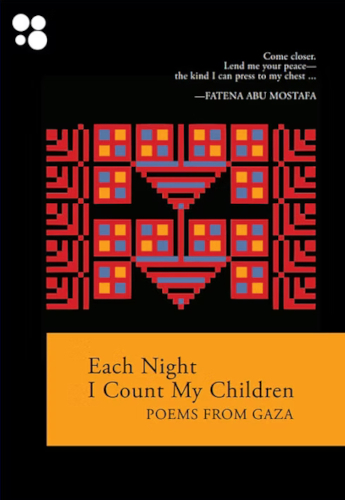
Each Night I Count My Children: Poems From Gaza, edited by Denise Howell, 5 Islands Press 2025
Speaking at the 2025 Blue Mountains Writers Festival, Ali Cobby Eckermann spoke of the need to create new genres of poetry and literature to allow First Nations voices to be heard in (post)-colonial Australia. Arguing that culture has largely been defined in European/Settler terms, she argued First Nations writers and poets to find the most appropriate forms and structures to work within. The dominance of settler culture is, of course, not confined to Australia, it holds true for most colonial and post colonial societies and nowhere is it more evident today than in the struggles of the Palestinian people against the violent occupation and illegal settlement of their land.
Palestinian poetry has, of course, a rich history and tradition outside of the English/European cultural hegemony. Indeed dating back to pre-Islamic times poetry was seen as a diwan, an historical record that “penetrates people’s consciousness”. As Rana Issa says1 “Palestinian poets are also Arab poets and they find inspiration in a poetic tradition that is both geographically expansive and far pre-dates the Zionist project. Palestinians write a poetry of resistance, enshrining poetry as both a diwan and a protest against oppression. They learn and memorise poetry as well as produce it. Through poetry, Palestinians cultivate their political imagination and preserve their collective spirit”.
The poetry that has been/ is being written during the current genocide/war fits into this tradition which questions our prevailing understanding of poetry. This is a poetry with an immediate purpose, which rings with desperation, hope and despair at the same time. It is a poetry which demands our attention beyond the literary magazines, the poetry competitions and the academy.
It is also important to remember that the genocide being perpetrated against the Palestinian people is a cultural as well as physical one (as is the case in most acts of colonisation). From the perspective of the Israeli Government and the Israeli Defense Force (IDF), it is important that the world doesn’t know what is happening in Gaza – hence the targeting of journalists, writers and artists. As of August 2025 UNESCO estimated that at least 62 journalists working within Gaza had been killed by the IDF. As of February 2025 it is estimated that at least 45 writers and artists have been killed in actions carried out by the IDF, The attacks on Palestinian culture run much deeper, as of February 2025 it was estimated that numerous cultural centres, museums and artifacts, including ancient pottery and manuscripts had been destroyed. The best estimates at the time were- 32 cultural centres and 12 museums. The numbers are now likely far higher2.
A number of writers have referred to a poetic emergency in Gaza3 (why should poetry be exempt from the wider cultural genocide?). All the structures support the writing, reading and publication of poetry have been eliminated by the Israeli government. No room or space of one’s own, no venues to read in, no means to publish books — yet still poetry is being produced and shared.
The recently published chapbook, Each Night I Count my Children: Poems from Gaza, is one example of how poetry has survived in the rubble of Gaza and, indeed, how it has become an essential part of the struggle to keep Palestinian society and culture alive. In the brief introduction by editor Denise Howell we see an example of one way these poems have “escaped’ the genocide – many first appeared on-line, uploaded whenever there was a chance, or smuggled to an area where there was still a chance of connectivity with the outside world. The immediacy of the message demanded that they be read now, to supplement the limited reporting that could be made from Gaza. Howell also refers to the fact that many of the poems were translated by the poets themselves, an important point that assists in the poems reaching a wider western audience. The assassinated Gazan poet Dr Refaat Alareer, for example, understood the importance of writing and translating poetry into the language that “actively seek the erasure” of Palestine4 .
Each Night I Count my Children opens with a poem by Ahmed Al Qahwaji. Howell has made sure to provide a biographical note to each poet which serves to emphasis the tragedy of their position, we identify with the poets, with their lives and ambitions. Ahmed, for example:
…is displaced living in a tent east of Khan Younis with his family. He is 23 years old and a graduate in multimedia and web development, who aims to pursue further studies
This could be an entry in a year book, yet the stark reality of his life becomes apparent in the first few lines of his poem:
We don’t cry like we used to
We cried when the first martyr fell.
Then we cried when the homes were destroyed.
The we cried when the hunger clawed at us.
And now we’ve stopped crying.
Today, we watch bodies fall in front of us,
part of the daily routine.
The first section of the poem ends:
We are not okay.
We are not as strong as people think.
We are simply still alive.
Ahmed has captured the raw desperation in this poem, the tragedy that has shrunk to surviving the next day, the next hour. Yet the poem provides the answer that appears to be a step to far even now for the Israeli government: “The solution is simple and clear: open the crossings.”
Fatena Abu Mostafa was a student of Dr Refaat Alareer and she has continued his legacy in a series of of poems that begins with ‘O War, Let Me Write the Ending’. In this poem the war is a “relentless buzzing drone” that attacks Gazans in their dreams as well in their day to day struggle:
I’ll never have again what I had before
in life–
so at least
let me have it
in sleep.Let me walk
the alleyways of my city
before its ruin….
I’ll catch the disease
Of forgetting –
as I’ve caught
the ache of longing.
Fatena’s long sequence of poems is one of the highlights of this book. The sequence ‘Famine Does Not Knock (Inside a Tent)’ provides a painful parallel between the way Israel is using famine as a weapon of colonialisation in the same the way the English used it as weapon against the Irish in the 19 century:
Famine does not knock –
she slips in,
a shadow through cracks in the wall,
and claims the kitchen as her throne.
A central theme of these poems is resilience. In a genocide survival is resilience, to push back, to write and speak the truth of what is happening is resilience. Shahd Alnaami’s poem ‘In the Middle of the Exam, Crying Outside’, takes resilience a step further:
Today, I had an Elizabethan
literature exam. I went to a place
with good internet connection
so I could take the test without
interruptions.
In the middle of the exam she is interrupted by the sound of men crying and she turns around to see them carrying a body. The act reminds her:
………………………. .…of the last
Farewell to my sister. What could
Ever heal our hearts from such pain?
The poem ends by acknowledging the importance of resilience, of how completing an Elizabethan Literature exam becomes an act of defiance.
While Each Night I Count my Children is a slim collection, 48 pages and 11 poets, it is a very important publication in terms of the emerging genre of Gazan war poetry. In his publisher’s notes Mark Tredinnick talks of how poetry “refuses and softly refutes the violence of dehumanising discourses”. The poets in this collection are definitely pushing back against the dehumanisation of the current genocide. By speaking out with such poems, detailing the destruction, the death and suffering of an entire people, these poets demand our attention. They demand that we read and share these stories. Hopefully, we will hear more of these poets in the years ahead and that they can start writing of rebirth, of rebuilding of increasing hope and of justice.
1 ‘We Have Been Here Forever. Palestinian Poets Write Back’ by Rana Issa in Collective Study in Times of Emergency edited by Nick Aikens, Sara Buraya Boned, Lama El Khatib, Charles Esche, Martin Pogačar, Ovidiu Țichindeleanu and Ezgi Yurteri. EBook Puplication 2024
2 Art as survival: Gaza’s creators transform pain into protest by By Asem Al Jerjawi https://www.aljazeera.com/features/2025/2/12/art-as-survival-gazas-creators-transform-pain-into-protest
3 See Vincenzo Di Nicola & h. Stephen Moffic ‘The Gaza-Israel War: A major Poetic Emergency’ Psychiatic Times, 20 November 2023,
4 ‘The End of Palestine in English’ , Rawad Z. Wenbe. Protean Magazine, 5 October 2025
– Mark Roberts
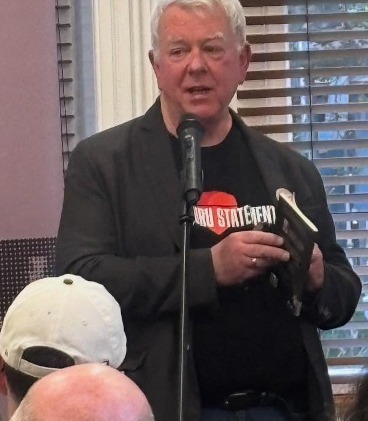 Mark Roberts is a writer, critic and publisher living on unceded Darug and Gundungurra land. He is co-editor, along with Linda Adair, of Rochford Street Review. His latest poetry collection, The Office of Literary Endeavours, was published by 5 Islands Press in May 2025. Mark’s writing on poetry and culture can be found at https://printedshadows.substack.com/
.
.
Each Night I Count My Children: Poems From Gaza, edited by Denise Howell, is available from https://www.5islandspress.com/product-page/each-night-i-count-my-children
 Rochford Street Review