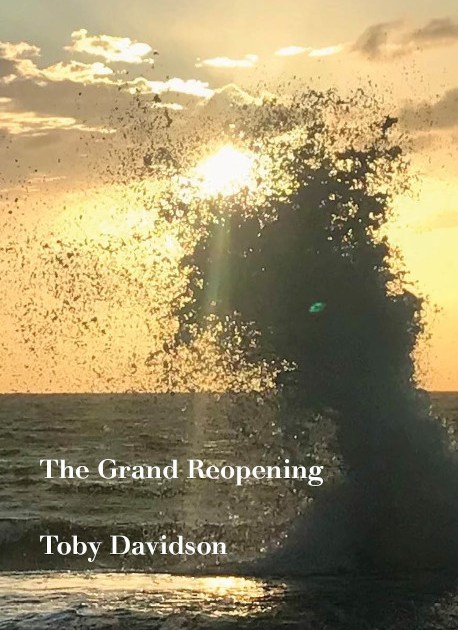
The Grand Reopening by Toby Davidson, Puncher and Wattmann 2025, was launched by Morgan Yasbincek on Sunday 31 August 2025 at Mattie Furphy House during the Perth Poetry Festival.
The title taps us all at those points during the pandemic and in life where, after losing the world as we know it, we walked through all that is gone. A cover image of a burst of black water from a dark sea, lifting like a hive of dispossessed insects before a weakening sun, prepares us with a clear, uncompromising image statement.
Yet herein there is no falling into cynicism. In fact, the collection opens on a different plane altogether, in the heights of timelessness, drawing on the magic of lyric, the beginningless, looking to creation story, with the poem called ‘Fable for Erin’ and so it all begins:
From a dawning outcrop
………..by the sea
rose All-to-come
………..and All-to-be.
The comfort of this long view hammocks across the mess of human time. Such are the fathoms traversed in this collection.
The poem, ‘Livestreamed Funerals’, recalls the griefs of being isolated from collective mourning and the reach of one’s internal work to participate, even in that failure. In the poem ‘Haircuts and Happy Hour’ the paradoxical anxieties of being in lockdown and then being out of it are described as:
…………………………………………….….a strange
kind of panic no none ever really masters…
And this in the third stanza made me smile, as a perfect image will do:
…………………………we learn to avoid people physically again,
bob and spin like hallway balloons …
What stays with you – firstly, a hesitancy to claim anything – Davidson waits; for the life, the drama, question or pain to make its own way, provide its own context, clarified by the light of the other – this is the place for the calling out of genocidal intent as in ‘Tyranny’, a poem which opens with a passage from Gai-mariagal man Dennis Foley, detailing a horrific official response to a smallpox epidemic in the camps of his people – and Davidson is clear in his notes, where he states:
Yet between accident and design lies neglect, which is not an accident.
He then draws a straight line to the recent pandemic, where those who are restricted by a national emergency, because this government wants these people to survive, are rageful against a ‘police state’ because they’re unaccustomed to being told where they can and cannot be.
This hesitancy to claim, is also the place, as in ‘An Octopus Tests My Left Big Toe’, for the joyous surprise, incidental unexpected connection. In ‘Off My Face and Skin At The Dentist’, our narrator, on enough nitrous oxide, becomes a snake, not only a snake, but the snake:
………………………………………………………….. and I sense I’m a snake
with a world eating maw……………..astronomically detached
fangs stuck in an egg……………………………which is earth …
So, a voice without guile and yet audacious enough to speak to capital ‘L’ love as addressee in not one but two poems.
Then in short three-line stanzas in ‘Sunday After Five’, an account emerges, builds as though each stanza is a wave reaching for a way to make sense of a struggle this poem is already in. A life is almost lost in this poem that becomes the sea, and once you read this poem, when you consider all the ways it might have been written, the humility of a narrative voice that restrains these options, in the presence of someone in extremis, is very moving.
There are poems in awe of flowers – elevated beings with strange hearts – gymea lilies addressed as royalty and in the ‘Relocations’ a succulent lives outrageously in red glory for weeks.
The poem, ‘Shadow’pulsates with the uncanny – the call of your name in the night, the knock at the door, a doorbell going off – Shadow, the unlocatable visitor in the dark, we are told is ‘old’ the italics here suggest a ‘before measured time’ old. Shadow immediately precedes the final sequence, and the depth the next voice is about to rise from.
The final sequence titled ‘His Blood Whisper Scolds the Deathless Intelligence’ recasts all gone before. After reading this and rereading this collection it struck me that many times in this collection we are pointed to matters of skin, how things are read at a surface, and the compatibilities and incongruities with other layers of being; the spotted skin of uncontrolled epidemics suffered by First Nations peoples, an octopus with green, mutable skin, the earth snake shedding itself in a dentist’s chair, the white supremacist tattoo in ‘Just Another Aussie Nazi’. With skin being the liminal, an outer surface and an inner surface, we have three layers of it, we are always shedding and renewing, whether we like it or not.
The blood whisper is the voice of the mutation which causes the vascular disorder Klippel Trenaunay Syndrome (KTS), commonly known as the port wine stain birth mark. This voice knows its power over a life, by exposing it as other, by hampering physical comfort, by snatching away the predictable and by finding itself identified as a medical condition. It has pre-emptive veto over any suggestion of mystic presence here named ‘Deathless Intelligence’, claims greater intimacy, consistency and twice claims to be the keeper of the promise that the ‘he’, belonging to the body, be never alone, as opposed to the elusive and fickle one who periodically abandons him. This voice has the characteristics of the classical Greek daimon – a being, often morally ambiguous, divine or supernatural in nature, between humans and gods. Daimons, pre-empt Christian angels and can express as benevolent or hostile. This blood whisper is very aware of the terrible identities it’s protected this from and the gifts which accompany difference.
And just as the Dublin’s seagulls carry the gravel of terrible happenings in their keening (‘The Gull-Cries of Dublin’), all of these lived poems carry more to the surface of the beauty and mess of human time.
Congratulations Toby on this collection. There’s much to be proud of in this gift you have made for us.
– Morgan Yasbincek
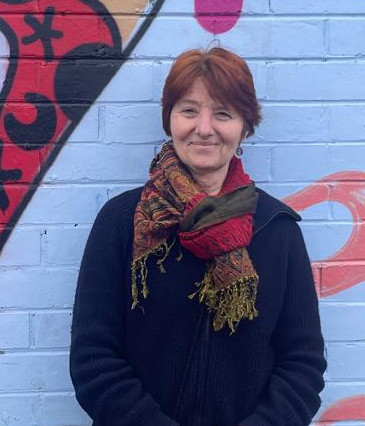 Morgan Yasbincek has published four collections of poetry and one novel, the most recent of which is the poetry collection, Coming to nothing. Her first poetry collection, Night Reversing, won the Anne Elder and Mary Gilmore awards. Her second collection Firelick, was shortlisted for the Victorian Premier’s C.J. Dennis Award. Her third collection, White Camel was shortlisted for the NSW Premier’s Kenneth Slessor Award. Her novel, liv, was shortlisted for the ASAL Gold Medal Award and highly commended by the Victorian Premier’s Award. She lives in the area of Whudjak Nyoongar Booja known as ‘the hills’, works in the libraries area and continues a writing practice.
 Rochford Street Review