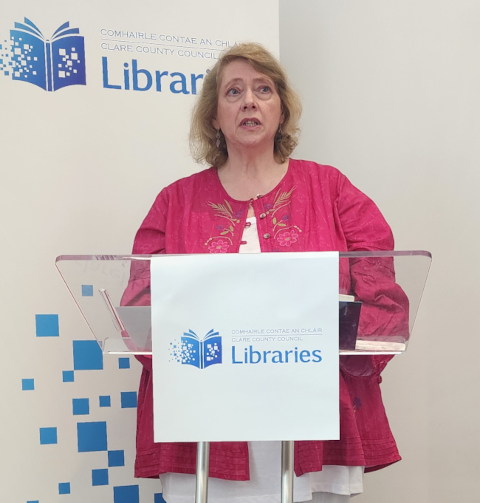
Tidal by Karen J McDonnell, Doire Press 2025, was launched by Kate Ennals on Saturday 20 September 2025, in Ennis Library, County Clare, Ireland.
First of all, I want to say how honoured I am that Karen asked me to launch her latest poetry book, Tidal. While I was once active in the Irish poetry scene, in recent years, for various reasons, I have faltered with my words and published very little. I have been nervous of the white page. But, because Karen has been so welcoming and supportive in my move to Clare, I said yes. Now I am so pleased I did, for reading her poems has reminded me of the joy of poetry and word making and why art, culture and reading poems are so important for our health and well being. So, thank you, Karen, both for asking me to launch Tidal and making me feel so welcome in Clare.
Before I chat about the poems in Tidal, which incidentally is a wonderful book and you all have a treat in store, I am aware that you probably don’t know anything about me. So, a quick introduction. I have lived in Ireland over 30 years, in Dublin, rural Cavan, Cavan Town and now Clare. For nearly thirty years I worked in the community sector in Ireland: supporting community groups through various poverty and community development programmes, but in 2012 I went off to do an MA in Writing at NUI Galway. Following that, I immersed myself into the poetry scene. I set up AT The Edge in Cavan which was based on Over The Edge run by Kevin Higgins and Susan Millar du Mars in Galway. I have three volumes of poetry published, and a fourth is due….when I finally get back to inking the blank page! Anyway, I love poetry, and I’m delighted to be here. Back to Tidal.
Seamus Heaney once said: “Each person is on earth to make sense of themselves and for themselves and to bring in inchoateness of this self into an expressible state.” For me, this is exactly what poetry is. I try to write poetry because it expresses my every day, gives voice to my uncertainties, and provides me with a test run for my thinking. For me, a poem must be accessing some sort of truth. For me, the poem must come from the gut.
I think Tidal does just that. Karen brings forward her ideas and feelings, releases them onto the page using nature and paper, then pens wonderful, poignant images that bring her reader circling into her orbit. Here is an example from her title poem, ‘Tidal’.
Some days are best spent at salty, liminal places:
walking a long spit of land jutting out into the bay
swimming to rocks furthest from shore
learning how to read the ocean, before it turns
murderous.
Out of one’s depth, in full knowledge
of the barnacled causeway home.
I love how this poem actually captures the liminal space between life and death, using rock, land and sea and then capturing the perfect image/metaphor of the barnacled causeway home.
I can feel Karen’s notions swirl about in all her poems. Each stanza is like a stork landing a bag of words to shape and make a coherent form from a dream or a thought. I like how each poem makes sense of a thought and brings it to life.
Karen clearly loves history, old things, remnants of past lives and polishes them up beautifully in her poems. She and her historical family are very much present in this volume of poetry. In an early poem ‘Litany of Ancestral Bones’ she does a lovely, compact presentation of her family history and then throughout the book her ancestors continue to sail Karen’s Tides.
And I loved how Karen also uses the small of every day to capture our attention. She has some real killer lines and images that we can all relate to. For instance, in ‘Now’, a poignant poem about leaving home, she watches her mother disappear in her rear view mirror. It’s a moment that we probably have all experienced, yet not quite appreciated the power of the image at the time. It’s a short poem. I’d like to read it.
Now
My mother
comes out to the car when I leave for
home.At the turn for the main road,
the rear-view mirror
pinpoints her. Still standing
at the end of the cul-de-sac
beside the river.I tear my eyes back, steady
my hands on the wheel
for the road ahead
lost for words at the vanishing point.
I loved the Vanishing Point. Karen’s short staccato lines are very effective. I really like the way she thinks about the structure of her poems, how she thinks about the lines break, how and and when they should be short or longer. She really makes a poem work for her. And not just by thinking about her line formation. Karen obviously listens. Personally, I think the sound of a poem is one of the most important aspects of a poem. I like crunch, the rhyme, the echos of sound in a poem. Karen does this well in her poem Scroll. The words pick up and echo…scroll, pillow, glow…the rhymes are often internal and I love that.
Paul Muldoon said “The point of poetry is to be acutely discomforting, to prod and provoke, to poke us in the eye, to punch us in the nose, to knock us off our feet, to take our breath away.” This quote comes from the Being Alive series published by BloodAxe. I think Karen achieves this well in Good Friday 2023. Again, I am going to take the liberty of reading it to you for I think Paul Muldoon would have approved.
Good Friday, 2023
‘Who looks forward to having a funeral?’
……………………………………….— Columba McVeigh’s sister, DympnaA dead mother’s rosary is there,
ready to bless her disappeared boy.The terrain is sparse, rough, biscuit coloured.
Split by a narrow road. Cheerful machinery cuts the silence
as motors come to life, though yellow and blue police car
sirens are silent.What’s the rush after 45 years?
They’re digging. Again.
Up at Emyvale.
Looking for that lost lad
who could be a grandfather now.
(Given the chance.) He’s blooming with Bragan bog
as it emergesfrom ossifying winter:
blanket embroidered Bog Cotton
dove white
Lousewort pink
Marsh Violet purple.Nature patterning the place before the diggers’ maws
desecrate it, and the gorse — threatened with cremation —
holds on to be hung on doors come May Day.There’s a mother’s rosary, awaiting burial
with her son — once he has been resurrected.
I love the images in this poem, bright, loud, cheery yet the poem is about looking for body, a mother’s boy. Karen uses nature so cleverly, weaving the beauty of wild flowers, the bog with the noisy yellow and blue of the police car and digger. It makes for a wonderfully disjointed and affecting poem.
In a good few of her poems, Karen cleverly combines poignancy with politics. ‘Clearance’ (which again is a nice reference to Seamus Heaney) is about clearing and tidying away the effects of a dead relative.
In the first stanza, Karen captures the stress and fear of the Troubles and in the third though the game of loose change lottery, the panic of dealing with death. I’ll read the first three verses.
In the northland,
where your name doesn’t say who you are
but who you are notwe are taking down posters; not tearing.
Clearing out cupboards.
Is there a foodbank in this once-starved city?To the clothes, where we jolly things along
with a game of loose change lottery. Winner buys lunch.
Out somewhere airy, in the sun.
But I can’t go on reading you Karen’s poems, though I’d like to. You need to do that yourself. I can highly recommend them. You will find history, humour, romance, nature, love, and loss. There are superb images…her hair becomes sea spaghetti, she finds word shoals on a beach and Karen has wonderful word combinations which as Paul Muldoon says, catch your breath. I loved them.
Finally, to finish, Michael Longley said If I knew where poetry came from, I’d go there
You’ll definitely get there reading Tidal. Congratulations, Karen, on a lovely book.
– Kate Ennals
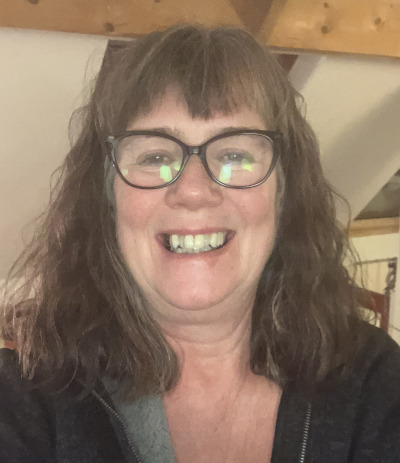 Kate Ennals is a poet and short story writer and has published both in a range of literary and on- line journals (Crannog, Skylight 47, Honest Ulsterman, Live Encounters, Poetry Ireland Review, Boyne Berries to name a few). Her first collection of poetry At The Edge was published in 2015 by Lapwing, Her second, Threads in 2018, her third Elsewhere in 2022. A fourth, Practically a Wake is in the offing. Over the years, Kate has run regular poetry and writing workshops and was funded by Cavan Arts to run At The Edge, a poetry evening for six years. She now lives in Clare. Her blog can be found at kateennals.com.
Tidal by Karen J Mcdonnell is available from https://www.doirepress.com/ books/poetry/feminist-poetry/tidal
.
 Rochford Street Review