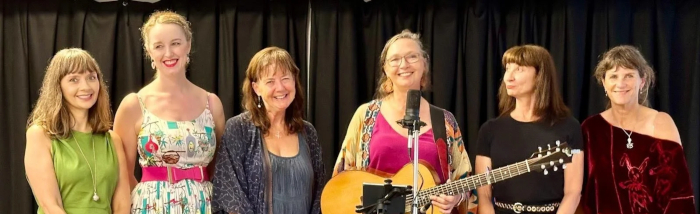
Imbolg the time of the year associated with Brigid marks the end of winter in Ireland occurring as it does, midway between the winter Solstice and Spring equinox. As an Irish Australian feminist artistic Collective, the Prankqueans enjoy marking significant events in the Celtic calendar such as Imbolg that are strongly associated with the feminine.
According to the Celts, Brigid was the Goddess daughter of the powerful Celtic God Dagda. She is thought of as being a triple deity although depending on the source you consult her triple powers seem to vary. Most sources agree that she is a Goddess of healing and the protection of domestic animals. She is also identified as a Goddess of poetry as well as fire and the associated art of the smith who in ancient times used fire to make objects from metal. Imbolg in Ireland was a time to celebrate the Goddess Brigid and the onset of the lambing season. The Irish language word ‘bolg’ means ‘stomach’ and if you translate the Irish language phrase ‘i mbolg’ it gives the literal meaning ‘in the stomach’. It is easy therefore to see that Brigid can also be considered a Goddess of Fertility. In Celtic mythology Brigid was the mother of the warrior Ruadan (fiery red headed warrior) who died tragically and so legend has it that her grieving for her son led to the art of ‘keening’ which is a special ancient female mourning for the dead in Ireland. This art is still alive in pockets of the Irish Gaeltacht (Irish language speaking areas), mainly to be found in the west of Ireland.
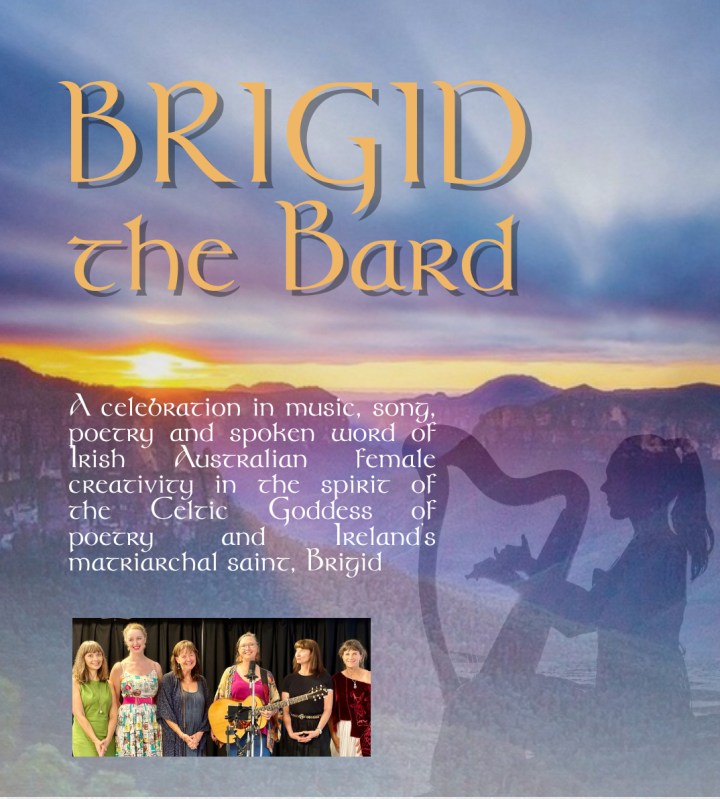
Since 2019 when we first began celebrating Brigid in music, song and spoken word the Prankqueans have chosen themes inspired by Brigid mythology and lore. During Covid for example our theme was Brigid the Healer. This year the opportunity to partner with Poetry Sydney was a perfect platform for looking at Brigid the Bard which has become the theme of our festival. A Bard in ancient Ireland was a poet and person of learning who took many years to learn their craft and the bardic tradition is also closely associated with the Irish harp as an almost sacred instrument. The Prankqueans have two accomplished Irish harp players among our number, Clíona Molins who trained classically at the Royal Irish Academy and not only plays extensively with highly regarded artists such as Riley Lee but also composes prolifically for the instrument. Jacqui McPhee, another of our wonderful musicians, is an accomplished vocalist and fiddle player who has come more recently to the harp. We also have our very own internationally renowned poet, Anne Casey whose highly regarded award-winning Brigid poems have been inspired by Brigid events we have held over the years. So our 2026 theme has really resonated with all of the members of our artistic ensemble.
While we look to ancient mythology and lore for our inspiration we also incorporate traditions and beliefs around the Christian Saint Brigid or Brigid of Kildare. She was apparently the daughter of a nobleman and a pagan slave mother. Legend has it that she defiantly approached the King of Leinster demanding land upon which to build a monastery. Refusing to take ‘no’ as an answer the King finally gave in saying he would grant her as much land as her small cloak would cover. However, when the cloak was laid on the ground it stretched for miles much to the dismay of the same king who subsequently granted the saint enough land to establish a Christian convent. The ‘brat Bríde’ tradition still exists in Ireland where even a small piece of cloth or ribbon is left outside the house for Brigid’s blessing on the eve of 1st of February and it can subsequently be used for healing purposes. The Brigid cross was reputedly used by Brigid to explain the crucifixion to a dying Irish Chieftain who subsequently became a Christian. The cross is traditionally made on the eve of Brigid’s day and hung in the house for the remainder of the year to bring protection to its inhabitants. It is of course along with the harp and shamrock an Irish national symbol. St Brigid’s Day, 1st February. is now a National Holiday in Ireland celebrating our matriarchal saint mirroring the more established practice of honouring our patriarchal saint, Patrick.
The Celtic Goddess and the Catholic Saint align for the Prankqueans in that they both represent a defiant female rebel spirit and potency refusing to be bound by societal convention. The female Celtic Christian traditions of Brigid are testimony to the healing and comfort that Brigid offers. Mary Kennedy and Deirdre Ní Chinnéide recently co-wrote a beautiful book entitled ‘Journey to the Well’. In this book they celebrate both the Celtic Goddess and the Christian saint with a special focus on Brigid wells around Ireland. These are associated with both the Celtic Goddess and the Christian saint and their waters offer healing to those who draw from them. Deirdre who lives on the largest of the Aran Islands, Inis Mór, talks about a tradition that is alive still on the middle island of Inis Meáin where children make a little doll or brídeog from the branch of a birch tree and bring it from house to house. They visit the homes of neighbours to bless the families and livestock chanting the following blessing which incorporates so much that is at once ancient, contemporary and beautiful about honouring Brigid, Goddess and Saint.
Bríd i mo chrois
Muire is a Mac
Bríd ‘is a brat.
Más fearr atá sibh anocht,
Go mba seacht bhfearr a bheidh sibh
Bliain ó anocht.
Brigid Mary and her son, bless all here.
May you be seven times better than you are now
This time next year.
 Rochford Street Review