Bríd na mín fhocal
Ag an tráth sin den bhliain, tar éis shuan an ghrianstad, leis an maidneachan geal, ag pléascadh an earraigh, siúd chugainn an tsióg i mbraillíní ceo, ag toirneáil is ag tochailt trasna na bportaigh, bachlóga bláthanna ins ‘chaon lámh – lus an chromchinn, plúiríni sneachta – a folt catach ag cuaileáil trasna chlár a baithise, broibh luachra óir ceangailte trasna fána cliabhrach. Bríd bhog na bhfás, Bríd na mínfhocal, Bríd bhrí na mná.
Is le gach coisméig, síolta ag sileadh óna sála, á slogadh béaloscailte ag saint na cré, trasna na cnoic, na caoráin is na claiseanna, tá rutaí na breithe á gcur. Is deargaíonn sí gríosáin is gathanna solas ar chosán is ar choirnéil do na mná óga ina cuideachta, ag beathú báibíní milse ina mbaclainn. Mná cruaite ina ngrua is ina gcorp, ach bogtha ina gcroíthe is ina nglórtha. Is cuireann siad, is fliuchann siad, is faireann siad, is fanann siad, go bpléascann cuisle nua as an gcré, as na spéartha, as na réaltraí. Is suíonn Bríd leo ar an teallach, a cosa i solas airgeadais an earraigh, a droim fós i sioc an gheimhridh, is tine ina béal. Bríd bhog na bhfás, Bríd na mínfhocal, Bríd bhrí na mná.
**
Bríd of the soft words
At that time of year, after the sleep of solstice, with the light of dawn, at the burst of spring, before us rises the fairy in sheets of fog, thundering and burrowing across bogs, buds of flowers in each hand – daffodils, snowdrops – her curls coiling across her forehead, golden rushes wrapped across her chest. The soft Bríd of growth. Bríd of the gentle words, Bríd of the strength of women.
And with each footstep, spilling seeds from her heels, being swallowed open-mouthed by the greed of the soil, crossing hills, moors and trenches, the roots of birth are planted. And she reddens embers and rays of light on paths and corners for the young women in her company, nourishing sweet babies in their arms. Women, hardened of face and body, softened of hearts and voices. And they plant, and water, and watch, and wait, until new pulses explode through the earth, from the skies and galaxies. And Bríd sits with them at the hearth, her feet in the silver light of spring, her back yet in the frost of winter, and a fire in her mouth. Bríd of the growth, Bríd of the soft words. Bríd of women’s strength.
.
Beatháisnéis:
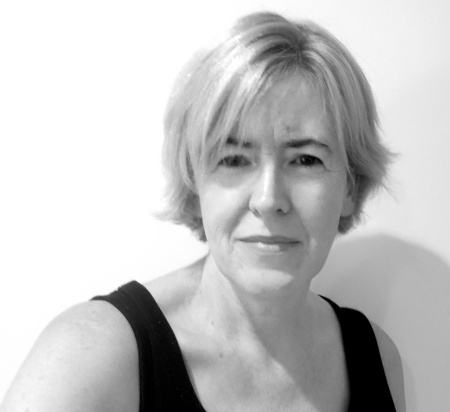
Is file agus scribhneoir dátheangach, amharc ealaíntóir, síceolaí cairte i Julie. Tá sí páirteach i bhfoireann eagarthóireachta Tinteán. Tá trí chnuasach filíochta curtha i gcló aici agus ceann acu sin dátheangach. Tá an ceathrú cnuasach dátheangach i gclo léi le Colin Ryan, file Astrálach a scríobhann i ngaeilge. Tá an chéad chnuasach eile dá theangach – hiopnagóige:hypnagogia le teacht go gairid ó Pierian Springs Press. Tá altanna agus filíochta léi san Irish Times, is i gcnuasaigh éagsúla ar nós The Waxed Lemon, Poetry Ireland Review, Channel Lit Mag, Howl New Irish Writing, Trasna Literary Magazine, Crossways Literary Magazine, Iris Comhar, An Lúibín, The Mackinaw: a journal of prose poetry, The Galway Review, Bone and Marrow / Cnámh agus Smior: An Anthology of Irish Poetry from Medieval to Modern.
Bio:
Julie Breathnach- Banwait is a bilingual poet, writer, visual artist, a chartered psychologist and member of the Tinteán Editorial Collective. To date she has had three poetry collection published with two of those being bilingual and another coauthored with the Australian Irish language poet Colin Ryan. Her fifth bilingual prose poetry collection – hypnagogia/hiopnagóige is imminent with Pierian Springs Press. She has had articles and poetry published in The Irish Times, and in various anthologies such as The Waxed Lemon, Poetry Ireland Review, Channel Lit Mag, Howl New Irish Writing, Trasna Literary Magazine, Crossways Literary Magazine, Iris Comhar, An Lúibín, The Mackinaw: a journal of prose poetry and in The Galway Review. Her poetry has been included in Bone and Marrow / Cnámh agus Smior: An Anthology of Irish Poetry from Medieval to Modern and in various anthologies in Australia and internationally.
.
 Rochford Street Review