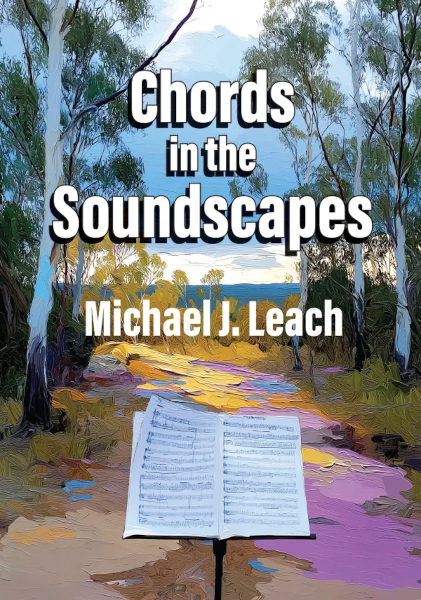
Michael J. Leach’s Chords in the Soundscapes, Ginninderra Press, 2025, was launched by Tru S. Dowling on 5 December 2025 at the North Central Goldfields Library, Bendigo, Victoria
Michael J. Leach’s poetry collection, Chords in the Soundscapes, reads as a love song to generations within a changing world, rooted in personal experience. I’m swept up in these story song poems, mesmerized by their music, mechanics and emotions. I hadn’t heard of half the songs or lyrics embedded in the poems but I’m still invested and enticed to listen as I swim through the breaths, rhythms and echoes of this beautiful collection. From the cover’s sheet music standing before a colour-washed landscape to the (un)muted pages within, its design exemplifies the careful composition and crafting of genres and forms. Its heart beats with sounds and sights (& silences), where the present is seeded in memory. Voice is explored in all its disguises and vulnerabilities. Though autobiographical, language speaks through singers, instruments, loved ones, internal and external landscapes.
The book comprises two parts – ‘The Science of Music’, and ‘Love Notes’ – divided by an eight-word ‘Intermission’. This solitary slip of a untitled poem embodies simplicity, space, ‘silence,’ centering the whole, even as it solidifies grief. The book’s material arrangement builds like a novel.
The poems are rich and complex in content and structure, though they appear simple. They draw on figurative language and grammatical tricks: most commonly, repetitions, rhymes and contrasts, while lists, enjambment, caesuras and line placement are rarer devices. Words are often crossed through or bracketed to emphasize alternative or underlying meanings. Each word and placement is purposeful. The nub is never far from the revelation.
Page compliments tight forms. Ghazals, prose poems, triolets, ginkos and haikus, sestina and villanelle, even the obscure golden shovel form, are at home mining the space surrounding the words. While free verse experiments with enjambment, and at times sparse lines and stanzas space, allowing the reader to breathe. The page without ink echoes the rhythms in white thought. There’s room to think, feel, absorb.
There’s a tenderness amongst these musical ‘factoids’ that speaks to our human experiences. Therefore, we find this book of contrasts quietly shines, with same/same and same/different comparisons, evident in lists and bookended poems as memory’s refrains: we recall memories differently at different times. Repetitions speak what is true but also might question the memory, with an incredulous air.
Dadaist fragment poems like ‘Wind Chimes’ and ‘December Remembrances of the Worst Winter’, out polar emotional reactions – from “radiant light” to darkness, life to death, warmth to “bitterly cold”. Comparably, concrete poems sit comfortably alongside the fragments with equally intense contrasts. ‘The Plight of the Adélie’ Penguin’ turns – from its lifecycle, to “a growing disturbance in a delicate balance” in the atmosphere and landscape, while ‘(H)ear’ riffs on the science of call and response through the refrain, “each voice”. The audio-visual blaring from this ear-shaped poem expands every voice as necessary.
A poet’s work is in the act of listening. From the earlier existential works, the ‘sound’ poems play with notes within forms ie, the ghazals ‘Jazz-al’, and ‘Pre-reformation Tea Party’ epitomize discordant subject matter that gives resonance to the traditional structure, acting both with and against the rhythm & repetitions. Like Jazz! Like the protests & arguments in politics. While ‘Wind Chimes’ uses structure and vowel sounds to imitate content, with the mystery of random notes: wind chimes call, and “the tympanic membranes” react in response. It adopts a classic protest song style to demonstrate the science of sound forming, traveling, and how it is heard. Talk about a metaphor for this book – it’s playful and brilliant!
Throughout, poems are self-reflective, using song quotes to revisit the past, to retell in the retelling (particularly in ‘Philology’, where there are constant “reminders, reminders, reminders” of how languages expand). Mimesis reminds us over and over of the value of shared stories – just as the first poets remembered and passed down their stories long before the written word. Leach continues this tradition in unique, intimate and often profound ways, using simple clear language to pass down and along musical and family lines. Orality & aurality– the calls and responses of land, of personal and social connections – recreate the poet’s experiences of protest, celebration, grieving, growing – a myriad of emotions in the act of presence. Of remembering.
The repetitions are often refrains ‘on loop,’ particularly in the prose-poem, ‘Grandpa’s Acoustic Guitar’, where the intimate refrain, “I found myself/ Listening to…,” reveals a universal act of the poet and of the human desire to understand. Comfort is also a strong desire here, as Grandpa enters hospice. Contrast ruminates on love and grief in a single line. Comparably, ‘Imagined Piano Lessons’ plays with the refrain “Sometimes I imagine”, exposing hopeful possibilities. Here, as in ‘Emergence of Voice’, imagination reflects “breakthrough moments,” processes and progressions that become a sounding board for the poet’s voice.
Leach’s “traveling groove(s)” inspire us to discover what it is to be in and into the sounds of this world over time. The resulting effect – a soundtrack to life, that is also a way to track emotional and mental growth in life. Relatable themes, for sure.
We move with the poet across the collection, sharing in the shifts – from the earlier, formative years to the grief and growth of change, and on to the hopeful newness of now. ‘Stage Shows’, and ‘Music Shop Memories’ turn on possibilities, on “yellowed memories” and their twists. Their warmth and playfulness appeal to a broader audience, despite the intimate family subjects. The recall “vibrates” with sensory life, way beyond sepia memory. With a playlist accompaniment we travel through heart-breaking loss to a desperate, philosophical cry in ‘(Sym)phonic’, to emerge at the final poems, where the poet finds his beloved. In ‘The Story’ poem, the literal word ‘intertwined’ is planted inside the poem’s two stanzas as an irrepressible symbol, expanding, contracting, calling, responding, here for the long haul. Together, writer and subject, writer & reader.
‘Day of the Sun’ sums up with poignancy, how reading this book causes me to
‘open dimmed eyes/ rise with violin & cello strings
… walk/ to the beat of another’s drums/ to the rhythm of others’ guitars
… feeling transienttranscendent,
I surrender…
to the radiance of sunlight.’,
How bright Chords in the Soundscapes calls to me, to absorb the places its songs take me, in all their varied imagery and arrangements. To consider time passing, the world changing, how and why its music, its words and our place in it matters. I hope you find it matters to you. It’s with gratitude and pleasure, then, that I launch Michael Leach’s book!
– Tru S. Dowling
 Tru Dowling is a Bendigo poet, performer, editor and teacher, with poems read, awarded or published in Australia, Ireland, the UK and USA. Her books include Memoirs of a Consenting Victim (Mark Time Books, 2011) and Butcher Baker His-Story Maker (Birdfish Books, 2021).
.
.
.
Michael J. Leach’s Chords in the Soundscapes is available from https://ginninderrapress. com.au/product/chords-in-the-soundscapes/.

 Rochford Street Review