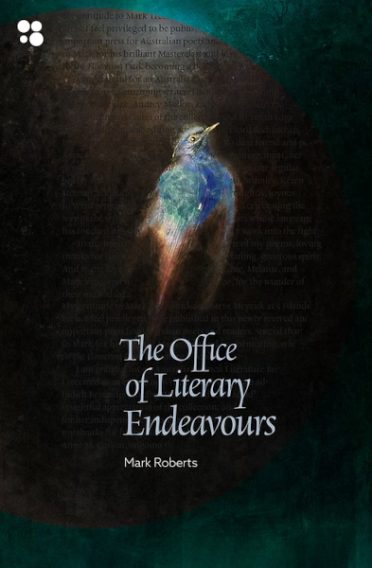
The Office of Literary Endeavours by Mark Roberts, 5 Islands Press 2025.
This collection opens with an evocative fable which recalls The Bridge Of San Luis Rey, in which human beings crossing a bridge fall to their death when the bridge collapses. Each traveller on the bridge is at a pivotal moment in their lives, on this apparently ordinary day. In Roberts’ opening poem, the protagonist Maree is on her way to work. The story of Maree is told in intermittent triptych: ‘The Office Of Literary Endeavours’, Parts 1, 2 and 3’. Interspersed between these sturdy but surreal flag posts are a series of lyrical poems, in diverse forms, each in its way portraying the journeys human beings undertake in the panorama of their individual lives: physical journeys on trains, in cars, on planes, walking across bridges, climbing hills.
But also imaginative journeys, scanning history and retrieving, through empathy, the narrative of Australia’s journey through the conflict of colonisation to the present day. Some of the poems mourn, some celebrate. An elegy for a lost friend finds both stillness and motion in commemorating her. At the heart of these personal vignettes are two of the most powerfully sensual love poems I have read in recent times, illustrating the evolving journey of a lifelong soulmateship.
The tone of most of the poems is quiet, and restrained. Noise, chaos and extraneous issues are minimized, and there is a focus and detail in each poem which both embodies and invites meditativeness. In effect, each poem in this collection is a journey in a Quiet Carriage, as experienced on Australian (NSW) interurban trains. The genre shifts from prosaic description to magical realism and surrealism which establishes the protagonist as a vehicle for poetry.
The words of the opening poem are seen via a form of imaginative MRI as being inlaid inside the woman’s body:
… all through her
as she lay among the stones
at the bottom of the valleyand
etched into her bones
as her skin fell away
the words in her fingers
toes belly and heart
dissolved into the earth.
The evolutionary history of species in which human beings find their own lives so significant is seen against the cycles of accumulation, breakdown and absorption via biological death, evoked in the time lapse photographic style of ‘Limestone’. We operate:
from horizon to a forgotten shore
… a point between a grounded history
and an infinite curve of time.
The poet’s stylistic control and sensitivity to shape and layout are shown in the diverse presentations of ‘Skipping’ and ‘Cargo Road’, the joyful spontaneous exuberance of the first contrasting with the slow pace of the second. The ecstatic onomatopoeic iterations of “up swoosh up swoosh” in ‘Skipping’ are like sonic exclamation marks and rhythmic outbursts in this stream of excitement, with its unbroken lines and freedom from the demarcations and external controls of punctuation.
The whole ululating crescendo of the poem traces a boat journey, and then a train journey to a rural destination. The poem’s protagonist cannot stay still, “skipping, swaying and bouncing”, and the energy crackling through the poem evokes youth and joy.
The human personality is the cargo that the vessel of the body carries, in ‘Cargo Road’. The poem is pieced together in shards and glints of imagery, like a sensory mosaic. The journey here goes from exterior to interior, to tracking the poet from observer of landscape’s exterior forms to a muser on historical and ancestral connection with place, on continuity juxtaposed with a sense of dissociation.
The two poems ‘Lewis Ponds Creek/ Drunong Drung’ and ‘Wolgan Valley’ are like short films in their detailed imagism, tracking journeys by car and on foot from moment to moment, through vivid sensory impressions under which profound insights and realisations slowly unfold. The shapes and sounds of the land are registered, in sequence, and the physical motion of the body across exterior spaces is counterpointed by the quiet movement of the mind and intellect, pondering what the senses register.
This is the observer in the Quiet Carriage: sensitive, attune, contemplative, coming to no hasty or forced conclusion. Roberts’s poetry has texture and heft, but it is a slow and gentle revelation of insight that builds to multiple crescendos of awareness in the reader. The ordinary everyday instances of life are shown to have revelatory impact.
There is an elegiac and wistful tone in several of the poems, evoking a daily life which is being continually lost. Roberts has a multiple layered perspective, which enables him to see and present human experience simultaneously from several viewpoints. In ‘Gweagal Shield’ the frontier battles of colonisation are evoked, in spare and heroic tribute to those drawn to defend their country, while their humanity is unrecognized by those invading it, for whom it
…is empty country, Terra Nullius
the confrontation an inconvenience.
‘River Poem’ asks for a stripping away of the truisms imposed by land acquisition:
I want
to know
the real name
of this riverNot the name on your map
I want to know the name it has had forever
This poem is as pure and perfect as a raindrop, in its spherical simplicity, depth and clarity.
‘Elegy’ evokes the distinct personality of a fallen friend, whose death long after they survived a car crash, calling up a vision of “the way Darlinghurst spun around the car” both graphically and intuitively. The friend had survived to describe the surreal time slip of near death to the poet, but the poet remembers the description told to him by the friend of how she had improbably seen a seascape through the windscreen of his car, “oceans, waves and a glimpse of a dolphin’s fin”, and recalls this ecstatic insight as he hears of the friend’s ashes being scattered on a north coast beach after her death.
‘Subsidence’ is a continuous tracking shot of a poem, looking at another seascape as if the poet’s quiet contemplative vision is a camera registering the various elements in what he sees in front of him, each in relation to the other, making meaning of the cryptic causality of the sight. This is a jewel of a collection, full of elemental images and resonant engagement with country, history and human feeling. It’s the enactment of the Quiet Carriage code, you see. ‘The rules are for all the passengers to follow voluntarily’.
– Devika Brendon
 Devika Brendon is an academic, teacher, editor, reviewer and writer. Her journalistic pieces on contemporary culture have been widely published in both print and digital media, and her academic articles, poetry and short stories have been published in Australia, India, the U.K., Europe, and the U.S.A, including Quadrant Magazine and The Hopkins Review. Her first novel has recently been published in Sri Lanka by Jam Fruit Tree Publications. Devika is Reviews Editor at Verity La, Executive Editor of Glitterati Journal, and Content Editor for New Ceylon Writing.
The Office of Literary Endeavours by Mark Roberts is available from https://www.5islands press.com/ product-page/the-office-of-literary-endeavours-by-mark-roberts

 Rochford Street Review