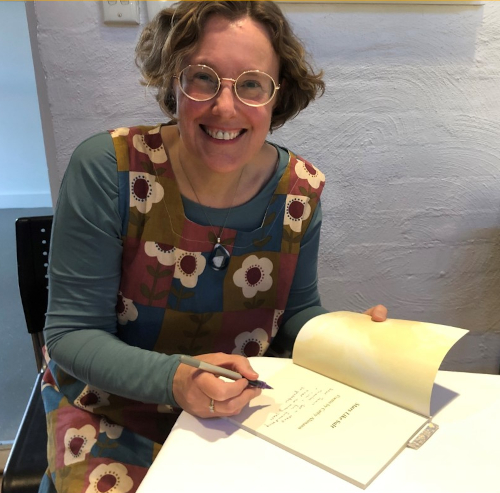
Stars Like Salt by Cathy Altmann, Liquid Amber Press, 2024, was launched by Angela Costi at the Surrey Hills Neighbourhood Centre on 21 April 2024
I acknowledge the First Peoples of Australia, in particular, the Wurundjeri Woi-wurrung people of the Kulin Nation, as the true keepers and teachers of this land upon which we are gathered today.
I am happy to announce the triumphant arrival of Cathy Altmann’s third book of poetry. Triumphant because despite the public and personal exhaustion of COVID, with its insistence on longevity, Cathy birthed, gathered and salvaged thirty-nine poems, turning them into a collection of attentive and intuitive distillations for our times. It is difficult to climb out of illness and to create resonance for others however, Cathy gifts us with this ability. In her earlier acclaimed, award-winning books with their direct and familial experiences of cancer, she eclipsed her journey with words of wonder, curiosity and awe. She continues to do so in Stars Like Salt. Here her focus is the natural world – the signs, the teachings, the surrender.
The title of the book itself is metaphorically inspiring. Stars Like Salt, carrying us both near and far, which is how we exist. Stars and salt are elemental in humans. Our bodies are part of the universe, and part of the sea. The book begins with the first stanza from her longer poem titled ‘One Year Later’, which is placed towards the end of the book. This repetition echoes life with its patterns and routines. The stanza reads:
Stars like salt
in the blue glazed
bowl of night …a
heavy moon
eyes me
Stars, salt, bowl, night, moon, eyes – all seemingly disparate entities and yet the way they are sequenced into five short lines reveals their proximity. We see how ‘the blue glazed bowl of night’ holds the ‘Stars like salt’, and how the moon reciprocates our stare. Our interconnectedness with the universe is made tangible with this use of vivid domestic description. Throughout the collection, the poems are immersed in the small expanding to the large, and the large expanding to the small; the ‘glazed bowl’ is after all the ‘night sky’, holding stars in a bowl and carrying salt for the night. As Cathy states in her preface to the book, ‘Things outside of us can speak to us of our deepest self and our interconnections.’ Her poems masterfully bring both the micro and macro spheres into an embodiment.
Generously, the book offers us another pathway in the way each poem is thoughtfully placed. From beginning to end, the trajectory of the collection reveals the narrative arc of a poet’s day. These insightful poems creatively document the early moments of wake to the late seconds of sleep. This is done by dividing the poems into five sections with the following headings: ‘1. Light and Invisibility 2. Sound, Sand 3. Taste of Pebbles 4. The Ending of this Day 5. That Hour of Night’.
The headings are carefully chosen from words or lines taken from a poem within that section. For example, the first section’s title ‘Light and Invisibility’ is from the first poem in the book, ‘The Web’. This is a compelling poem with its suggestion that incomplete spider webs are:
first drafts, flimsy
lines left in the
branches,
My immediate association is the early drafts of poems. The ones you make up in your head as you transition from dream to reality before the teeth are brushed and the coffee is gulped. I feel for those stray strands of web and I hope the spider hasn’t lost its way. But then the poem pivots as the unseen threads of the web become ‘unmoored’ become ‘illuminating’ become ‘silver filaments’ in the final stanza of the poem, helping the poem to become complete. This reliance on nature to help us see what we need to, in order to heal, is core to the book.
The earlier poems deftly speak of a struggle to learn the discourse of nature. As in the poem, ‘Speaking in Tongues’ where the tree communicates:
Like static between
stations, or cards shuffledin the dark.
Frequency, code, susurration, murmur, fizz – multiple words are used to decipher their language and to learn from trees. In the poem titled ‘The Language of Tree’ the poem is emphatic with its first stanza:
I am trying
to learn the language
of trees.
Then the poem progresses towards witnessing what the tree shows:
They show me
what has
been doneon the scarred
wax tablet
of their trunk.– ‘The Language of Tree’
Not resting with witness, the collection progresses further towards the penultimate and final poems where the exchange between the tree and the speaker of the poems entails an opening inward and outward, a reverential surrender. The final poem is dedicated to Cathy’s ‘Aunt Sally’. This poem speaks with tree, not to or at tree, as it endeavours to solidify a respectful relationship. The melody, imagery and emotional charge of this poem are braided effortlessly, as it ends with:
I cry before tree
it raises tears
in me (wind
comes through
and birds)
………….I can never
hear enough
of its many-tongued
love– ‘Tree’
‘Love’ is the final word in the book. It sits comfortably on its own line. It’s a perfect word to end the collection with as every poem in the book is imbued with the love for the word, for poetry making and for our intricate, weeping world. Even in the middle section, with its depiction of violence, love for the wounded and maimed underpins the storyline in the poems ‘Survival’, ‘Boat’, ‘Ceasefire’ and ‘The Night Explodes’. This section is aptly titled ‘Taste of Pebbles’, as it alludes to the lumps we hold in our mouths as global, national and local warring force their way onto our screens. In ‘Ceasefire’ we are rendered as nameless, countless witnesses, as collateral damage never to be counted, with the poem describing what are done to bodies, which are people, which are us, and how ‘white crosses fly/ like flocks, cast adrift / in the sky but keeping/ their formation. They / shadow the land below / they rain hopeless tears / they speak without tongues.’
As well as her empathic spirit, Cathy enriches the collection with her scholarly expertise as a teacher of English and Latin, with a Masters in Creative Writing from Melbourne University. There are poems that springboard from the great works of Jordie Albiston, Joy Harjo and Lascia Ch’io Pianga by Handel. In ‘Almost Absent’ there’s a moment as a teacher where she is talking to her students about the poems of Wislawa Szymborska, stating:
‘I love that she
is so philosophical
so intellectual – and a
woman! …’
In other poems her theological background illuminates as in ‘Tide Marks’ where the ‘Book of Kells’ is ‘washed-out’ synonymous with ‘clouds’ that are ‘unkempt’.
Cathy’s seeding of multi-disciplinary knowledge is organic, reminding me of the polymath Hildegard of Bingen, whom I read in my early twenties, which feels like a lifetime ago. I was disenfranchised with the Greek Orthodox Christian faith. This was the religion of my childhood. I walked into a theology bookshop and found Illuminations of Hildegard of Bingen, with Text by Hildegard of Bingen and commentary by Matthew Fox (Bear & Company, Sante Fe, New Mexico, 1985). I read it and was immediately drawn to her visions and mandalas, particularly her teaching about the interconnection of the macro and micro, and how we are connected to the cosmos. Her work felt like a perfect confluence of art, religion and science. She spoke of the ‘breath of the world’, where the inhale and exhale are a collective act from the very small creatures to the all-encompassing Earth, and then there was her advocacy work and railing against the patriarchy – so much to admire.
Many years later, I read Stars Like Salt and I find synergies with Hildegard’s focus on interconnectedness as Cathy’s poetry shows us how engagement with a tree becomes unspoken understanding between sisters and then becomes a mother soothing a newborn which is also the ocean with ‘the / effervescence / of a wave.’ Here too I feel there is so much to admire.
Another evocative alignment is the artwork on the book’s cover. Its title is ‘Landscape with Stars’ by the French artist, Henri-Edmond Cross (ca. 1905-1908). Liquid Amber Press continues to uphold its meticulous attention to every aspect of the book experience.
And so, I invite you all to lift your spirits (both metaphorically and literally) as I declare Stars Like Salt launched. Congratulations to Cathy Altmann and to Liquid Amber Press for bringing this world into a book and for making a book of this world.
– Angela Costi
———————————–
 Angela Costi is a poet and a writer of plays, essays, fiction and reviews. She has a community-engaged writing practice, which sees her working with various groups on storytelling projects. She was writer-in-residence at the former Kensington Public Housing Estate on the ‘Relocated’ arts project, which received the LGA national award for community innovation, 2002. Angela is the author of five poetry collections, including Honey & Salt (Five Islands Press, shortlisted Mary Gilmore Prize, 2008) and An Embroidery of Old Maps and New (Spinifex, awarded the Prize for Poetry in English by the Greek Australian Cultural League, 2022). Her sixth poetry manuscript, The Heart of the Advocate, is forthcoming with Liquid Amber Press. Angela’s heritage is Cypriot Greek and she lives on Wurundjeri land.
Stars Like Salt by Cathy Altmann is available from https://liquidamberpress.com.au/product/stars-like-salt-poems-by-cathy-altmann/

 Rochford Street Review