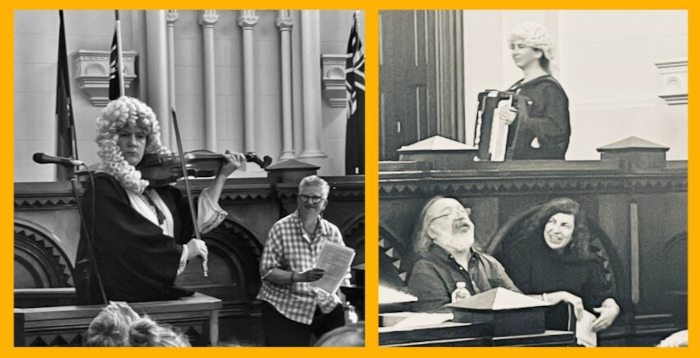
The Heart of the Advocate by Angela Costi, Liquid Amber Press 2025, was launched by Alana Kelsall at The Old Magistrate’s Court Melbourne on 23 March 2025
I’m honoured to be launching Angela Costi’s latest poetry collection, The Heart of the Advocate, a provocative play on the title of a book, The Art of the Advocate by Richard Du Cann, given to Angela by her mentor to further her training. This collection, however, explores the juxtaposition of law, advocacy and poetry, so it is especially interesting to have the launch in the Old Magistrate’s Court, this classical building steeped in the atmosphere and tradition of another time.
I first became acquainted with Angela’s poetry during spoken word sessions at the Dan O’Connell in the 90s, and we appeared in several journals together and featured more recently at Radio Laria. I felt then and now that we just seem to click. But it wasn’t until recent years that we were able to workshop our poetry together. It has been my privilege to see the early drafts of most of these poems and now to read them in this fine collection.
I really enjoyed the way in which the chronological order of the collection reflects the evolution of Angela’s thinking and her response to the moral issues she’s been confronted with when she was a practising lawyer. The layout underlines this, resembling a court in session with an ‘Opening Address’, four sections charting the course of the trial, and a poem titled ‘The Sentence’ at the end. This raises questions of what or who is on trial and what the outcome will be. The poems in the first and second sections speak to her journey from immigrant background to dux of her school and an acceptance into law at Melbourne University. From an early age Angela developed a strong, protective love for the vulnerable and for those denied justice. As she writes in the Opening Address:
This was reinforced by my Cypriot Greek families who gave me the informal role of advocate from childhood through to young adult.
As I’m sure most of you know, Angela is of Cypriot Greek heritage. Her poems operate on many levels of language and sound, meaning and metaphor as she creatively documents using various speakers and voices. The poem, ‘Philoxenia’, shows the author’s introduction to advocacy with this remarkable cultural tradition of looking after the stranger with love. A 3-bedroom dwelling in Lalor housing their family of four as well as five refugees is captured perfectly in the following:
we lived within walls of small steps and hesitant
knocks.
The refugees, traumatised by war, are described in another moving line:
………………………………… they used pillows to muffle their cries.
In the poem, ‘Dancing on Shards: An Affidavit’, Angela uses the full force of sound with her description of a backyard party in full swing. In the foreground are the sounds of traditional music,
drowning the bang….. bang …..bang
made by the neighbour’s football
against the tired fence
The dance between recently arrived Cypriots Takis and Chrystalla is the rhythmic and narrative centre of the poem and I will quote these two memorable lines in full:
Tákis was the boat moving in the flow
………………………………. and current of his wife’s hips.
In this poem Angela hones in on the idea of cutting: a boat through water, Cyprus finally being calved up in the 70s, the violence Cypriot neighbours inflicted on Takis before he left: “they cut him up too”. In the end, Chrystalla’s words to the author explain why Takis went back alone to Cyprus:
she said he returned to save
what was left of him.
The author’s poetry is supremely accomplished when exploring the complexities and motivations of people. The poem, ‘Writs of Passage II’, is about the grandfather and his
………………………….tired story of working
a loud machine to make vanilla milkshakes
and how he is “still able to hide in his stories”. It is just as much about the grandson “their beautiful eyes magnified with my mascara”, who will not hide in his.
Angela’s determination to succeed in VCE so as to study law is outlined in ‘The Discipline of Panic’ with unnerving descriptions such as “pistol whipped by test questions” and “Stuck in the mud of multiple choice” and finally,
……………………………………..….. they saw me chasing Ms Roberts
all the way to her car, declaring You need to give me your mind!
This poem likens the struggle to get to the exams as akin to a horse race
while the Class Favourite flicked dirt as she sped
past.
This raises the disturbing question of the adversarial nature of the VCE and the purpose of this education. The ending is one line on its own, does not show her score, but says so much about Angela.
You…… Dare ……To ……Be
The memorable poem ‘What to Wear to a Day of Civilised Warfare’ examines how the law actually works in practice and is a stirring protest against the adversarial nature of law and misogyny in the courtroom. This poem has a unique form in the shape of a wig. Angela describes both the ancient practice of law and the judges’ costumes with irreverent humour:
………………………………their white jabots tucked
under their necks
like bibs for toddlers………………………….
Later in the same verse, she comments on their behaviour:
…………………………these judges sweat to impress
the lord chief justice of england…….. huddle
in the heat of their disdain … ………………….
This disdain is directed at female lawyers, specifically their dress. Angela deftly sends them up in the following 1993 encounter between Sue MacGregor, wearing polka-dot stockings and with dyed red hair, and the judge:
…………………………………..…who closed
his eyes to fend off the onslaught
of colour with curve.
The judge’s words to the lawyer are shockingly offensive,
sit down
girly.
It is a tribute to Angela and the editors of this book that readers have a good idea of how the legal fraternity may look, sound and act in a courthouse before we come to the poem, ‘Swapping one Subservient Family for Another’. This poem makes ingenious use of lists and the pronoun ‘we’ to convey all the active people in a courtroom including observers:
before we walked into the courthouse
………………..we brushed our teeth drank coffee had toast cereal or a
………………..muesli bar
until by the end the reader realises it is all of us who are and will be affected by the outcome. In this insightful poem Angela draws on our collective memory of childhood and being made to be subservient at one time or another:
……………………………………made to sit on the sweaty lap
of a santa …..smile now….. made to kiss the gnarled hand
of the priest.
In doing so, she asks if we, too, are complicit in the failures of the system, and how can we change it and ameliorate the suffering of the vulnerable in society. These are real questions that we are all now grappling with.
The development of Angela’s advocacy and her protest against all forms of injustice are at the core of this book. The dedication itself reads,
For the Survivors, the Victims and
the Victim-Survivors…
This last section, ‘To Salvage Advocacy’, is a powerful protest against sexism, racism and gendered violence. Subjects include Brittany Higgins, Gillian Meagher, Zelda D’Aprano and Lindy Chamberlain-Creighton and each is explored from surprising angles. Part of the latter’s suffering, for example, is told from the point of view of Azaria’s black dress:
……………………………each thread
a pure balance of contrast and flair
as this mother is an artist, choosing red
for ribbons, buttons and booties to play
with black lace and pilchers, not demonic’.
The poem ‘Countless’, Gillian Meagher’s story, is approached from the route she took:
There were 700 metres to get her home
equal to 920 steps in heel….
and includes the subsequent overwhelming protest:
Silence will scream into 12 million
posts on twitter into 3000 walkers
reclaiming that night.
Generously, Angela includes the second last poem, ‘Some advocates however, do develop a recognisable style of their own’, which lists four advocates and their almost superhuman struggle to help those in dire need. The excellent File Notes at the end of this collection state that their names have been changed to ensure their privacy. The poem ends movingly with Aina Nazari:
……..the peer worker gives up ……….she keeps the file open ……waits
knows ……she is the only thread her client can hold.
This collection is both powerful in its poetry and its relevance to these times. Congratulations to Angela Costi and to Liquid Amber Press for bringing this inspiring book to publication. Please join me as I declare The Heart of The Advocate launched.
– Alana Kelsall
—————————
 Alana Kelsall is poet and prose writer who is widely anthologised and awarded, including the Liquid Amber Poetry Prize 2024, runner up in the June Shenfield Poetry Award 2023, shortlisted in the Rachel Funari Prize Fiction 2023, and shortlisted for the ACU Poetry Prize 2022. She is the author of The Distance Between Us, Melbourne Poets Union 2015. She is currently working on a novel loosely informed about her five years living in Japan.
.
The Heart of the Advocate by Angela Costi is available from https://liquidamberpress. com.au/product/ the-heart-of-the-advocate/

 Rochford Street Review