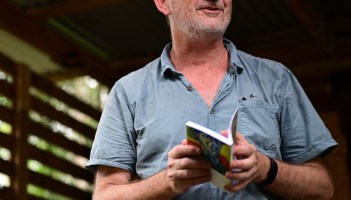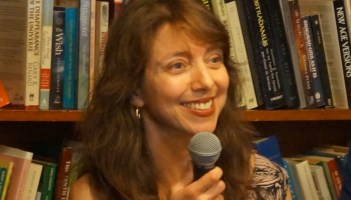
The tile of his new book Heard-Hoard, derived from the phrase “word-hoard” which appears in the poem ‘North’ in a book of the same name by Seamus Heaney (North, Faber and Faber, 1975) is perfectly coined. It positions Riley as a recorder and hoarder of words but also of stories, place and sounds.

Read More

A poetic exploration of the dual experiences of extrication and loss; youth and survivor guilt; connection and dissipation, Tracy Fuad’s debut poetry collection about: blank—so titled as this is the URL for a blank web page—problematises belonging, as a concept and a practice. While remaining loyal to her diasporic experience as a woman of mixed heritage (Kurdish-American), the book has universal scope.

Read More

When the poetry book inãianei/now by Vaughan Rapatahana was given to me to review the cover, by Pauline Canlas Wu, not only intrigued me but also surprised me. Why? Because it portrays a group of men showing anger and two women with a resigned look on their faces and a hand expression that I interpreted as “What can we do?”. Once I read the book the cover made sense to me.

Read More

Brian has always been a poet, but he is one of those people who also has a wide variety of artistic interests: he was lead singer for the post-industrial band, Distant Locust, together with being their lyricist – there is an earlier book of song lyrics; he is a painter (as you can see from the cover) and a photographer.

Read More

Disassembling A Dancer is a moving, visceral and beautiful chapbook collection from Canadian Australian writer Kyeren Regehr. It paints the tragic landscape of a dancer’s body, the pain, torment and passion and draws us into the sublime drama of ballet. The artwork by Monica Piloni and Lindsay Beal, as well as the woven ballet ribbon for binding, make this book an exquisite visual as well as literary work of art.

Read More

A Fickle Pendulum has five parts to its labyrinth of sites and the movement is a progressive shift from the ancient word to the future perfect. Beginning with Part 1, ‘A Tensile Faith’, I find myself unavoidably wrapped up in an image of a stretched out architectural form that is temporary and unimposing

Read More

Never heavy, Rose Lucas’s voice is measured, paced – on the page and in the ear – with the rhythms of heartbeat or walking. The ‘murk’ of human obsessions and cruelty are suggested subtly, but in such a way that her poetics affirms a kind of grace. Despite its sometime pious or religious overtones, in Lucas’s poetry ‘grace’ itself is a word that the poet risks effectively.

Read More